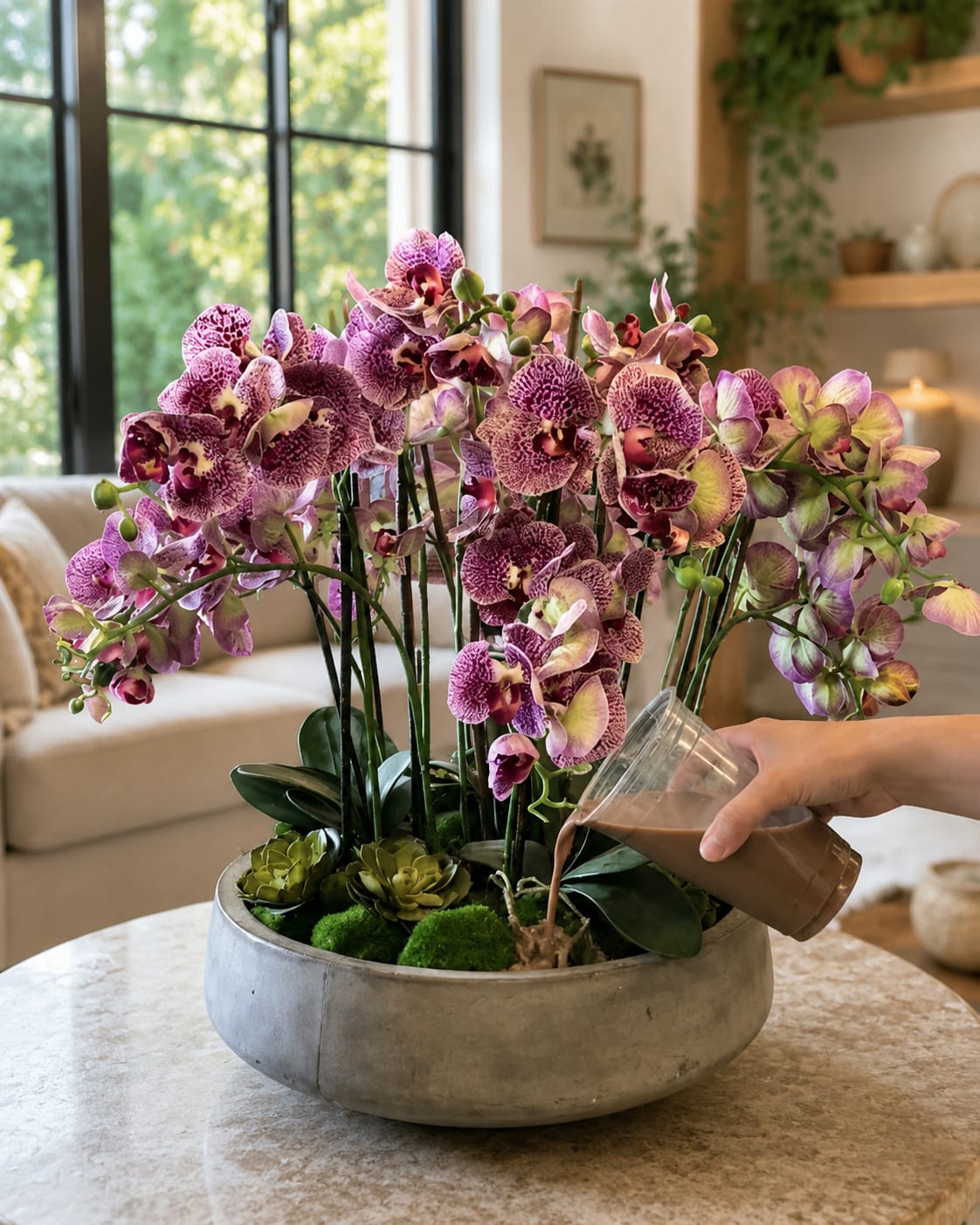
Orchids are among the most elegant indoor plants you can grow. Their tall flower spikes, glossy leaves, sculptural roots, and long-lasting blooms make them look expensive and delicate, but many common orchids are easier to care for than people think. The secret is not constant feeding or complicated tricks. The secret is balance. Orchids need bright indirect light, airy roots, careful watering, gentle feeding, and good airflow.
One popular plant-care idea is using a brown homemade tonic for orchids. This kind of tonic is often made from natural ingredients such as weak compost tea, diluted worm casting tea, diluted banana peel water, or very weak unsweetened black coffee. Some plant lovers use it to support root health, encourage stronger leaves, and help orchids stay beautiful during their blooming season.
But orchids are sensitive plants. A brown tonic can help only if it is mild, clean, and used rarely. A strong homemade liquid can damage orchid roots, sour the potting mix, attract fungus gnats, stain decorative displays, and shorten the life of the plant. Orchids are not grown like ordinary houseplants in dense soil. Most common indoor orchids, especially Phalaenopsis orchids, need chunky bark or airy orchid mix around the roots. If that mix stays wet or dirty, the roots can rot quickly.
This guide explains how to use a brown orchid tonic safely, what ingredients are safer, what ingredients to avoid, how to water orchids correctly, how to feed during bloom, how to support new roots, how to extend flowering time, and how to style orchids beautifully indoors. The goal is to enjoy the tonic as a gentle support, not as a miracle cure or daily watering routine.
What Is a Brown Orchid Tonic?
A brown orchid tonic is a weak liquid plant boost made from natural ingredients. It may look like tea, coffee, or diluted compost water. The color usually comes from organic materials, such as worm castings, compost, banana peel, bark-based extracts, or very diluted black coffee.
For orchids, the safest brown tonic is always light and watery. It should never be thick, sticky, sugary, fermented, oily, salty, or smelly. Orchids have exposed and sensitive roots that need oxygen. Heavy liquids can coat the roots and make the potting mix break down faster.
The tonic should be treated as an occasional support during active growth, not as a replacement for regular orchid fertilizer or proper watering. A healthy orchid needs a complete care routine, not just one homemade liquid.
Best Safe Brown Tonic Options for Orchids
There are several mild brown liquids that can be used carefully for orchids. Some are safer than others. The safest options are those that are weak, fresh, strained, and free from sugar, salt, milk, and oil.
- Weak worm casting tea: A gentle liquid made by soaking worm castings in water and straining well.
- Very diluted compost tea: Only if fresh, mild, and clean-smelling.
- Diluted banana peel water: Used rarely and strained carefully.
- Very diluted plain black coffee: Only unsweetened, cooled, and heavily diluted.
- Weak orchid fertilizer solution: The safest and most predictable option for most growers.
For beginners, a diluted orchid fertilizer is usually safer than homemade tonics because the strength is easier to control. Homemade tonics can vary widely depending on how they are made.
What Not to Use on Orchids
Orchids should never receive random kitchen liquids. Many common home remedies can harm roots or encourage rot. Avoid anything that creates a sticky, sour, or greasy environment around the roots.
- Do not use coffee with sugar, cream, milk, or flavoring.
- Do not use leftover drinks from cups or cafes.
- Do not use salty cooking water.
- Do not use vinegar water as a tonic.
- Do not use soda, juice, or sweet tea.
- Do not use thick banana paste.
- Do not use spoiled or fermented liquid.
- Do not use strong compost tea that smells bad.
- Do not use oily kitchen water.
- Do not use fertilizer at full strength on weak roots.
Orchid roots need cleanliness and airflow. If a liquid smells bad before it touches the plant, it should not be used.
The Safest Brown Tonic Recipe for Orchids
A gentle worm casting tea is one of the safer natural brown tonics for orchids when used correctly. Worm castings are mild compared with strong fertilizers, but they still need dilution.
Gentle Worm Casting Tea
- 1 teaspoon worm castings
- 2 cups room-temperature water
- Soak for 2 to 4 hours
- Stir gently
- Strain very well
- Dilute again with equal parts clean water
Use this only when the orchid is ready for watering. Pour it through the bark mix, let it drain fully, and never let the pot sit in the liquid. Use once every 4 to 6 weeks during active growth.
Safe Diluted Coffee Water for Orchids
Some plant lovers use diluted black coffee as a brown tonic. This must be done very carefully. Coffee can be acidic and can create buildup if used too often. It should never be used on orchids with damaged roots or old soggy potting mix.
Safe Coffee Dilution
- 1 part plain cooled black coffee
- 6 to 8 parts clean water
- No sugar
- No milk
- No cream
- No flavoring
- Use rarely
For orchids, the coffee mixture should be weaker than what you might use for many ordinary houseplants. Orchids are sensitive, and their bark mix can sour if too many organic liquids are added.
How Often to Use a Brown Orchid Tonic
Use a brown tonic sparingly. Once every 4 to 6 weeks during active growth is enough. During winter or after blooming, reduce or stop tonic use unless the plant is actively growing new leaves or roots.
Orchids do not need heavy feeding while they are stressed. A plant with rotten roots, yellowing leaves, or soft crown tissue should not receive homemade tonic. It should be inspected, cleaned, and repotted if needed.
If the orchid is already blooming beautifully, do not overdo the tonic. Too much liquid or feeding can shorten bloom life or damage roots.
When Not to Use the Tonic
There are times when a brown tonic should be avoided completely. Orchids often decline because of root problems, and adding more liquid can make those problems worse.
- Do not use tonic if the bark is still wet.
- Do not use tonic if the pot smells sour.
- Do not use tonic if roots are mushy.
- Do not use tonic if fungus gnats are present.
- Do not use tonic if the crown is soft or rotting.
- Do not use tonic right after severe root trimming.
- Do not use tonic in a pot without drainage.
- Do not use tonic if the orchid is in dense soil.
In these cases, solve the root and drainage problem first.
Understanding Orchid Roots
Orchid roots are different from the roots of many common houseplants. Phalaenopsis orchids have thick roots covered in a spongy layer called velamen. This layer absorbs moisture quickly and also needs air. In nature, many orchids grow attached to trees rather than buried in heavy soil.
Indoors, orchid roots should be grown in bark, moss, or a special orchid mix that allows air to move through the pot. If the roots are packed in wet soil, they can suffocate and rot.
This is why any tonic must pass through the pot and drain away. Orchids should not sit in a bowl of brown liquid.
How to Tell if Orchid Roots Are Healthy
Healthy orchid roots are firm. They may look silvery when dry and green when wet. Roots inside the pot may also look pale cream or light tan. Color can vary, but firmness is the key.
Unhealthy roots are mushy, hollow, black, slimy, or smelly. If you squeeze a rotten root, the outer layer may slide off and leave a thin string behind. These roots cannot absorb water properly.
Before using any tonic, check that the orchid has healthy roots. Feeding a plant with rotten roots will not help. It may worsen the problem.
How to Apply Brown Tonic Correctly
The best way to apply a brown orchid tonic is to use it like a light watering. Take the orchid to a sink or drainage area. Pour the diluted tonic slowly through the bark mix. Let it run out of the bottom. Do not let the plant sit in the runoff.
Avoid pouring tonic directly into the crown where the leaves meet. Water trapped in the crown can cause rot. If any liquid gets into the crown, blot it dry with tissue.
After using the tonic, place the orchid where there is good airflow and bright indirect light. This helps the roots dry at a healthy pace.
Why Drainage Is Essential
Drainage is more important than the tonic itself. Orchids should always grow in pots with drainage holes. Clear orchid pots with side holes are excellent because they allow you to see the roots and monitor moisture.
Decorative containers can be used, but they should not trap water. Place the orchid in a plastic orchid pot inside the decorative pot. Remove the inner pot for watering. Let it drain completely. Then return it to the decorative container.
If water collects at the bottom, root rot becomes likely.
Best Orchid Potting Mix
Orchid mix should be chunky and airy. The exact mix depends on your home conditions. A dry home may need a little moss. A humid home may need more bark and perlite.
Basic Orchid Mix
- Medium orchid bark
- Perlite
- Charcoal
- Small amount of sphagnum moss, optional
For beginners, bark-based orchid mix is often easiest. It gives roots air and dries more predictably than packed moss. If your orchid is planted in dense soil, repot it into orchid mix before trying any tonic.
How to Repot an Orchid Before Feeding
If your orchid is in old bark, soggy moss, or a pot that smells bad, repot it before using brown tonic. Remove the orchid from the pot. Shake away old mix. Trim mushy roots with clean scissors. Place the plant in a clean orchid pot with fresh bark mix.
Do not bury the crown. The crown should sit above the mix. Add bark around the roots gently. The orchid should be stable but not packed too tightly.
After repotting, wait before heavy feeding. Let the orchid adjust first.
Watering Orchids the Right Way
Orchids should be watered when the potting mix is nearly dry. In a clear pot, dry roots often look silvery. Wet roots look green. The bark should not stay constantly wet.
To water, run room-temperature water through the pot. Let it drain fully. Do not leave standing water in the saucer. Avoid watering into the crown.
Watering frequency depends on light, temperature, humidity, pot size, and potting mix. Do not water only by the calendar. Check the plant.
Can Brown Tonic Help Orchids Bloom More?
A gentle tonic may support general health, but it does not force blooms instantly. Orchids bloom when they have healthy roots, enough light, proper temperature, and mature growth. Feeding can help only when the plant already has the right conditions.
If your orchid has healthy leaves but no blooms, light may be the main issue. Move it to brighter indirect light. Many orchids need a slight nighttime temperature drop to trigger blooming as well.
Do not keep adding tonic to force flowers. Overfeeding can damage roots.
How to Make Orchid Blooms Last Longer
Orchid blooms can last for weeks or even months when conditions are right. During bloom, avoid stress.
- Keep the plant in bright indirect light.
- Avoid hot direct sun.
- Keep away from cold drafts.
- Do not place near heaters.
- Keep away from ripening fruit.
- Water carefully when the mix dries.
- Do not overfeed during bloom.
- Support heavy flower spikes with stakes.
Too much fertilizer or homemade tonic during bloom can sometimes stress the plant. Light feeding is enough.
What to Do After Flowers Fade
When orchid flowers fade, the plant is not dead. It is simply ending one blooming cycle. You can cut the flower spike depending on its condition.
If the spike is brown and dry, cut it near the base. If it is green, you can cut above a node to encourage a possible side spike, or cut it near the base to let the plant focus on roots and leaves.
After flowering, the orchid often enters a leaf and root growth stage. This is a good time for gentle feeding if the roots are healthy.
Best Light for Orchids
Most common indoor orchids need bright indirect light. East-facing windows are often ideal. South or west windows may be too strong unless filtered by a sheer curtain.
Leaves can tell you about light. Very dark green leaves may mean too little light. Yellow-green leaves or burned patches may mean too much light. Medium green leaves usually indicate good light.
Good light is more important than most homemade tonics.
Airflow for Orchid Health
Airflow helps orchid roots and leaves dry properly after watering. Stale air combined with wet media can cause rot and fungal issues.
Place orchids where air moves gently. A small room fan can help, but do not blast the plant with cold air. Airflow is especially important if you use any organic tonic because it helps prevent sour smells and mold.
Good airflow supports healthy roots and long-lasting blooms.
Humidity for Orchids
Orchids enjoy moderate humidity. Many homes are dry, especially during winter. A humidity level around 40% to 60% is helpful for many orchids.
You can raise humidity by grouping plants, using a pebble tray, or placing a humidifier nearby. Make sure the pot is not sitting directly in water.
High humidity should always be paired with airflow. Humidity without airflow can cause fungal problems.
Feeding Orchids Safely
Orchids are light feeders. Use a balanced orchid fertilizer diluted to half or quarter strength. Many growers feed weakly during active growth and flush with plain water between feedings.
If using a brown tonic, do not also use strong fertilizer at the same time. Too many nutrients can create root burn and buildup in the bark.
When in doubt, feed less. Healthy roots and good light matter more than heavy feeding.
Brown Tonic vs Orchid Fertilizer
A brown homemade tonic may provide mild organic support, but it is not as predictable as orchid fertilizer. Fertilizer labels show nutrient ratios. Homemade tonics vary from batch to batch.
For reliable growth, a weak orchid fertilizer is often best. For a natural routine, a mild worm casting tea can be used occasionally. The safest approach is to keep everything diluted and infrequent.
Never use a homemade tonic to replace all orchid care.
Signs the Tonic Is Working Well
- Roots remain firm and healthy.
- No sour smell comes from the pot.
- Leaves stay firm and green.
- New root tips appear during active growth.
- Flower spikes remain strong.
- Blooms last normally.
- The bark dries at a healthy pace.
Good results are gradual. Orchids do not transform overnight.
Signs You Should Stop Using the Tonic
- The pot smells sour.
- Fungus gnats appear.
- White mold grows on the bark.
- Roots become mushy.
- Leaves yellow suddenly.
- The bark stays wet too long.
- Flower buds drop after feeding.
- The crown feels soft.
If these signs appear, stop using the tonic. Flush the pot with plain water if drainage is good, or repot if the mix smells bad.
How to Flush Orchid Mix
Flushing helps remove buildup from fertilizer or homemade liquids. Take the orchid to a sink. Run room-temperature water through the pot for a short time. Let it drain completely.
Do not flush if the pot has no drainage. Do not leave the plant sitting in runoff. Avoid getting water in the crown.
Flushing once in a while is helpful when feeding orchids regularly.
Common Orchid Problems
Yellow Leaves
Yellow leaves may be natural aging, overwatering, root rot, sun stress, or nutrient buildup. Check the roots before adding tonic.
Wrinkled Leaves
Wrinkled leaves often mean dehydration, but dehydration can come from dry roots or rotten roots. Inspect the root system.
Bud Drop
Bud drop can happen from sudden temperature changes, dry air, low light, overwatering, or stress after moving the plant.
Root Rot
Root rot happens when roots stay wet without airflow. Remove rotten roots and repot in fresh orchid mix.
No Blooms
No blooms often means not enough light or the plant needs a temperature shift. Feeding alone will not solve it.
Orchid Root Rot Rescue
If roots are mushy, remove the orchid from the pot. Trim rotten roots with clean scissors. Repot into fresh bark mix. Keep the plant warm with bright indirect light and good airflow.
Do not use brown tonic on an orchid with active root rot. Wait until the roots recover. A weak plant needs stability, not extra organic liquid.
Once new roots appear, gentle feeding can resume.
Continue to Page 2
Continue to page 2 for more details about this article and the key points many readers miss on the first page.