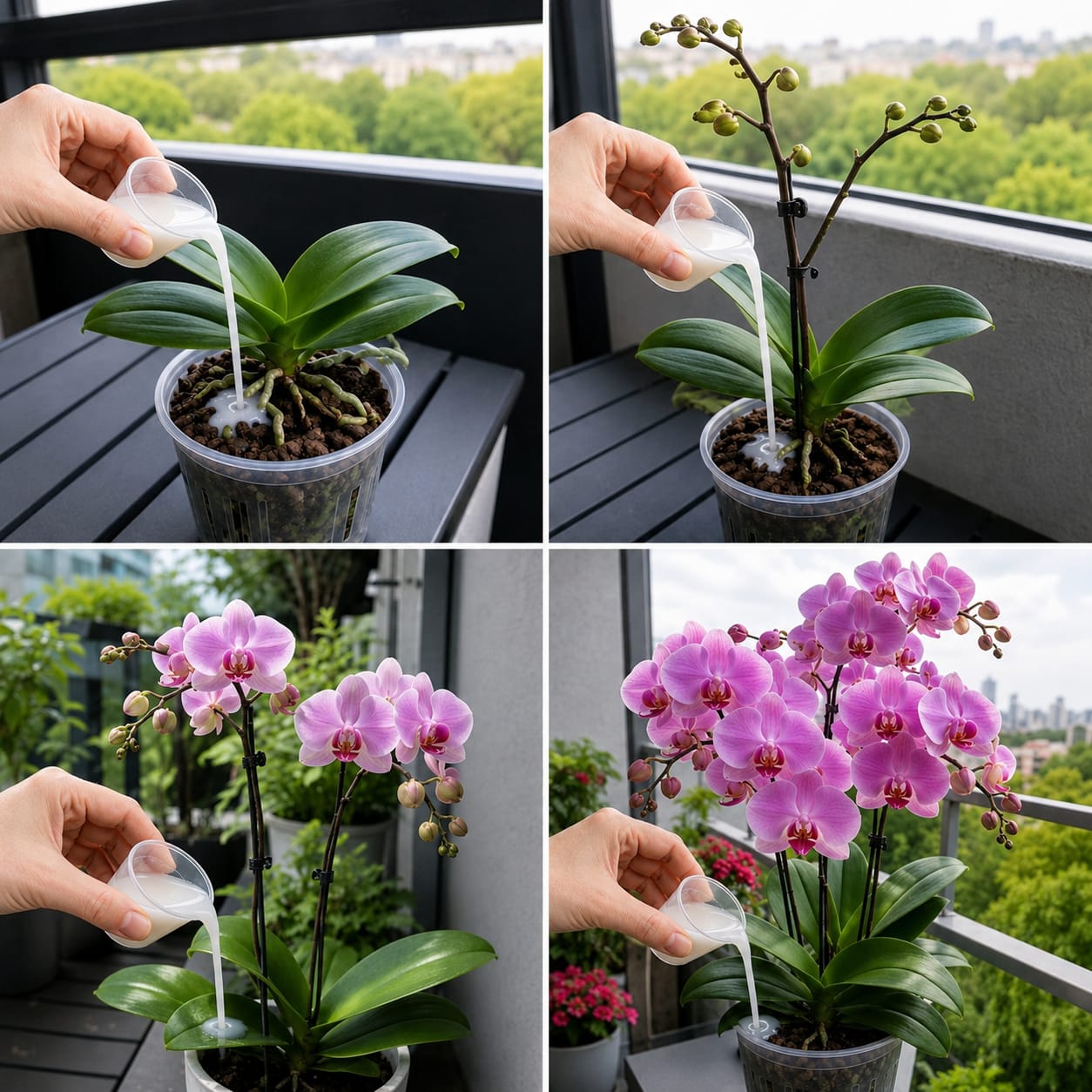
Orchids are among the most beautiful indoor flowering plants for homeowners who want graceful blooms, glossy leaves, elegant stems, and a refined decorative display that feels luxurious without needing a large space. Their sculptural flower spikes, smooth green foliage, exposed roots, and long-lasting blossoms make them a favorite for indoor plant care, orchid care, modern apartment decor, balcony plant styling, bright windowsill displays, home office plant design, luxury home staging, commercial interior landscaping, and premium indoor plant displays. A healthy orchid can turn a simple table, balcony corner, bedroom shelf, or living room window into a polished botanical feature.
Many orchid owners become curious when they see a light white liquid being poured around the root zone. The idea is often presented as a simple orchid hack for stronger roots, more buds, bigger blooms, and a cleaner display. This white liquid may be diluted milk water, rice water, weak liquid fertilizer, calcium water, eggshell water, or another homemade root-zone tonic. It may look gentle and natural, but orchids are not ordinary potting-soil plants. Their roots need air, fast drainage, and a clean growing medium. A white tonic can support the plant only when it is fresh, heavily diluted, used rarely, and applied to a healthy orchid growing in a proper airy orchid mix.
The most important thing to understand is that orchid blooms do not come from one quick liquid trick. Strong flowering comes from healthy roots, bright indirect light, correct watering, good airflow, proper orchid bark or airy medium, stable temperature, and gentle feeding during active growth. If the roots are already weak, if the pot holds too much water, or if the plant is sitting in a dense wet medium, pouring any white liquid into the pot can make the problem worse. A mild tonic may be useful only as a small support step, not as the foundation of orchid care.
Orchids, especially Phalaenopsis orchids, are often grown in clear pots because their roots benefit from light and visibility. Healthy roots usually look firm and green or silvery depending on moisture. Green roots are hydrated, while silvery roots usually mean the plant is ready for water. Mushy brown roots, black roots, sour smell, algae-heavy media, and collapsed leaves are warning signs. Before using any homemade liquid, the root system should be checked carefully. A plant with damaged roots needs clean recovery care, not extra organic liquid.
Understanding Orchid Growth
Most indoor orchids sold for home decor are Phalaenopsis orchids. They grow with thick leaves arranged from a central crown and produce flower spikes that can carry many blooms for weeks or months. Their roots are thick and covered with a sponge-like layer called velamen, which helps absorb moisture and nutrients from the surrounding environment. This root structure is the reason orchids need airy conditions instead of heavy soil.
In nature, many orchids grow attached to trees, where their roots receive air movement, rainwater, and quick drying. Indoors, the pot must imitate that balance. The roots need moisture, but they also need to dry and breathe. A dense potting mix or constant wetness can suffocate roots quickly. This is why pouring thick homemade liquids into orchid pots must be done carefully, if at all.
An orchid that is ready to bloom usually has firm leaves, healthy roots, and enough light. Flower spikes often appear when the plant has stored enough energy and experiences stable care. Some orchids also respond to a small drop in night temperature, which can help trigger blooming. A white root tonic cannot replace these natural signals. It can only support a plant that is already in good condition.
What the Light White Liquid Might Be
The white liquid may be diluted milk water. Some plant-care tips suggest milk water because milk contains calcium and small amounts of other nutrients. However, milk can sour quickly in an orchid pot, especially if it is poured thickly into bark or moss. Straight milk should never be used. It can leave residue on roots, attract fungus gnats, create odor, encourage mold, and reduce the clean appearance of the pot. If milk water is used at all, it should be heavily diluted until it is barely cloudy and used very rarely.
The liquid may also be rice water. Rice water can look cloudy white and is often used as a mild homemade plant tonic. It may contain trace minerals and starches, but starches can feed microbes in a pot. In a small orchid container, repeated rice water use can create sticky residue, sour smell, mold, or fungus gnats. Fresh diluted rice water is less risky than fermented rice water, but it should still be used with caution and never poured into a pot that is already wet.
Another possibility is eggshell water or calcium water. Eggshell water is often promoted as a natural calcium support, but eggshell calcium breaks down slowly and does not act like instant fertilizer. Orchids do not usually need heavy calcium treatments from household mixtures. If a calcium supplement is needed, a labeled orchid-safe product is more predictable than a homemade mixture.
The safest white liquid may simply be a weak orchid fertilizer solution. Some liquid fertilizers look cloudy when mixed with water. A properly diluted orchid fertilizer can support root growth, leaf strength, and blooming potential. However, orchids prefer weak feeding. Strong fertilizer can burn roots, especially when the medium is dry or already filled with mineral buildup.
What This Method Can Actually Do
A light white root tonic may support an orchid only if it is safe, diluted, fresh, and applied at the right time. A weak orchid fertilizer can provide nutrients that help the plant maintain leaves and roots during active growth. A very mild homemade tonic may provide trace support, but the results are less predictable. The liquid itself does not create flowers instantly. It cannot turn a weak orchid into a blooming display overnight.
The visible improvement many people associate with this method often comes from better care around the same time. When the plant is moved into brighter indirect light, watered correctly, cleaned, supported with stakes, and fed gently, it naturally performs better. The tonic may seem like the main reason, but orchid blooming is always the result of a complete routine.
This method cannot repair root rot, cannot force buds on a plant with no energy, cannot replace orchid bark, cannot fix low light, and cannot overcome poor drainage. If the orchid has weak roots, the priority should be root recovery. If the orchid has healthy roots but few blooms, the priority should be light, temperature, and feeding rhythm.
Why Orchid Roots Need Air
Orchid roots are different from the roots of many common houseplants. They are thick, sensitive, and adapted to moisture followed by airflow. When they remain wet too long, they can rot. When they are covered with thick residue, they may struggle to absorb moisture and breathe properly. This is why heavy homemade liquids can be risky.
A clear orchid pot with drainage and side ventilation is often helpful because it allows the grower to see the roots and monitor moisture. The growing medium should be chunky and airy. Orchid bark, charcoal, perlite, pumice, and sometimes sphagnum moss can be used depending on the growing environment. The medium should not behave like regular soil. It should let water pass through and air return quickly.
If the plant is growing in old broken-down bark, the medium may hold too much moisture. Old bark can become compacted and sour. In that case, a white tonic will not solve the issue. Repotting into fresh orchid medium may be the real fix. Healthy roots in fresh medium are the foundation of stronger leaves and future blooms.
Best Orchid Medium for Healthy Growth
The best orchid medium depends on humidity, watering habits, and pot type, but it should always provide airflow. Bark-based orchid mix is a common choice for Phalaenopsis orchids because it drains quickly and keeps air around the roots. Sphagnum moss holds more moisture and can be useful in dry homes, but it can also stay too wet if packed tightly. Many orchid problems come from moss that never dries around the roots.
A good orchid mix should not smell sour. It should not look muddy. It should not stay soaked for a long time after watering. If the medium breaks down into fine particles, it is time to repot. Fine decomposed material can suffocate roots and invite rot. Fresh chunky medium supports root oxygen and makes watering easier to control.
When using any liquid tonic, the medium must be able to drain. If the medium holds liquid too long, organic mixtures can create mold and odor. A healthy orchid medium allows the tonic or water to pass through, wet the roots briefly, and then drain away. This is the safe rhythm orchids prefer.
Watering Orchids Correctly
Orchids should be watered based on root color and medium dryness, not a fixed schedule. In clear pots, silvery roots usually mean the plant is ready for water, while green roots mean it is still hydrated. The medium should feel lighter and less damp before watering again. Watering too often is one of the most common reasons orchids lose roots.
When watering, let water flow through the pot and drain completely. Do not let the orchid sit in standing water. If the plant is in a decorative outer pot, remove the inner pot after watering and empty any collected liquid. This is especially important if a white tonic is used because leftover organic liquid can sour quickly.
A white tonic should count as watering. It should not be poured into a plant that was already watered recently. If the medium is moist, wait. Orchid roots need a dry-down period. Adding more liquid just because the plant is being “fed” can damage the roots.
Best Light for Orchid Blooms
Bright indirect light is one of the most important factors for orchid blooming. A Phalaenopsis orchid often blooms best near a bright window where the light is filtered. The leaves should receive enough light to produce energy, but not so much direct sun that they burn. Harsh afternoon sun can create yellow patches, brown burns, and leaf stress.
If an orchid grows healthy leaves but does not bloom, light may be too low. Moving the plant closer to a bright window can help. A balcony or window area with filtered light can be excellent, as long as the plant is protected from direct hot sun, cold drafts, and strong wind. Light changes should be gradual so the plant can adjust.
Blooming also depends on maturity and seasonal signals. Some orchids produce spikes after a period of cooler nights. A mild temperature drop between day and night can encourage spike formation, but the plant should not be exposed to cold damage. Consistent bright indirect light and stable care are safer than forcing the plant with stress.
How to Feed Orchids Safely
Orchids benefit from gentle feeding during active growth. A weak orchid fertilizer applied occasionally can support roots, leaves, and future blooms. Many orchid growers use the idea of feeding weakly rather than strongly. A diluted fertilizer is less likely to burn roots and can be used more safely than a heavy dose.
If the white liquid is a fertilizer solution, it should be diluted according to orchid needs. Full-strength fertilizer is often too strong for indoor orchids. A quarter-strength or half-strength solution may be safer, depending on the product. Fertilizer should not be applied to dry, stressed roots in a concentrated form. The plant should be watered properly and allowed to drain.
Do not combine many feeding methods at once. Milk water, rice water, eggshell water, liquid fertilizer, and bloom booster used together can overload the root zone. Orchids prefer clean, simple care. Too much nutrition can cause root burn, salt buildup, and bud problems. A balanced routine is better than constant experimentation.
Risks of Milk Water on Orchids
Milk water can be risky for orchids because the roots are exposed and the growing medium is airy. Any residue can cling to bark and roots. If the mixture is too strong, it may sour and smell unpleasant. It may also attract insects or encourage mold. This is not ideal for a premium indoor plant display, especially when the orchid is placed on a balcony, table, windowsill, or decorative stand.
If milk water is tested, it should be extremely diluted and used rarely. The pot should drain fully, and the orchid should be watched closely afterward. If there is any odor, sticky residue, mold, or root discoloration, stop immediately and flush with clean water. If the medium becomes sour, repot into fresh orchid bark.
For most orchid owners, weak orchid fertilizer is safer than milk water. It provides known nutrients in controlled amounts and reduces the risk of spoiled organic residue. Natural kitchen ingredients are not automatically better for orchids.
Risks of Rice Water on Orchids
Rice water can also create problems if used too often. The starches may feed microbial growth in the medium. In an orchid pot, where air and cleanliness matter, sticky residue can interfere with root health. Fermented rice water can be even stronger and less predictable. It may smell sour and may not suit sensitive orchid roots.
If rice water is used, it should be fresh, diluted, and allowed to drain completely. It should never be thick. It should not be used every watering. Plain water should be used between any tonic applications. If the medium begins to smell or develop mold, stop using rice water and refresh the pot.
Rice water is not necessary for orchid blooming. The plant can bloom beautifully with proper light, watering, airflow, and gentle orchid fertilizer. Homemade methods should always be secondary to proven orchid care.
When a White Tonic Should Be Avoided
A white tonic should be avoided if the orchid has mushy roots, yellowing leaves, a rotten smell, collapsing leaves, bud blast, or a pot that stays wet too long. These signs suggest stress. Feeding or adding organic liquid can worsen the issue. The orchid should be inspected and stabilized first.
It should also be avoided during cold, dark, low-growth periods. Orchids use less water and fewer nutrients when conditions are dim or cool. Extra liquid can sit around the roots and create problems. Feeding is most useful when the plant is actively growing roots or leaves.
A tonic should never be poured into the crown of the orchid. Water or liquid trapped in the crown can cause crown rot, which can be fatal. Liquids should be directed to the medium and roots, then allowed to drain completely. The crown and leaves should stay dry, especially overnight.
How to Encourage More Orchid Blooms Naturally
To encourage more blooms, start with root health. Healthy roots give the plant the strength to produce flower spikes. If many roots are brown, mushy, or hollow, focus on recovery before expecting blooms. Repot into fresh orchid bark if the medium is old or sour. Remove dead roots with clean tools and keep the plant stable while it rebuilds.
Next, improve light. The orchid should receive bright indirect light. Leaves that are very dark green may indicate low light, while yellow or scorched leaves may indicate too much direct sun. A healthy medium green leaf color often suggests a better balance. Once the plant has enough light, it can build energy for flowering.
Then feed lightly during active growth. Use a weak orchid fertilizer and avoid overfeeding. Some orchids benefit from a slight drop in night temperature to initiate flower spikes, but this should be gentle and safe. Avoid exposing the plant to cold drafts or extreme temperature swings. Patience is important because orchids develop spikes and buds slowly.
What Buds and Flower Spikes Need
When an orchid begins forming a flower spike, stability becomes very important. Sudden changes in light, temperature, watering, or humidity can cause bud blast, where buds yellow and drop before opening. A white tonic should not be introduced strongly during delicate bud formation if the plant is already doing well. Too much change can stress the plant.
Flower spikes may need support from stakes and clips. Support should be gentle and should not pinch the spike tightly. The plant should be turned carefully, because buds tend to orient toward light. Moving the plant repeatedly during bud formation can cause uneven growth or bud stress.
Once blooms open, keep water and tonics away from the flowers. Wet blooms can spot or age faster. The root zone should be watered carefully, and the display should stay clean. Orchids look most elegant when flowers, leaves, roots, and pot surfaces are tidy.
Cleaning Orchid Leaves and Roots
Orchid leaves should be kept clean so they can absorb light. Dust can be wiped away with a soft damp cloth. Avoid oily leaf shine products because they may leave residue. Support the leaf gently while wiping so it does not bend or crack.
If white liquid splashes onto leaves, wipe it away before it dries. Milk or rice residue can leave marks and may attract dust. The leaves should look naturally glossy, not coated. The crown should stay dry after cleaning.
Visible roots can also reveal care quality. Firm green or silvery roots are a good sign. Brown mushy roots are not. If residue from homemade liquids builds up on the roots or bark, flush with clean water and allow full drainage. If the residue remains or the medium smells, repotting may be needed.
Balcony and Indoor Styling
Orchids can look stunning on a balcony, especially when placed in bright filtered light with protection from harsh sun and wind. A balcony orchid with pink blooms, clean leaves, and a clear pot can create a fresh luxury display. However, balcony conditions can change quickly. Heat, wind, rain, and direct sun can stress the plant. The pot should be protected from extreme weather.
Indoors, orchids look beautiful on side tables, window ledges, plant stands, kitchen counters, bedroom dressers, and home office shelves. A white ceramic outer pot can create a clean modern look. A clear inner pot allows root monitoring, while the decorative outer pot hides the practical container. This combination is excellent for premium plant display styling.
For luxury home staging and commercial interior landscaping, orchids are especially valuable because their blooms look refined and long-lasting. They work well in reception areas, salon counters, hotel-style interiors, boutique shelves, and staged living rooms. In professional displays, avoid homemade mixtures that smell or leave residue. Clean water, controlled fertilizer, and careful placement create a more reliable premium look.
Continue to Page 2
Continue to page 2 for more details about this article and the key points many readers miss on the first page.