Meet the Anthurium
The anthurium, most commonly Anthurium andraeanum, is a tropical perennial from the rainforests of Colombia and Ecuador. It is sold as the flamingo flower or laceleaf, and it is one of very few houseplants that flowers reliably indoors all year round.
The red part is not a flower. It is a modified leaf called a spathe, and the yellow spike rising from it is the spadix, which carries the actual tiny flowers. That is why the colour holds for weeks rather than days.
In the wild anthuriums are epiphytes, growing on tree trunks with their roots open to the air. This is why they thrive in a loose, chunky medium and why the thick roots pushing up out of the pot are a sign of a healthy plant.
A well-kept anthurium produces a new bloom every six to eight weeks.
What Slow-Release Granules Do
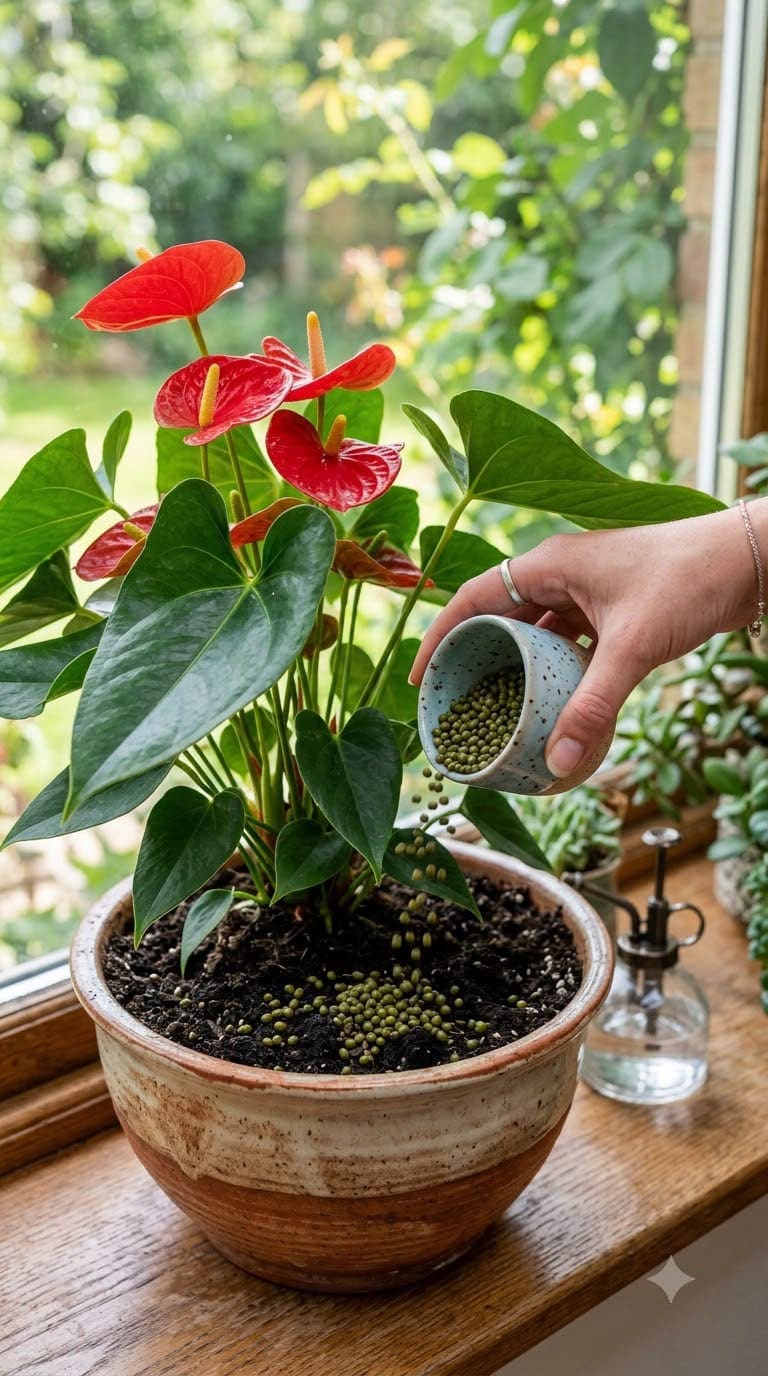
The small green granules in the photo are slow-release fertilizer, and they are one of the most reliable products in houseplant care.
Each granule is a nutrient core inside a permeable resin shell. Water passes through the shell, dissolves the nutrients, and they seep out gradually over three to six months.
One application covers a whole season. No weekly schedule to remember and no measuring liquid feed every two weeks.
The release matches how the plant absorbs. A steady trickle suits an epiphyte far better than periodic strong doses.
It supplies everything at once. Nitrogen for leaves, phosphorus for blooms, potassium for overall vigour, plus trace minerals.
Look for an N-P-K around 14-14-14, or a formula labelled for flowering houseplants.
What You Will Notice
More frequent blooms. A well-fed anthurium in good light produces spathes every six to eight weeks rather than two or three times a year.
Deeper leaf colour. The foliage darkens to a rich glossy green within a few weeks.
Stronger stems. Flower stems hold themselves upright instead of leaning, so the blooms sit above the leaves.
Longer-lasting spathes. Individual blooms hold their colour for six to eight weeks with good nutrition behind them.
Steady new growth. New leaves unfurling every few weeks through spring and summer.
How to Apply Them
Step 1: Choose the right time
Apply at the start of the growing season in early spring, or immediately after repotting.
Step 2: Measure by pot size
Use about 1 teaspoon per 6-inch pot, scaled to your container. Check your product label, since concentrations vary between brands.
Step 3: Scatter in a ring near the rim
Distribute the granules around the outer edge of the pot rather than in the middle.
This spreads them across the widest part of the root zone and keeps them clear of the crown and the aerial roots.
Step 4: Work them into the surface
Scratch them gently into the top half inch of the medium with your fingers.
Lightly buried, they sit in contact with moisture and begin releasing. Left loose on top they simply move around.
Step 5: Water thoroughly
Water until it runs from the drainage hole. This activates the coating and starts the release.
Step 6: Empty the saucer
Drain it within twenty minutes so nothing sits around the roots.
Step 7: Note the date
Mark it on a label or your phone, so you know when the three to six months are up.
Step 8: Flush at the end of the cycle
Water heavily with plain water once the cycle finishes, letting it run through freely for a minute.
Getting the Most From It
Give it bright indirect light. Light is what turns nutrients into flowers. An east-facing window is close to ideal.
Use a chunky medium. Orchid bark, perlite, and a little coco coir. Open air around the roots is what an epiphyte is built for.
Keep the humidity up. Sixty percent or higher. A humidity tray or a nearby humidifier makes a visible difference to leaf quality.
Water when the top inch is dry. Usually every 7 to 10 days, thoroughly, then let it drain fully.
Keep it slightly snug in its pot. Anthuriums flower more freely when the roots have filled the container.
Repot every two to three years. Fresh bark mix restores structure and nutrients together.
When to Apply Through the Year
Early spring. The main application, as new growth begins.
Late summer. A second application only if the first cycle has fully finished, which you can judge from the date you noted.
Autumn and winter. No feeding. Growth slows and the plant lives on what it has.
Frequently Asked Questions
How often do I reapply?
Once every three to six months during the growing season, following your product label.
How much for a small pot?
About half a teaspoon for a 4-inch pot, one teaspoon for a 6-inch pot.
Can I use liquid fertilizer instead?
Yes. A balanced liquid feed at quarter strength every two weeks in spring and summer works just as well. Use one method or the other.
Will it make my anthurium bloom more?
It helps considerably when light and humidity are already right. Light is the primary driver, and feeding supports it.
What about the aerial roots?
Leave them exposed. That is how the plant grows naturally. You can tuck a little sphagnum moss loosely around them if they look dry.
What N-P-K should I look for?
Around 14-14-14, or anything labelled for flowering houseplants.
Final Thoughts
Slow-release granules suit the anthurium well because they feed the way the plant absorbs: a little at a time, over months, rather than in bursts.
A teaspoon scattered around the rim of the pot in early spring, worked into the surface and watered in, covers the whole growing season. Pair it with bright indirect light, a chunky bark mix, and decent humidity, and the plant will keep producing spathes every six to eight weeks.