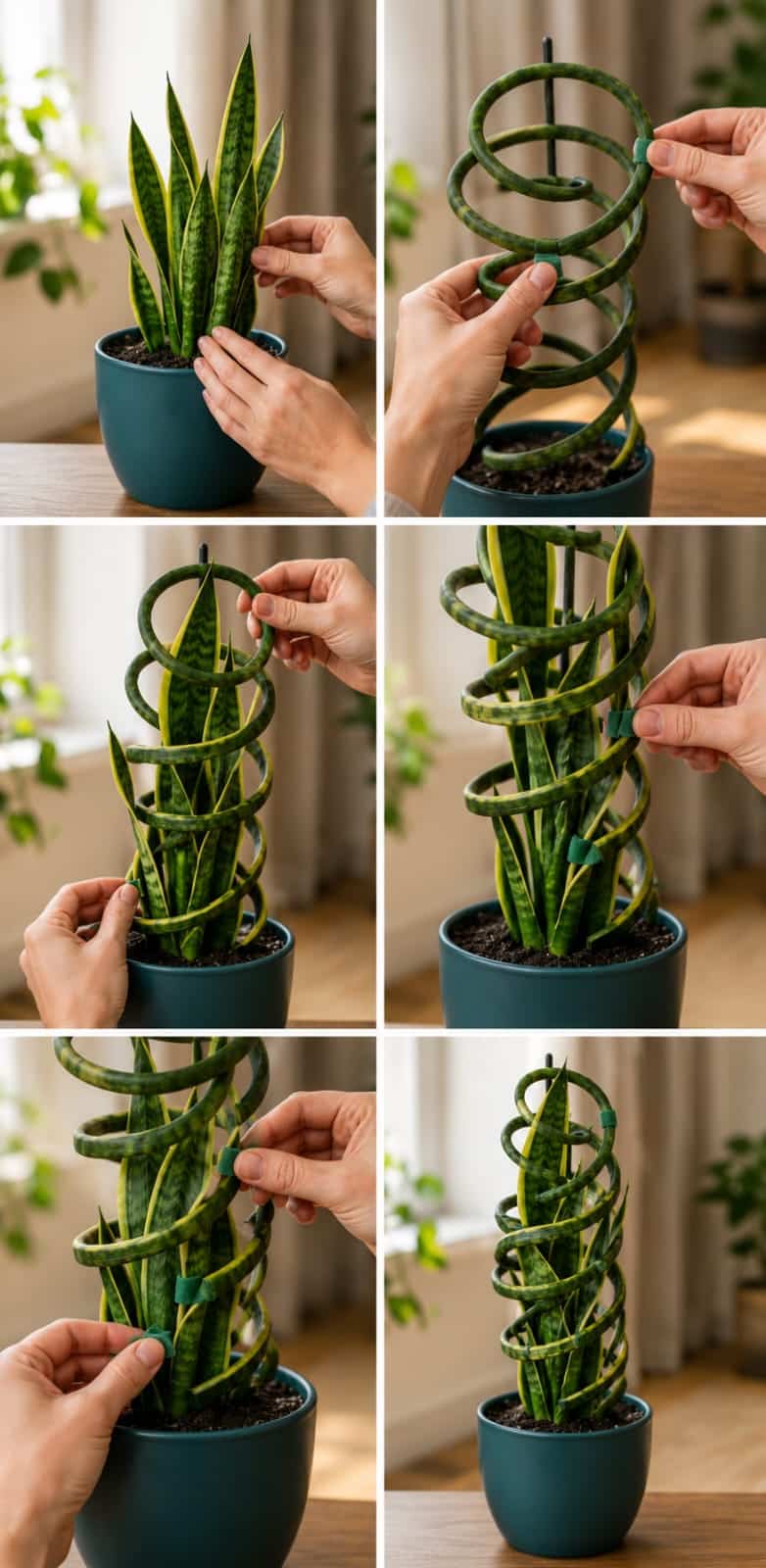
Snake plant is one of the most stylish indoor plants for homeowners who want bold upright leaves, strong green patterns, yellow-edged variegation, simple care, and a clean sculptural display that fits beautifully in living rooms, bedrooms, apartments, home offices, entry corners, bright kitchens, plant shelves, commercial interiors, luxury home staging, and premium indoor plant styling. Its sword-shaped foliage already gives a room height and structure, but many plant lovers now want to take that natural beauty further by training the plant into a spiral or circular shape.
A spiral snake plant display can look dramatic, modern, and expensive when it is done carefully. The idea is usually to place a spiral support or circular plant guide around the upright leaves, then gently guide the leaves into a curved pattern over time. This creates a living sculpture that looks different from a normal potted snake plant. However, snake plant leaves are thick, firm, and not naturally flexible like vine stems. They can bend slightly when young, but they can crack, crease, or scar if forced too quickly.
The safest way to understand this method is to treat spiral training as a slow styling technique, not a quick bending trick. A snake plant should never be twisted hard in one day. It should be guided gradually with soft ties, a stable support, bright indirect light, careful watering, and patience. The goal is to create a beautiful shape while keeping the leaves healthy, upright, and free from damage.
Why Snake Plants Can Be Styled But Not Forced
Snake plants have strong, thick leaves that grow from underground rhizomes. These leaves are designed to stand upright, store water, and tolerate dry indoor air. They are not climbing vines and they do not naturally wrap around a pole like pothos, philodendron, or monstera vines. This means a spiral display works best as a support-guided arrangement, not as true vine training.
Some leaves may naturally curve or lean, especially younger leaves. These can be guided more easily. Older leaves are usually stiffer. If an old leaf is forced around a tight spiral, it may split, crease, or break. Once a snake plant leaf is damaged, the mark will remain. The plant may continue living, but the decorative look can suffer.
For this reason, the best spiral snake plant display uses gentle pressure, wide curves, and soft ties. The support should guide the leaves without crushing them. A beautiful spiral should look intentional and healthy, not strained or damaged.
Choosing the Right Snake Plant for Spiral Styling
The best snake plant for a spiral display is healthy, upright, and actively growing. The leaves should be firm, not soft or wrinkled. The base should feel stable. The plant should not have root rot, yellowing bases, mushy leaves, or weak new shoots. A stressed plant should recover before any styling is attempted.
Medium-height snake plants are often easier to style than very small or very old plants. A very small plant may not have enough leaf height to create the spiral effect. A very mature plant may have thick leaves that are too stiff to guide safely. A plant with several medium leaves and some younger flexible growth is usually the best candidate.
Variegated snake plants with yellow edges can look especially beautiful in a spiral because the yellow border creates movement as it curves upward. The leaf pattern becomes part of the design. Still, the health of the plant matters more than the visual effect. Never sacrifice the plant’s structure for a rushed shape.
Choosing a Spiral Support
A spiral support should be smooth, stable, and wide enough to avoid sharp bending. It may be made from coated metal, plastic, bamboo, or another plant-safe material. The surface should not scrape the leaves. Rough wire, sharp edges, or tight metal loops can damage the foliage.
The support should be tall enough to cover the main leaf height without forcing the tips. It should also be anchored securely in the soil so it does not wobble. A loose support can shift and rub against the leaves. If the support moves every time the plant is touched, the leaves may develop marks.
The spiral should not be too narrow. Tight curls look interesting, but snake plant leaves cannot safely wrap around tight circles. A wider spiral gives a more natural look and reduces the risk of cracking.
Using Soft Ties Correctly
Soft plant ties are essential for safe styling. They hold the leaves near the support without cutting into them. Foam ties, soft garden tape, cloth strips, or flexible coated plant ties can work well. Avoid thin wire, fishing line, rough string, or anything that can dig into the leaf surface.
The tie should be loose enough to allow the leaf to breathe and continue growing. It should not pinch the leaf. A tight tie can leave permanent dents or restrict growth. Check the ties regularly and loosen them as needed.
Attach leaves to the support gently. Do not pull the leaf sharply into place. Instead, guide it a little closer to the spiral and secure it softly. Over several weeks, small adjustments can create a cleaner shape without damaging the plant.
How to Start the Spiral Shape
Begin by placing the spiral support into the pot carefully. Insert it near the center, avoiding the main rhizomes if possible. Push gently into the soil until the support stands firmly. If the pot is small or the soil is loose, the support may need extra anchoring.
Next, look at the natural direction of the leaves. Some may already lean slightly left or right. Use those natural angles instead of fighting them. Leaves that already lean toward the support are easier to guide. Leaves standing perfectly stiff should be left mostly upright unless they can be moved without pressure.
Start with only a few leaves. Do not tie every leaf at once. Choose flexible leaves and guide them lightly along the spiral. The plant should still look natural and comfortable. A good first session should feel like styling, not forcing.
Training Slowly Over Time
Spiral training works best when it is done gradually. After the first ties are placed, leave the plant alone for a week or two. Watch for stress signs such as cracking, bending marks, yellowing, or soft bases. If the leaves remain firm and healthy, you can make small adjustments.
Move the leaves only a little at a time. A slight change every few weeks is safer than a dramatic bend in one day. Snake plant leaves do not behave like flexible vines. They need slow guidance and respect for their natural stiffness.
If a leaf resists, do not force it. Some leaves are better left upright inside the spiral. The support can still create a beautiful circular frame around the plant even if not every leaf follows the curve.
Best Light for a Spiral Snake Plant
Bright indirect light is important for a spiral snake plant. Good light keeps the leaves strong, firm, and richly patterned. A plant kept in very low light may survive, but it may grow slowly and become weaker over time. Weak leaves are harder to style well.
Place the plant near a bright window with filtered light. Morning sun can be helpful if the plant is acclimated. Harsh afternoon sun through hot glass can scorch leaves, especially where ties or supports touch the foliage. If the plant sits near a window, rotate it occasionally so growth stays balanced.
Light direction affects the shape. Leaves naturally lean toward brightness. If the plant is always lit from one side, it may pull away from the support. Rotating the pot every few weeks helps maintain a more even spiral display.
Watering a Styled Snake Plant
A snake plant in a spiral display should still be watered like a normal snake plant. The styling support does not change the plant’s root needs. Water only when the soil has dried well. Check deeper than the surface because the top can dry while the lower soil remains damp.
When watering, use room-temperature water and water evenly around the soil. Let all excess drain out. Do not leave the pot sitting in water. Snake plants store moisture in their leaves and rhizomes, so they do not need frequent watering.
Avoid pouring water directly into tight leaf bases or around tied areas. Moisture trapped where leaves meet the support can create marks or rot risk. Water the soil carefully and keep the leaves mostly dry.
Best Soil for a Spiral Snake Plant
Fast-draining soil is essential. A cactus or succulent mix is a good base. It can be improved with perlite, pumice, coarse sand, lava rock, or small bark pieces. The mix should drain quickly and allow air to reach the rhizomes.
A spiral support can make the plant feel more top-heavy, so the soil and pot should provide stability. A lightweight loose mix may need a slightly heavier pot to keep the plant from tipping. However, the soil should still be airy. Do not use dense soil just to hold the support in place.
If the pot has no drainage, the plant is at risk. A stylish spiral display should still use a functional draining pot. A decorative cover pot can be used outside a nursery pot, but the inner pot should drain fully after watering.
Choosing the Right Pot
A spiral snake plant looks best in a stable pot that complements the vertical design. A teal, white, black, stone, terracotta, or matte ceramic pot can all work beautifully. The pot should be heavy enough to support the tall leaves and spiral frame.
A pot that is too small may tip easily. A pot that is too large may hold too much soil and stay wet too long. Choose a pot that fits the root ball comfortably while giving enough room for support placement. The pot should feel balanced, not oversized.
A clean modern pot can make the spiral design look more premium. Keep the pot surface wiped and the soil level neat. The support and ties should look intentional, not messy.
How to Avoid Leaf Damage
Leaf damage is the biggest risk with spiral styling. Snake plant leaves can crease if bent sharply. They can split if pulled too hard. They can scar if ties are too tight. They can rot if moisture stays trapped against them.
Always move leaves gently. Support the base with one hand while guiding the upper part with the other. Do not bend from one single point. A smooth gradual curve is safer than a sharp angle.
Check the leaves after tying. If a tie leaves an indentation, loosen it. If a leaf begins to crack, remove it from the training position and let it stand naturally. A healthy upright leaf is better than a damaged spiral leaf.
Should You Use Heat or Water to Bend Leaves?
Do not use heat to bend snake plant leaves. Heat can damage the leaf tissue and cause permanent marks. Do not soak the leaves to make them flexible. Wet leaves trapped against supports can increase rot risk.
Snake plant styling should rely on time, soft ties, and gentle positioning. The leaves should not be steamed, warmed, pressed, rolled, or forced. These methods may damage the plant even if they seem to create a quick curve.
Natural growth is the safest tool. As new leaves emerge, they can be guided more gently than older leaves. Training future growth is easier than reshaping stiff mature leaves.
Can Snake Plants Really Grow in a Circle?
Snake plants do not naturally grow in a perfect circle like vines. A circular or spiral display is usually created by arranging leaves around a support, not by making the plant genetically grow that way. The support gives the illusion of curved movement while the plant continues to grow from the base.
Some leaves may keep a slight curve after long gentle training, but many will return toward their natural upright habit if the support is removed. This is normal. The spiral support is part of the design, not just a temporary tool.
Think of the display as living plant styling. The plant and support work together. The goal is not to force the plant into something unnatural, but to guide its natural upright beauty into a more decorative structure.
When Spiral Training Should Be Avoided
Spiral training should be avoided if the plant is weak, newly repotted, dehydrated, overwatered, yellowing, soft at the base, or recovering from root rot. Styling adds physical stress. A stressed plant should be stabilized first.
It should also be avoided if the leaves are very old, stiff, or already damaged. Trying to bend old leaves can create cracks. In that case, use a wider support as a decorative frame rather than forcing the leaves around it.
Do not train during very cold conditions or when the plant is in poor light. Healthy growth and warmth help the plant respond better to gentle shaping.
Continue to Page 2
Continue to page 2 for more details about this article and the key points many readers miss on the first page.