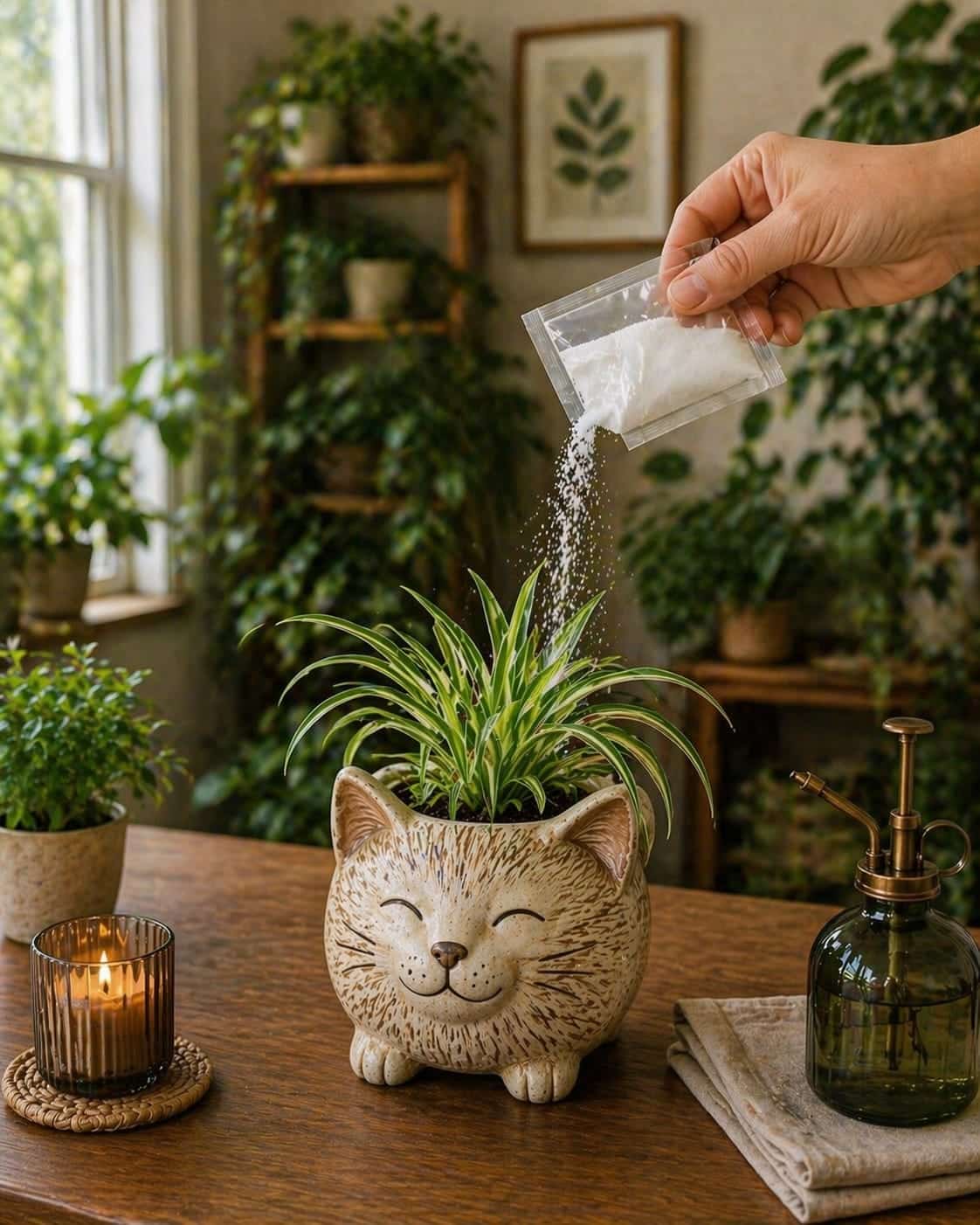
How to Propagate Spider Plant Babies (Turn One Plant into Many)
Once your spider plant produces babies, you can easily propagate them into new plants.
Method 1 – Soil Propagation (Easiest)
- Wait until the baby is at least 2–3 inches across and has tiny root nubs.
- Place the baby on top of moist potting soil in a small pot (3–4 inches).
- Keep the baby attached to the mother plant while it roots (use a stake or let it rest on the soil).
- Water lightly. After 2–3 weeks, gently tug — if there is resistance, roots have formed.
- Cut the runner stem and enjoy your new spider plant.
Method 2 – Water Propagation
- Place the baby in a small glass of water, with only the base submerged.
- Change water every 3–4 days.
- Roots appear in 1–2 weeks.
- Transfer to soil once roots are 1–2 inches long.
Method 3 – Direct Potting (Cut First)
- Cut the baby from the runner.
- Plant the base in moist potting soil.
- Cover with a clear plastic bag to increase humidity (open daily for air).
- Keep in bright indirect light. Roots form in 3–4 weeks.
Common Mistakes That Kill Spider Plant Babies
Even with good care, mistakes happen. Avoid these common errors.
· Cutting the baby too soon – Wait until it has at least 2–3 leaves and root nubs.
· Planting too deep – Burying the leaves causes rot. Plant just the base.
· Overwatering – Baby roots are delicate; keep soil lightly moist, not soggy.
· Too much direct sun – Babies burn easily. Use bright indirect light.
· Rooting in winter – Growth slows; wait until spring for best results.
Frequently Asked Questions (Spider Plant Babies)
How long does it take for a spider plant to produce babies?
From a healthy, mature plant in good conditions, you may see runners and babies within 2–4 months after improving care. Immature plants may take a year or more.
Why is my spider plant not making babies?
Most common reasons: not enough light, pot too large, overwatering, or the plant is still young. Move it to a brighter spot, check pot size, and water correctly.
Can I use Epsom salt to boost baby production?
Epsom salt provides magnesium. If your plant is deficient (yellowing between leaf veins), a diluted solution (1 teaspoon per gallon) once a month may help overall health. It is not a direct baby booster.
What is the best fertilizer for spider plant babies?
A balanced, water‑soluble fertilizer (10‑10‑10) diluted to half strength, applied once a month in spring and summer. Do not fertilize in fall and winter.
Should I remove the babies or leave them attached?
You can leave them attached for a fuller, cascading look. Or remove them to propagate new plants. Both are fine. The mother plant will continue producing more babies.
How do I know if my spider plant is root‑bound enough to produce babies?
Gently remove the plant from its pot. If roots are circling the bottom and sides, and the pot is not cracked, it is the ideal snug condition. If roots are densely packed with no soil left, repot into a slightly larger container.
Can I grow spider plant babies in water permanently?
Yes, but they will not grow as large or produce babies themselves. Water‑grown spider plants are smaller. For long‑term health, move to soil.
Are spider plant babies safe for pets?
Spider plants are non‑toxic to cats and dogs according to the ASPCA. However, ingestion can cause mild stomach upset. Keep out of reach if your pet is a heavy chewer.
A Simple Spider Plant Care Routine for Maximum Babies
Use this weekly and seasonal plan to keep your plant healthy and produce abundant offshoots.
Weekly
· Check soil moisture. Water when top inch is dry.
· Wipe leaves with a damp cloth to remove dust.
· Rotate the pot for even light.
Monthly
· Flush the soil with plain water to remove salt buildup.
· Inspect for pests (spider mites, aphids, mealybugs).
· Remove any dead or yellow leaves.
Spring & Summer (Active Growth)
· Bright indirect light (10–12 hours).
· Water every 5–7 days (when top inch dries).
· Feed once a month with half‑strength balanced fertilizer.
· Watch for runners and baby plantlets.
Fall & Winter (Resting Period)
· Still bright light, but days are shorter — consider a grow light.
· Water less often (every 10–14 days).
· Stop fertilizing.
· Keep away from cold drafts (below 55°F / 13°C).
Annually
· Refresh the top inch of soil with fresh potting mix.
· Repot every 1–2 years only if the plant is severely root‑bound.
· Divide if the plant is overcrowded.
Why a Healthy Spider Plant Is the Best Decor
A spider plant full of babies is more than a plant — it is a living decoration. It softens shelves, adds movement to hanging baskets, and brings life to neutral rooms. When your plant is thriving, it becomes a conversation piece. Guests will ask, “How did you get so many babies?” And now you know the real answer: consistent care, not mystery powder.
Final Thoughts
The idea of “just sprinkle this” is tempting because it feels simple and fast. But plants do not work like shortcuts. A spider plant produces beautiful babies when it is thriving — not when it is overloaded with random treatments.
So instead of chasing quick hacks, build the right environment: bright indirect light, a snug pot, proper watering, gentle feeding, and patience. That is the real formula.
And when your plant is happy… the babies will come naturally 🌿✨
Then you can propagate them, share them with friends, or let them cascade into a stunning indoor display. No mystery powder required — just good care and a little time.
Have you successfully grown spider plant babies? Share your tips in the comments below. And if you found this guide helpful, save it for later or send it to a friend who wants a fuller, baby‑filled spider plant.
This article is for informational purposes only. Growing conditions vary. Always observe your plant and adjust care as needed. When in doubt, focus on light, water, and soil before any supplement.