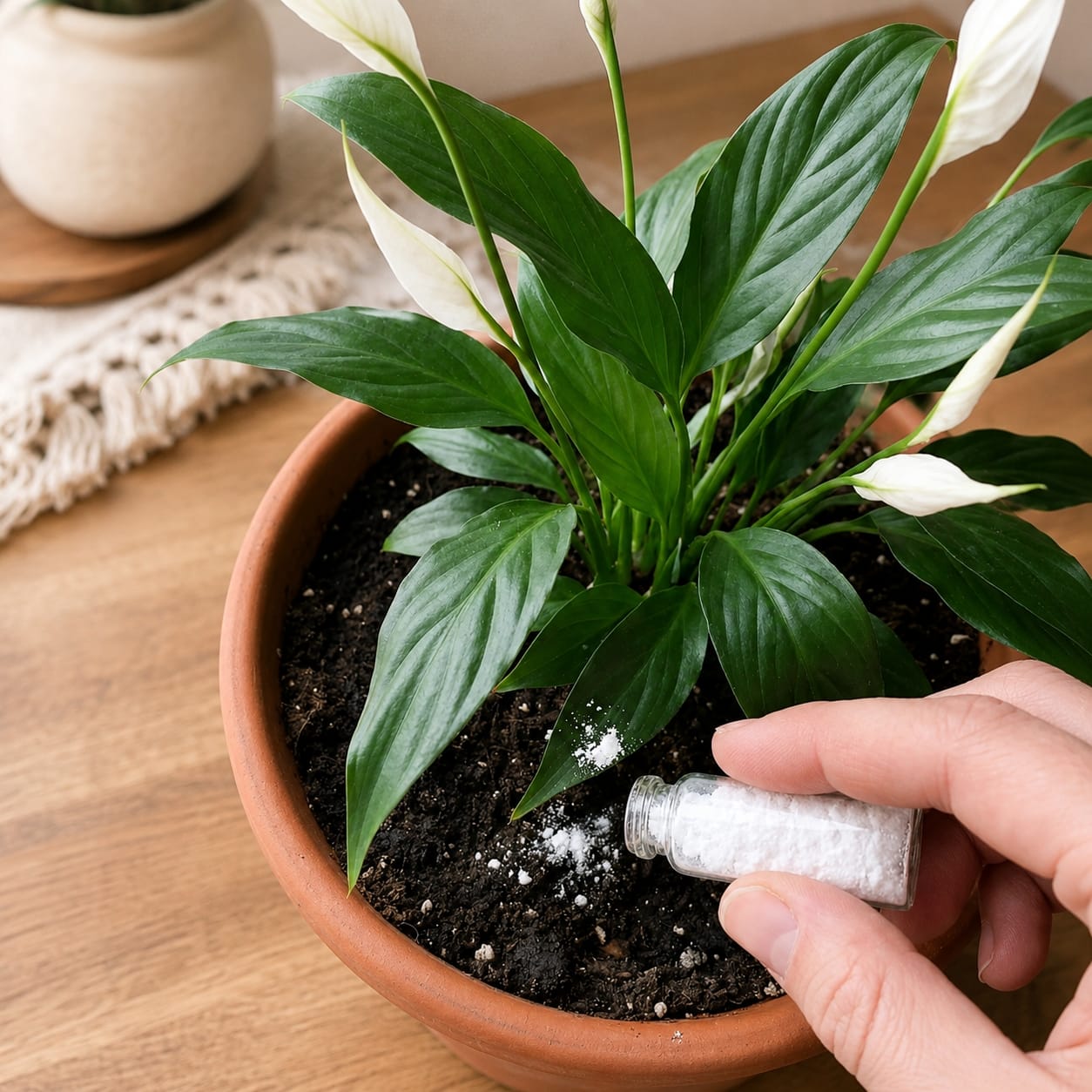
Peace lilies are among the most graceful indoor plants you can grow. Their deep green leaves, soft white blooms, and calm tropical shape make them perfect for bedrooms, living rooms, office corners, bathrooms, shelves, and bright windowsills. A healthy peace lily can make a home feel cleaner, softer, and more peaceful without needing complicated care.
One plant-care idea that often catches attention is the “white powder trick” for peace lilies. A small amount of white powder is added near the soil to support greener leaves, stronger growth, or better blooming. But this trick needs a very clear warning: not every white powder is safe for plants. Some powders can help when used correctly, while others can damage roots quickly.
The safest white powder options for peace lilies are usually gentle plant-safe materials such as crushed eggshell powder, a tiny amount of gypsum, or very diluted Epsom salt used carefully. The dangerous option is table salt. Table salt should never be added to peace lily soil. It can burn roots, dry the plant, and cause leaf damage.
This guide explains how to use a safe white powder routine for peace lilies, what to avoid, how to improve soil health, how to encourage white blooms, how to water correctly, and how to style peace lilies beautifully indoors.
What the White Powder Trick Really Means
The white powder trick is usually a simple plant-care method where a small amount of a powder is placed on or mixed into the top layer of soil. The goal is to give the plant a slow, gentle boost. For peace lilies, this should always be done lightly because they have sensitive roots and prefer balanced care.
The powder should never be used as a heavy fertilizer. It should not be poured in piles around the crown. It should not be used every week. It should not replace proper watering, drainage, light, humidity, or soil quality.
A peace lily grows best when the full care routine is balanced. A powder can support the plant only if the plant already has the right conditions.
The Most Important Warning: Do Not Use Table Salt
Many white powders look similar, but they do not act the same. Table salt is harmful to most houseplants. It pulls moisture away from roots and can create salt buildup in the soil. Peace lilies are especially sensitive to mineral buildup and chemical stress.
If table salt is added to the soil, the plant may show brown leaf tips, drooping, yellow leaves, crispy edges, weak roots, or slow decline. Even a small amount can create problems if used repeatedly.
If you want to try a white powder plant trick, make sure you know exactly what the powder is. Never guess.
Safe White Powder Options for Peace Lily
There are a few safer white powder options that can be used carefully. Each one has a different purpose.
- Crushed eggshell powder: Adds slow calcium over time, but works slowly.
- Gypsum: Adds calcium and sulfur without strongly changing soil pH when used lightly.
- Epsom salt: Provides magnesium and sulfur, but must be diluted and used rarely.
- Perlite: Not a fertilizer, but improves soil drainage and airflow.
- Dolomitic lime: Can add calcium and magnesium, but can change pH, so use carefully.
For most indoor peace lilies, crushed eggshell powder or perlite is safer than strong feeding powders. Epsom salt should be used as a diluted liquid, not sprinkled heavily on the soil.
Best Safe Version: Crushed Eggshell Powder
Crushed eggshell powder is one of the gentler options. It is not a fast fertilizer, but it can slowly add calcium as it breaks down. Calcium supports plant structure and root health, but peace lilies do not need large amounts.
To prepare eggshell powder, rinse the eggshells well, let them dry fully, then crush or blend them into a fine powder. The finer the powder, the faster it breaks down. Large shell pieces can take a very long time to benefit the soil.
Use only a small pinch around the soil surface. Mix it lightly into the top layer. Do not pile it against the plant stems.
How to Use Eggshell Powder Safely
- Rinse eggshells to remove egg residue.
- Let them dry completely.
- Crush into a fine powder.
- Use a small pinch for a small pot or half a teaspoon for a medium pot.
- Sprinkle lightly over the soil surface.
- Mix gently into the top soil layer.
- Water normally when the soil is ready.
- Repeat only every 2 to 3 months if needed.
Eggshell powder should not smell. If it smells bad, it was not cleaned or dried correctly.
Using Gypsum for Peace Lily
Gypsum is a calcium sulfate mineral sometimes used in gardening. It can add calcium and sulfur without raising soil pH as strongly as lime. For peace lilies, only a very tiny amount is needed, and many plants do not need it at all.
If you use gypsum, apply it lightly. A small pinch mixed into the top layer is enough for a small houseplant pot. Too much mineral material can build up in indoor soil because pots do not flush as freely as outdoor garden beds.
Use gypsum only if your plant care routine is already good and you want a very mild mineral support.
Using Epsom Salt Carefully
Epsom salt is magnesium sulfate. It is sometimes used for plants that may need magnesium. Magnesium helps with chlorophyll, which is related to green leaves. But peace lilies do not need frequent Epsom salt. Too much can disturb nutrient balance.
The safest way is to dissolve it in water and use it rarely. Do not pour dry Epsom salt directly in a pile around the roots.
A gentle ratio is:
- 1/4 teaspoon Epsom salt
- 1 liter of water
- Mix until fully dissolved
- Use once every 2 to 3 months at most
- Apply only when the plant needs watering
If the plant already has brown tips, chemical buildup, or weak roots, skip Epsom salt and use plain water instead.
Why Perlite Is a Helpful White Material
Perlite is a lightweight white volcanic material often found in potting mixes. It is not a fertilizer, but it is extremely useful for peace lilies because it improves drainage and airflow. Many peace lily problems begin with soil that stays too wet.
Adding perlite to the soil mix helps roots breathe. This can reduce root rot risk and support stronger growth. If you see white pieces in potting soil, they may be perlite, not fertilizer.
For peace lilies, a mix with perlite is often better than a dense, heavy soil.
Best Soil Mix for Peace Lily
Peace lilies like soil that stays lightly moist but not soggy. They do not like compacted soil that holds water for too long. A good mix should drain well while still holding some moisture.
A simple peace lily soil mix:
- 2 parts indoor potting mix
- 1 part perlite
- 1 part coco coir
- 1/2 part orchid bark
- A small amount of worm castings, optional
This mix gives roots moisture and oxygen. It is much safer than heavy garden soil.
Why Peace Lilies Get Brown Tips
Brown tips are one of the most common peace lily problems. Many people assume the plant needs fertilizer, but brown tips often come from water stress, mineral buildup, low humidity, overfeeding, or inconsistent watering.
- Tap water minerals
- Too much fertilizer
- Dry indoor air
- Underwatering
- Overwatering
- Cold drafts
- Direct harsh sun
- Old leaf aging
Adding white powder will not automatically fix brown tips. The best solution is to find the cause and correct the care routine.
Water Quality Matters
Peace lilies can react to chlorine, fluoride, and mineral-heavy tap water. If your plant often develops brown tips, try filtered water, rainwater, or water left out overnight. This may reduce stress on the leaves.
Water temperature matters too. Use room-temperature water. Cold water can shock roots, especially in winter.
Clean water is more important than most homemade tricks.
Best Watering Routine for Peace Lily
Peace lilies like evenly moist soil, but they do not like sitting in water. Water when the top inch of soil feels slightly dry. If the leaves droop and the soil is dry, the plant is thirsty. If the leaves droop and the soil is wet, the roots may be struggling.
Water slowly until water drains from the bottom. Empty the saucer after watering. Do not let the pot sit in standing water.
A pot with drainage holes is essential for healthy peace lily roots.
How to Know if the Peace Lily Is Thirsty
A thirsty peace lily often droops dramatically. This plant is famous for looking collapsed when dry, then perking back up after watering. If the soil is dry and the pot feels light, water thoroughly.
Do not let the plant reach severe drooping too often. Repeated drought stress can weaken leaves and reduce blooms.
Try to water before the plant fully collapses.
How to Know if the Peace Lily Is Overwatered
An overwatered peace lily may also droop, but the soil will feel wet. The leaves may yellow, stems may soften, and the pot may smell sour. Fungus gnats may appear if the soil stays damp too long.
If this happens, stop watering and check the roots. Rotten roots should be trimmed, and the plant should be repotted into fresh airy soil.
Never add white powder or fertilizer to a plant with root rot. Fix the roots first.
Light for Greener Leaves and More Blooms
Peace lilies grow best in bright indirect light. They tolerate lower light, but they bloom better with brighter filtered light. Direct hot sun can burn the leaves, while deep shade can reduce flowering.
Place the plant near a bright window with a sheer curtain or a few feet away from direct sun. Morning light is usually gentle. Harsh afternoon sun should be filtered.
If your peace lily has healthy leaves but no flowers, it probably needs more light.
How to Encourage White Blooms
Peace lilies bloom when they have enough energy. The biggest factors are light, root health, and balanced feeding. A white powder alone will not force flowers.
- Give bright indirect light.
- Keep soil lightly moist.
- Use a pot with drainage.
- Feed lightly during active growth.
- Keep leaves clean.
- Avoid stress from cold or drought.
- Repot only when needed.
Peace lilies can bloom several times a year under good indoor conditions.
Best Fertilizer for Peace Lily
Use a balanced liquid houseplant fertilizer diluted to half or quarter strength. Feed once every 6 to 8 weeks during spring and summer. Do not overfeed. Peace lilies are sensitive to fertilizer buildup.
If you are using any white powder supplement, reduce regular fertilizer. Too many nutrients can cause brown tips and root stress.
During winter, feed less or stop if the plant is not actively growing.
How to Flush Soil Buildup
If your peace lily has brown tips and you suspect mineral or fertilizer buildup, flush the soil. Take the plant to a sink and run room-temperature water through the pot for a few minutes. Let it drain fully.
This helps wash out excess salts. Only do this if the pot has drainage holes. Do not flush a pot without drainage.
After flushing, wait until the soil dries slightly before watering again.
Humidity for Peace Lily
Peace lilies enjoy moderate humidity. Dry air can cause crispy edges and dull leaves. Indoor heating and air conditioning can make the air very dry.
To raise humidity, group plants together, use a pebble tray, or place a small humidifier nearby. A bright bathroom can be a good location if it has enough natural light.
Avoid constant heavy misting in rooms with poor airflow. Wet leaves can invite fungal problems.
Temperature Needs
Peace lilies prefer warm indoor temperatures. Keep them away from cold windows, air-conditioning vents, heaters, and drafty doors. Sudden temperature changes can cause drooping or leaf damage.
A stable room is best. If the windowsill gets cold at night, move the pot slightly away from the glass.
Warm, steady conditions help the plant grow better.
Cleaning Peace Lily Leaves
Peace lily leaves are broad and collect dust easily. Dust blocks light and makes the plant look dull. Wipe leaves gently with a damp cloth every couple of weeks.
Support each leaf with one hand while wiping with the other. Do not use oily leaf shine products. They can clog the leaf surface and attract dust.
Clean leaves help the plant absorb more light and look healthier.
Where to Place the White Powder
If using a safe powder such as eggshell powder or a tiny amount of gypsum, place it on the soil surface away from the crown. The crown is the area where stems meet the soil. Keeping powders and moisture away from this area reduces rot risk.
Sprinkle lightly. Mix into the top layer with a small spoon or your fingers. Water normally only when the soil is ready.
Never bury the crown under powder or soil.
How Often to Use White Powder
Less is better. For eggshell powder, once every 2 to 3 months is enough. For gypsum, use only occasionally and in very small amounts. For Epsom salt, use a diluted liquid no more than once every 2 to 3 months.
Do not combine all of these at once. Choose one method, use it lightly, and watch the plant.
If the plant looks healthy, you may not need any powder at all.
Signs the White Powder Routine Is Helping
- Leaves stay firm and green
- New leaves appear healthy
- No sour smell develops
- Soil drains normally
- Brown tips do not increase
- The plant keeps steady growth
- Blooms appear during active growth
Good results should be slow and natural. Houseplants rarely transform overnight.
Signs You Should Stop
- Brown tips increase
- Soil crust appears
- Leaves yellow after application
- Soil smells bad
- Fungus gnats appear
- The plant droops in wet soil
- Roots look damaged
If these signs appear, stop using powders and focus on clean water, drainage, and soil health.
What to Do if You Accidentally Used Table Salt
If table salt was added to the peace lily soil, act quickly. If the pot has drainage holes, flush the soil with plenty of room-temperature water. Let it drain fully. Repeat if needed.
If a lot of salt was added, repot the plant into fresh soil. Remove as much salty soil as possible without damaging the roots too much. Trim any rotten or damaged roots.
Do not fertilize immediately after this. Let the plant recover.
Continue to Page 2
Continue to page 2 for more details about this article and the key points many readers miss on the first page.