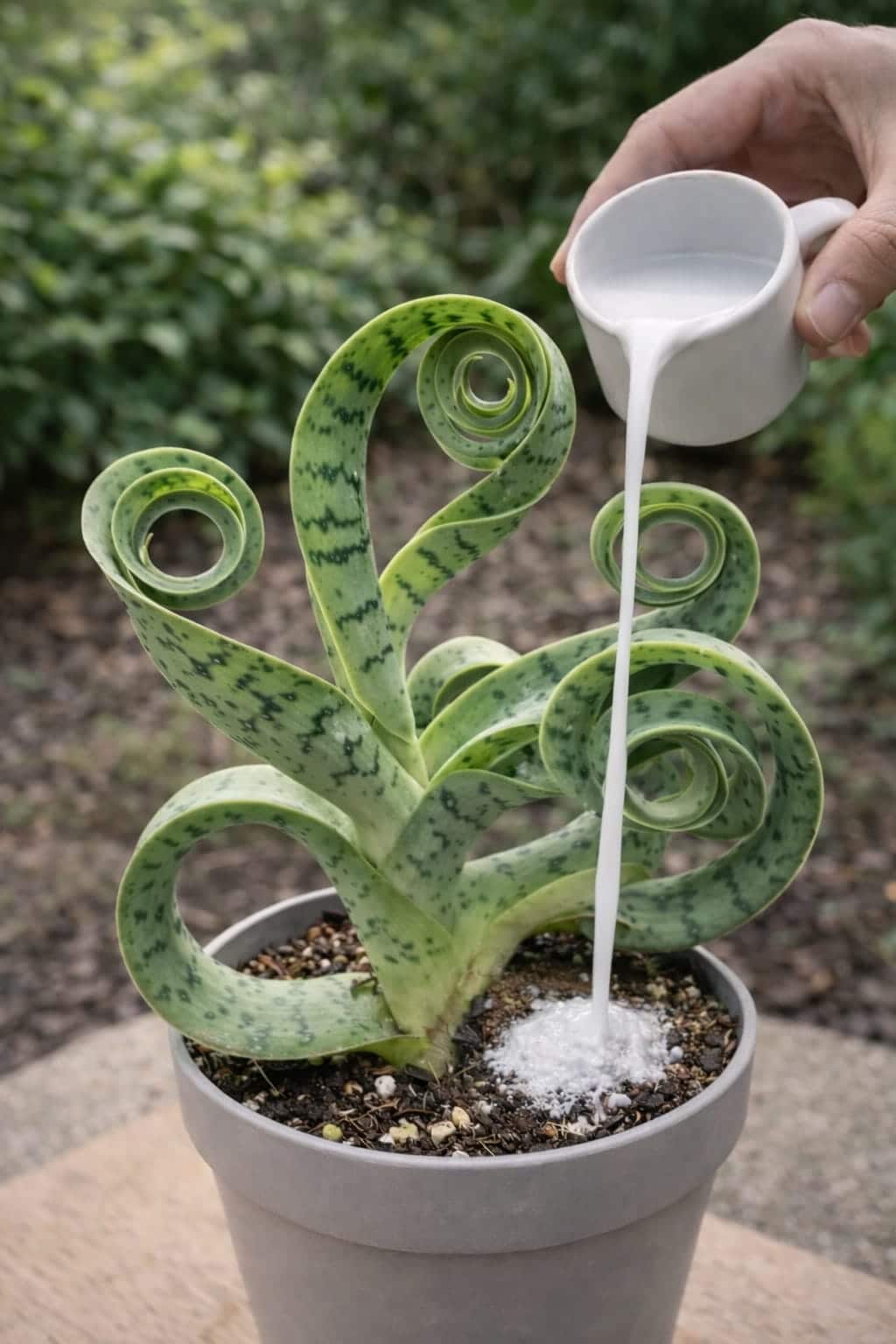
⚠️ Why Less Is More with Snake Plants
Snake plants thrive when they are left alone most of the time. They are adapted to dry, low‑nutrient environments. Overdoing any method can cause:
Problem Consequence
Root stress Yellowing leaves, soft base.
Soil imbalance Salt buildup, pH shifts.
Slower growth The plant focuses on survival, not growth.
Leaf damage Brown tips, curling.
Moisture buildup Root rot – the #1 killer.
That’s why luxury homeowners follow a simple rule:
👉 Minimal input, maximum stability.
🌱 The Real Secret Behind Healthier Plants
No “trick” works without strong fundamentals. The simple liquid is at best a tiny supplement – it will never replace the basics.
Healthy snake plants always come down to:
Factor Ideal Condition
Proper drainage Pot with holes; cactus/succulent soil
Controlled watering Let soil dry completely between waterings
Indirect light exposure Bright, indirect (east/west window)
Stable indoor temperatures 18–30°C (65–86°F)
Occasional, light feeding Once every 4–6 weeks in spring/summer (diluted)
When these are right, the plant naturally thrives. The simple liquid can give a very small boost – but it’s never the main driver.
How to Use the Simple Liquid Method Safely
If you want to try this approach, follow these guidelines.
Step‑by‑Step
- Choose a mild liquid – diluted seaweed extract, compost tea, or a balanced fertilizer at quarter strength.
- Dilute heavily – weaker is always better.
- Apply only during spring and summer – the active growing season.
- Use once every 4–6 weeks – not weekly.
- Water with plain water first – moisten the soil slightly.
- Pour the diluted liquid onto the soil – not the leaves.
- Do not use in fall and winter – the plant rests.
What to Avoid
· Strong concentrations – can burn roots.
· Frequent application – leads to salt buildup.
· Applying to dry soil – water first.
· Using on a stressed plant – fix light and water first.
Snake Plant Care Table – Quick Reference
Factor Ideal Condition Result
Light Bright, indirect (east/west window) Upright, strong leaves
Water Low frequency – let soil dry completely Prevents root rot
Soil Fast‑draining mix (cactus soil + perlite) Healthy root system
Feeding Light & occasional (every 4–6 weeks, spring/summer) Balanced growth
Placement Open indoor space Better air circulation
Simple liquid Occasional, diluted (optional) Gentle supplement
Frequently Asked Questions (FAQs)
Q: Do snake plants need fertilizer?
Only occasionally and in small amounts. Once or twice a year is plenty. Over‑fertilizing harms them.
Q: How often should they be watered?
Every 2–3 weeks depending on light and temperature. Always check that the soil is completely dry before watering
Q: Can natural liquids replace fertilizer?
No, they are only mild supplements. They provide trace nutrients but not significant NPK (nitrogen, phosphorus, potassium).
Q: Do snake plants grow fast?
They grow slowly but steadily. In bright light, you may see several new leaves per year. In low light, growth is very slow.
Q: What causes weak, floppy leaves?
Overwatering or poor light. Check soil moisture and move the plant to a brighter spot.
Q: Can snake plants live in low light?
Yes, but growth slows. They survive, but for best health and upright leaves, bright indirect light is better.
Q: Do they need repotting often?
Only every few years – when roots are crowded or soil is old. Snake plants like to be slightly root‑bound.
Q: Are snake plants beginner‑friendly?
Yes, very easy to care for. They are one of the most forgiving houseplants.
Q: Can they improve indoor air feel?
They contribute to a fresher environment – like many houseplants, they can remove trace VOCs.
Q: Are snake plants good for decor?
One of the best indoor decor plants – their clean lines work in any style, from modern to rustic.
Printable Snake Plant Care Checklist
☐ Place in bright, indirect light (east/west window)
☐ Use a pot with drainage holes (terracotta preferred)
☐ Fill with well‑draining cactus/succulent soil (add perlite)
☐ Water only when soil is completely dry (check with finger)
☐ Water deeply, then empty saucer
☐ Do not water again for 2–4 weeks (depending on light)
☐ Fertilize lightly once every 4–6 weeks in spring/summer (optional)
☐ Use simple liquid (diluted seaweed or compost tea) occasionally – optional
☐ Do not feed in fall/winter
☐ Wipe leaves with damp cloth monthly
☐ Inspect roots annually – repot if root‑bound or soil degraded
☐ Be patient – slow growth is normal
Final Thoughts – Minimal Input, Maximum Stability
The “simple liquid” method is not a secret trick. A very diluted natural supplement can give your snake plant a tiny boost, but it will never replace the fundamentals: proper drainage, controlled watering, bright indirect light, stable temperatures, and occasional light feeding.
Luxury homeowners understand that the best care is often the simplest. Snake plants thrive when you do less – less water, less fertilizer, less fuss. Focus on the basics, and your snake plant will reward you with strong, upright, beautiful leaves for years.
Now it’s your turn! Have you tried a simple liquid on your snake plant? What worked – or didn’t? Drop a comment below – I’d love to hear your experience.
And if you found this guide helpful, share it with a friend who loves modern plant decor. Pin it for later, and subscribe to our newsletter for more practical plant care.
Stay simple, stay consistent, and watch your snake plant thrive. 🌿✨