Snake plants are among the most dependable indoor plants you can grow. Their upright sword-like leaves, bold green pattern, low-maintenance nature, and sculptural shape make them perfect for living rooms, bedrooms, offices, entryways, apartments, plant shelves, sunny windows, and modern home decor. They are drought-tolerant, forgiving, and excellent for people who want beautiful houseplants without complicated care.
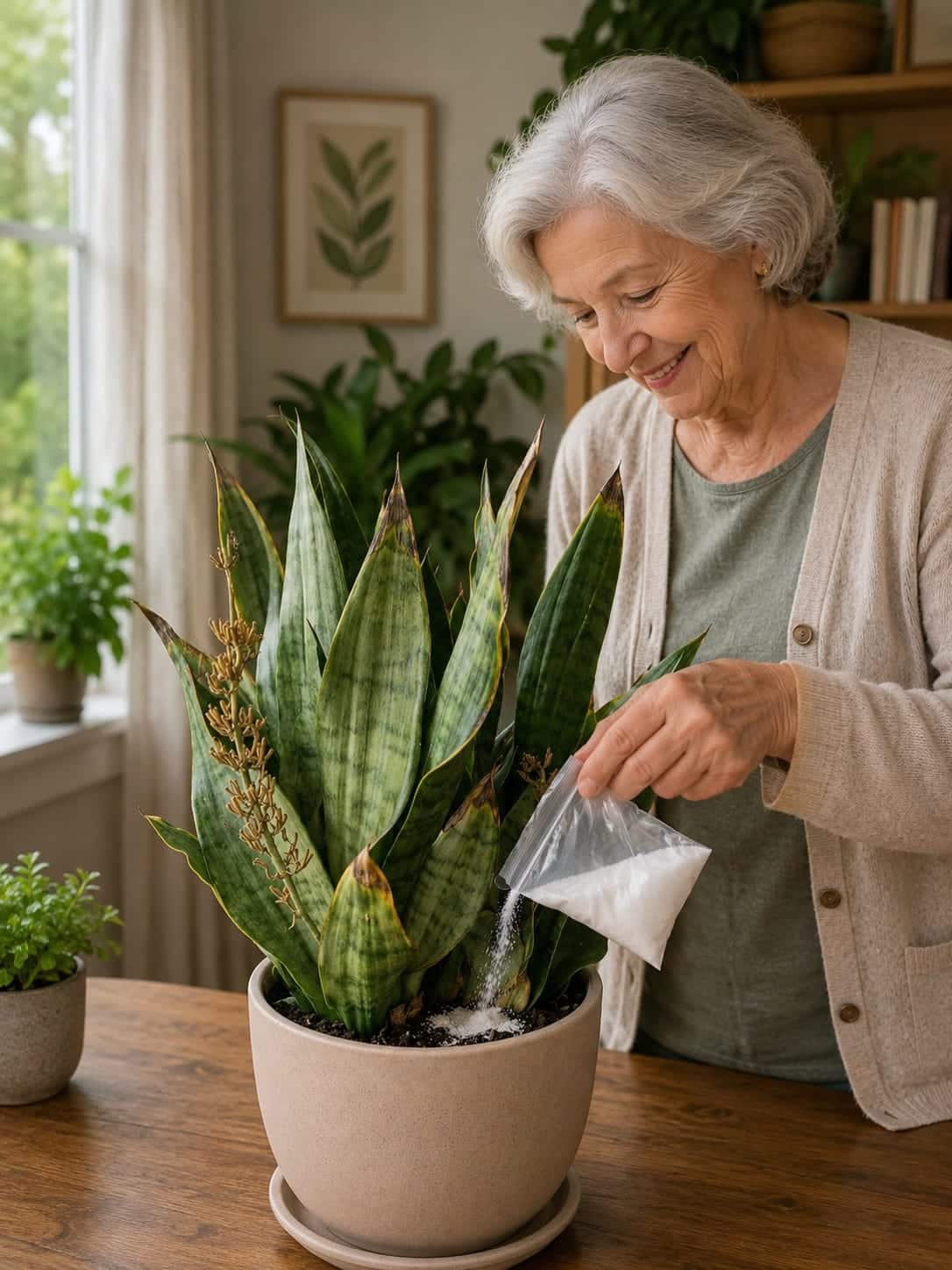
The image shows a mature snake plant with tall, firm leaves and dried flower stalks while a woman sprinkles a white powder around the soil. This white powder is best understood as Epsom salt, a common garden mineral also known as magnesium sulfate. Many indoor gardeners use a very small amount of Epsom salt for houseplants because magnesium can support chlorophyll production, leaf color, and steady growth when a plant is mildly deficient.
But snake plants are succulents. They store water in their thick leaves and prefer dry, airy soil. That means this trick must be used carefully. Sprinkling too much white powder directly onto the soil can cause mineral buildup, root stress, or leaf tip burn. The safe method is to use a tiny amount, dilute it properly, apply it only during active growth, and never treat it like daily fertilizer.
Used wisely, the Epsom salt trick may help a healthy snake plant maintain firm leaves, deeper green color, stronger root function, and better long-term growth. It may also support mature plants that are preparing to bloom, but it cannot force flowers on a young or stressed plant. Snake plant flowers appear only when the plant is mature, root-stable, and growing under the right conditions.
What Plant Is in the Image?
The plant in the image appears to be a snake plant, also known as Sansevieria or Dracaena trifasciata. It has thick upright leaves with green striping and firm pointed tips. Some dried flower stalks are visible, which suggests the plant may have bloomed recently.
Snake plants are popular because they are:
- Low-maintenance indoor plants
- Drought-tolerant houseplants
- Excellent for beginners
- Great for modern home decor
- Suitable for bedrooms and offices
- Easy to grow in pots
- Long-lasting indoor succulents
They do not need frequent feeding. In fact, most snake plant problems come from too much water, too much fertilizer, heavy soil, or pots without drainage.
What Is the White Powder?
The white powder in the image is best explained as Epsom salt. Epsom salt is magnesium sulfate, a mineral compound sometimes used in gardening when plants show signs of magnesium deficiency.
Magnesium helps plants produce chlorophyll, which is important for healthy green leaves. Sulfur also plays a role in plant growth. For a snake plant, a tiny amount of Epsom salt may help if the soil is old, the plant has been growing for years in the same pot, or the leaves look pale despite proper light and watering.
However, Epsom salt is not a complete fertilizer. It does not provide nitrogen, phosphorus, or potassium. It should not replace a balanced succulent fertilizer or good soil care.
Important Warning Before Using Epsom Salt
Snake plants are sensitive to overwatering and mineral buildup. This means Epsom salt should never be used heavily or often.
Too much Epsom salt can cause:
- Brown leaf tips
- Root stress
- Salt buildup in the soil
- Dry crispy edges
- Yellowing leaves
- Weak root absorption
- Soil imbalance
- Slower growth
The image shows powder being sprinkled directly onto the soil. For real care, it is safer to dissolve Epsom salt in water first. If you use it dry, use only a tiny pinch and water lightly afterward.
Why Gardeners Use Epsom Salt for Snake Plants
Gardeners use Epsom salt because magnesium may help support healthy leaf color and plant metabolism. Snake plants do not need much fertilizer, but a very mild mineral boost can sometimes help an older plant that has been sitting in depleted soil.
A careful Epsom salt treatment may support:
- Deeper green leaf color
- Stronger upright growth
- Better chlorophyll production
- Improved root-zone mineral balance
- Healthier mature leaves
- Steady indoor plant growth
- Recovery from mild magnesium deficiency
But this trick works only when the plant already has good light, dry soil cycles, drainage, and healthy roots.
Can Epsom Salt Make a Snake Plant Bloom?
Epsom salt cannot force a snake plant to bloom. Snake plant flowers are rare indoors and usually appear on mature, root-bound, healthy plants. Sometimes a little stress, such as being slightly pot-bound and receiving bright light, can encourage blooming. But forcing stress is risky.
A mature snake plant is more likely to bloom when it has:
- Bright indirect light
- A stable root system
- Well-draining soil
- A pot with drainage holes
- Dry periods between watering
- Light feeding during active growth
- Years of maturity
Epsom salt may support plant health, but flowers come from maturity and proper conditions, not from one spoonful of powder.
How to Make Safe Epsom Salt Water for Snake Plants
The safest way to use this trick is as a diluted mineral water, not a heavy dry powder.
Ingredients
- 1 liter clean water
- ¼ teaspoon Epsom salt
- Clean watering cup or bottle
Steps
- Add ¼ teaspoon Epsom salt to 1 liter of water.
- Stir until completely dissolved.
- Check that the snake plant soil is dry.
- Pour a small amount around the outer soil edge.
- Let the pot drain fully.
- Empty the saucer after watering.
The solution should be weak. Do not make it stronger because snake plants do not need heavy mineral feeding.
Extra-Gentle Recipe for Small Snake Plants
If your snake plant is small, recently propagated, or growing in a small pot, use an even weaker recipe:
- 1 liter clean water
- ⅛ teaspoon Epsom salt
This is safer for young plants and small root systems.
How to Use Dry Epsom Salt Safely
If you want to copy the image and use the white powder directly, use only a tiny amount. Never pour a pile of Epsom salt into the pot.
Safe Dry Method
- Make sure the soil is dry.
- Use only a tiny pinch for a small pot.
- Use no more than ⅛ teaspoon for a medium pot.
- Sprinkle it around the outer soil edge.
- Keep it away from the crown and leaf bases.
- Water lightly with plain water.
- Let excess water drain fully.
The diluted water method is still safer than the dry method because it spreads the minerals more evenly.
How Often Should You Use This Trick?
Snake plants need very little feeding. Use Epsom salt rarely.
A safe schedule:
- Spring: once if the plant is actively growing
- Summer: once if needed
- Fall: avoid
- Winter: do not use
For most snake plants, once every 2 to 3 months during active growth is the maximum. Many healthy snake plants do not need it at all.
When Not to Use Epsom Salt
Do not use this trick when the plant is stressed from moisture problems. Epsom salt is not a rescue cure for rot, soft leaves, or soggy soil.
Avoid Epsom salt if:
- The soil is wet
- The pot has no drainage holes
- The leaves are mushy
- The plant has root rot
- The soil smells sour
- The leaves are yellow from overwatering
- The plant was recently repotted
- The plant is in low light
- It is winter
- There is already white crust on the soil
If your plant is sick, fix the main problem first. Do not add minerals to a struggling root system.
How to Tell If Your Snake Plant Needs Magnesium
Most snake plants do not need extra magnesium. But a mild deficiency can appear when the soil is old, the plant has not been repotted for years, or the plant receives very limited nutrients.
Possible signs include:
- Pale green leaves
- Weak new growth
- Dull leaf color
- Slow growth during spring or summer
- Older soil that seems depleted
These signs can also be caused by low light, overwatering, root damage, or poor soil. Always check care conditions before assuming a mineral deficiency.
Best Light for Snake Plants
Snake plants can survive in low light, but they grow better in bright indirect light. If you want stronger leaves, better color, and possible flowering, give the plant a brighter location.
Best light conditions include:
- Bright indirect sunlight
- Morning sun near an east-facing window
- Filtered light near a south or west window
- Grow lights in dark rooms
Low light slows growth and makes the soil dry more slowly. If the plant is in a dark room, do not use Epsom salt often.
Best Watering Routine for Snake Plants
Watering is the most important part of snake plant care. These plants prefer to dry out between waterings.
Use this rule:
Water only when the soil is fully dry or almost fully dry.
In many homes, that may mean watering every 2 to 4 weeks, depending on light, temperature, pot size, and soil type. In winter, it may be even less.
Never keep snake plant soil constantly wet.
Continue to Page 2
Continue to page 2 for more details about this article and the key points many readers miss on the first page.