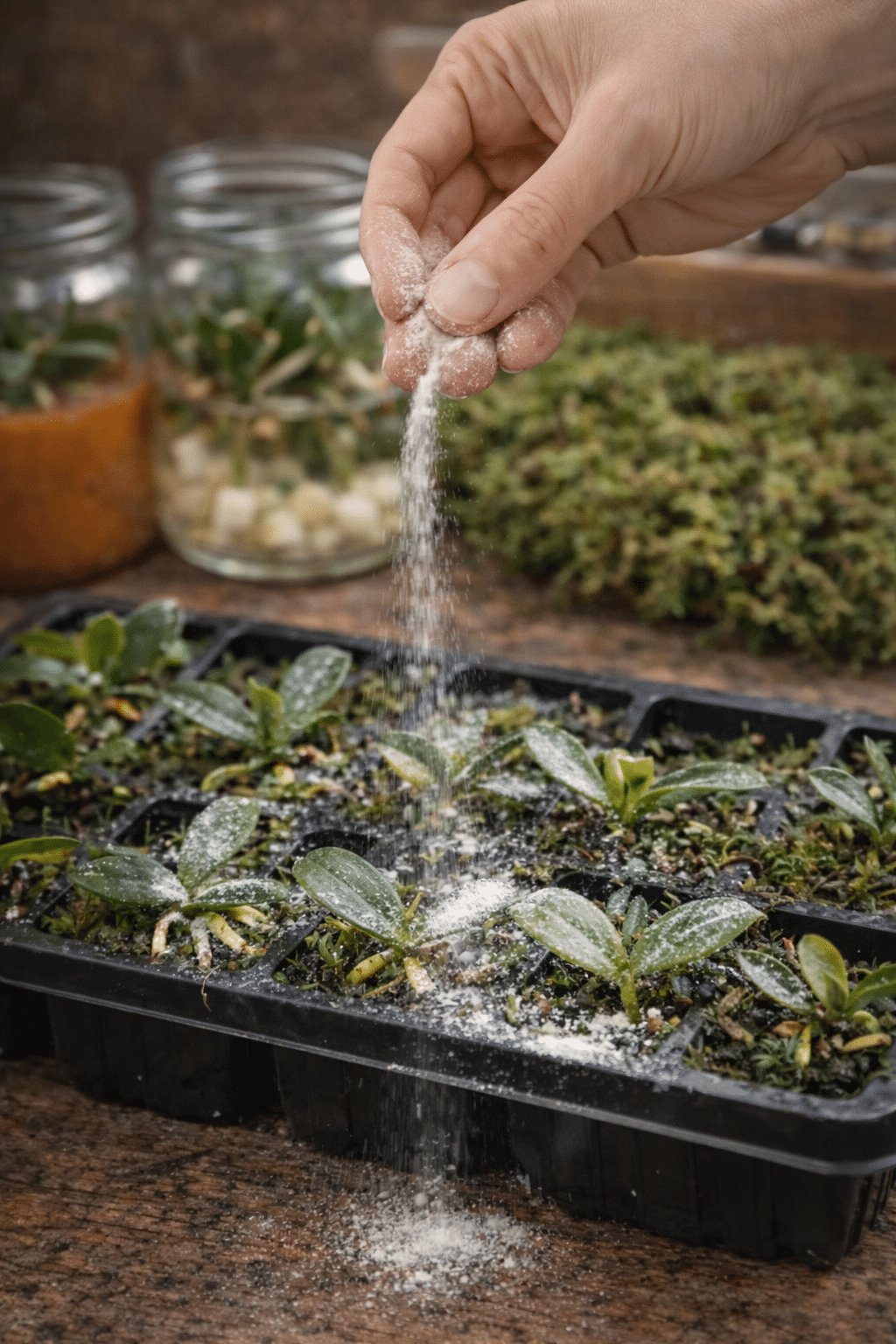
If you spend any time watching plant videos online, you have probably seen it.
A grower leans over a tray of tiny orchids, sprinkles a fine white powder across the surface, and suddenly the plants in the “after” shot look greener, stronger, and more established. It looks simple, mysterious, and almost magical.
So what is this white powder?
The honest answer is that it could be a few different things, and that is exactly why orchid lovers should be careful before copying the trick.
In orchid care, white powders are often used for very specific reasons. Some are meant to help with fungal issues. Some are used during propagation. Some are added only after trimming damaged roots. And some are just general mineral supplements that get overused in viral videos.
That means the powder itself is not really the secret. The secret is understanding what problem it is supposed to solve.
In this guide, we will uncover the most common white powders used on orchids, explain what each one actually does, and help you decide whether — and how — to use them safely.
Why People Use Powders on Orchids
Orchids are not grown like ordinary houseplants. Their roots need airflow, their growing medium (bark or moss) behaves differently from standard potting soil, and young orchids or weak orchids can be especially sensitive to excess moisture and rot.
Because of that, growers sometimes use powders to help with:
· Root cut protection – After trimming rotten or dead roots, cut surfaces are vulnerable to infection.
· Fungal control – Orchids in humid environments can develop surface mold or rot.
· Propagation support – When dividing orchids or starting keikis (baby plants), powders can encourage rooting.
· Surface moisture management – Some powders help keep the medium surface drier.
· Light mineral supplementation – Epsom salt or powdered fertilizers provide specific nutrients.
That is why powders show up so often in orchid videos. But each powder has a different purpose, and using the wrong one at the wrong time can do more harm than good.
The Most Common White Powders Used on Orchids
Let us break down the top contenders. Each has a specific use case, and none is a universal “miracle cure.”
- Rooting Hormone Powder (Most Likely for Tiny Orchids)
This is one of the most likely options when the powder is being used around very small orchid starts, cuttings, or propagated divisions. Rooting hormone powder contains auxins (plant hormones) that stimulate root growth.
Why growers use it:
· To support root formation on keikis (baby orchids) or divisions
· To help cut divisions establish faster
· To encourage early rooting after propagation, especially in high‑humidity trays
What it looks like: Fine white or grayish powder, often sold in small jars labeled “rooting hormone.”
How to use it: Dip the cut end of a stem or root into the powder before planting. For tray propagation, a light dusting on the growing medium surface is sometimes used, but less common.
Best for: Propagating orchids from keikis, back bulbs, or stem cuttings. Not for routine maintenance of mature plants.
- Powdered Fungicide
Orchid growers are always thinking about fungus, especially when working with seedlings, moss, or humid trays. A white powdered fungicide may be sprinkled lightly to help reduce fungal pressure on the surface.
Why growers use it:
· To help prevent fungal problems like botrytis or root rot
· To protect weak young plants in propagation trays
· To reduce disease pressure in humid growing environments
What it looks like: Fine white or off‑white powder, often sold as “sulfur powder” or a commercial fungicide (like Captan or Dithane). Some are wettable powders meant to be mixed with water.
How to use it: Light dusting on the medium surface or on cut areas. Always follow label directions — overuse can harm orchid roots.
Best for: Preventing fungal issues in propagation trays, after repotting, or when humidity is very high.
- Cinnamon Powder (The Home Remedy)
Cinnamon is one of the most common home orchid remedies. It is used on trimmed roots, damaged spots, or cut flower spikes because many growers believe it helps dry the area and discourage rot.
Why growers use it:
· After trimming bad roots or removing rotten tissue
· On damaged or dry areas to seal the wound
· As a simple, accessible home support treatment
What it looks like: Tan to light brown, not bright white. In some lighting and photos, it can appear off‑white. But true cinnamon is not a bright white powder.
How to use it: Dust lightly on cut surfaces. Do not pile it on. Avoid getting cinnamon on healthy roots or into the crown.
Best for: Home orchid owners who want a natural antifungal for cut wounds. Not a fertilizer or root stimulant.
- Epsom Salt or Powdered Fertilizer
Some people use mineral powders or powdered fertilizers and present them as miracle bloom boosters. Epsom salt is especially common in plant content because it sounds simple and harmless.
Why growers use it:
· To provide magnesium (Epsom salt) for chlorophyll production
· To support leaf color and overall health
· To give a light nutrient boost when dissolved in water
What it looks like: Epsom salt is white, crystalline, and granular. Powdered fertilizers vary — some are white, some are blue or green.
How to use it: Dissolve in water first. Sprinkling dry Epsom salt or fertilizer onto orchid bark can burn roots. The correct method is to dilute and apply as a liquid.
Best for: Addressing specific nutrient deficiencies (magnesium for Epsom salt) or general feeding when used as a diluted liquid. Not a “sprinkle and forget” product.
- Diatomaceous Earth
Less common but possible. Diatomaceous earth (DE) is a fine white powder made from fossilized algae. It is used to control soft‑bodied pests like fungus gnats, thrips, and mealybugs.
Why growers use it:
· To deter or kill pests on the soil surface
· To dry out fungus gnat larvae in the medium
What it looks like: Very fine, powdery, bright white to off‑white.
How to use it: Light dusting on dry medium. It works by dehydrating insects. Do not breathe it in.
Best for: Pest control, not growth or blooming.
Continue to Page 2
Continue to page 2 for more details about this article and the key points many readers miss on the first page.