Should You Fertilize Christmas Cactus?
Yes, but lightly and at the right time. A balanced houseplant fertilizer at half strength can be used during spring and summer when the plant is actively growing. Stop or reduce feeding before and during bloom season.
A good schedule:
- Spring: begin feeding after new growth appears
- Summer: feed monthly at half strength
- Early fall: stop regular feeding and begin bud‑setting conditions
- Bloom time: avoid heavy fertilizer
- After bloom: let the plant rest
Do not use Epsom salt and regular fertilizer at the same time. Separate them by at least two weeks.
How to Make the Plant Fuller
A fuller Christmas cactus comes from pruning, light, root health, and time. Sprinkling crystals will not instantly make the plant bushy. But a healthy care routine will encourage branching and more bloom points.
Prune After Blooming
After flowering is finished, pinch or twist off one or two segments from long stems. This encourages branching. Each new branch can eventually create more flower tips.
Give Bright Indirect Light
Good light supports compact growth. A plant grown in weak light may become thin and sparse.
Do Not Overpot
A slightly snug pot often encourages better flowering. A very large pot can lead to root focus instead of top growth and may hold too much moisture.
Feed During Growth
Light feeding in spring and summer supports the plant as it builds energy for the next bloom cycle.
How to Prune Christmas Cactus for More Buds
Pruning is one of the best ways to encourage a fuller plant. The best time is after blooming, not when buds are forming.
- Wait until flowering is finished.
- Choose long or uneven stems.
- Twist off one or two segments at the joint.
- Do not cut through the middle of a segment unless necessary.
- Let the plant rest afterward.
- Use removed segments for propagation.
Pruning creates more branch tips, and more branch tips can mean more places for buds to form later.
How to Propagate Removed Segments
Christmas cactus is easy to propagate from stem segments.
- Take a cutting with 2 to 4 segments.
- Let it dry for 24 hours.
- Place the bottom segment into lightly moist potting mix.
- Keep in bright indirect light.
- Do not overwater.
- Roots usually develop in a few weeks.
This is a great way to create fuller pots over time. You can even plant several rooted cuttings together to make a denser display.
Can Epsom Salt Increase Bud Count?
It may help only indirectly if the plant is low in magnesium. A healthy plant with proper bud‑setting conditions may respond well to balanced care. But Epsom salt alone will not increase bud count if the plant is kept in warm nights and constant artificial light.
For more buds, prioritize:
- Correct fall darkness
- Cooler nights
- Bright indirect light
- Stable watering
- Post‑bloom pruning
- Light feeding in spring and summer
Use Epsom salt only as a minor support.
Can White Crystals Burn the Roots?
Yes. Any mineral salt can burn roots if used too heavily. Even Epsom salt can cause problems when overused. Potted plants are especially vulnerable because minerals can build up in the soil over time.
Signs of too much mineral buildup include:
- White crust on soil or pot edges
- Brown stem tips
- Wilting even when soil is moist
- Yellowing segments
- Root stress
- Reduced growth
If you see buildup, flush the soil with clean water and avoid supplements for a while.
How to Flush the Soil Safely
Flushing helps remove excess mineral salts from the potting mix.
- Take the plant to a sink or tub.
- Use room‑temperature water.
- Pour water slowly through the soil.
- Allow it to drain from the bottom.
- Repeat once or twice.
- Let the pot drain completely.
- Do not leave it sitting in water.
Flush only when the plant is due for watering. Do not keep the plant constantly wet.
What If the Plant Already Has Buds?
If your Christmas cactus already has buds, be careful. This is not the best time to experiment with new tricks. Buds are sensitive. A sudden change in fertilizer, watering, light, temperature, or location can cause them to drop.
During bud stage:
- Keep the plant in the same location
- Water consistently
- Avoid heavy feeding
- Avoid strong supplements
- Protect from drafts
- Keep away from heaters
- Do not rotate excessively
If you want to use Epsom salt, do it earlier in the season, before buds are fully formed.
What If the Plant Is Not Blooming at All?
If your Christmas cactus is not blooming, do not assume it needs white crystals. Most non‑blooming problems come from light and temperature.
Ask yourself:
- Does the plant get long nights in fall?
- Is it exposed to lamps at night?
- Are night temperatures too warm?
- Is it getting bright indirect light during the day?
- Is the plant mature enough?
- Is the pot too large?
- Was it pruned at the right time?
- Is it overwatered or underwatered?
Correcting these issues will do more than adding Epsom salt.
How to Use This Trick in a Full Bloom Plan
Here is a safe yearly routine for a fuller bloom display.
After Blooming
Let the plant rest. Remove spent flowers. Water lightly as needed. After a few weeks, prune lightly to encourage branching.
Spring
Move the plant to bright indirect light. Begin light feeding once new growth appears. Use balanced fertilizer at half strength. If desired, use one very diluted Epsom salt watering, separate from fertilizer.
Summer
Keep the plant bright but protected from harsh sun. Water when the top inch dries. Feed lightly once a month. Avoid overwatering.
Early Fall
Stop heavy feeding. Begin bloom‑trigger conditions with longer nights and cooler temperatures. Use one final gentle magnesium watering only if the plant is healthy and you have not recently fertilized.
Bud Formation
Keep conditions stable. Do not move the plant. Do not use strong supplements. Water consistently.
Bloom Time
Enjoy the flowers. Keep away from heat vents, cold drafts, and sudden changes.
Best Homemade Bloom Support That Is Not Risky
Instead of relying on crystals, you can support blooms with safer habits:
- Place the plant near bright indirect light
- Use a breathable potting mix
- Keep the pot slightly snug
- Prune after bloom
- Give long dark nights in fall
- Keep nighttime temperatures cooler
- Avoid overwatering
- Avoid moving the plant during bud stage
These are the true “smart homeowner” methods. The white crystals are only a small optional addition.
Common Mistakes With Christmas Cactus
Mistake 1: Treating It Like a Desert Cactus
Christmas cactus is a tropical cactus. It likes more moisture and organic matter than desert cactus, but still needs drainage.
Mistake 2: Keeping It Too Wet
Soggy soil can rot the roots. Water when the top inch dries, not every day.
Mistake 3: Moving It After Buds Form
Sudden relocation can cause bud drop. Choose a good spot before buds develop and leave it there.
Mistake 4: Using Strong Fertilizer During Bloom
Heavy feeding during bud or bloom stage can stress the plant. Feed during active growth instead.
Mistake 5: Using Table Salt
Table salt is harmful to plants. Never use it as a bloom booster.
Mistake 6: Ignoring Night Darkness
Christmas cactus needs long nights to set buds. Artificial light at night can interfere with flowering.
Quick Safe Recipe Card
Gentle White Crystal Bloom Support for Christmas Cactus
Ingredients
- 1 quart room‑temperature water
- 1/4 teaspoon Epsom salt
Instructions
- Add Epsom salt to water.
- Stir until completely dissolved.
- Use only when the plant is healthy.
- Apply only when the top inch of soil is dry.
- Pour gently onto the soil, not over the stems.
- Let the pot drain fully.
- Use no more than once every 4 to 6 weeks during active growth.
- Do not use at the same time as regular fertilizer.
- Do not use table salt or sugar.
Short Caption for This Trick
For Christmas cactus, the safest “white crystal” trick is a very weak Epsom salt solution, not table salt. Dissolve 1/4 teaspoon Epsom salt in 1 quart of water and use it only occasionally when the plant is healthy and the soil is ready for watering. This may support greener growth if magnesium is low, but it will not force blooms by itself. For more buds, give bright indirect light, cooler nights, long darkness in fall, steady watering, and avoid moving the plant once buds appear.
Frequently Asked Questions
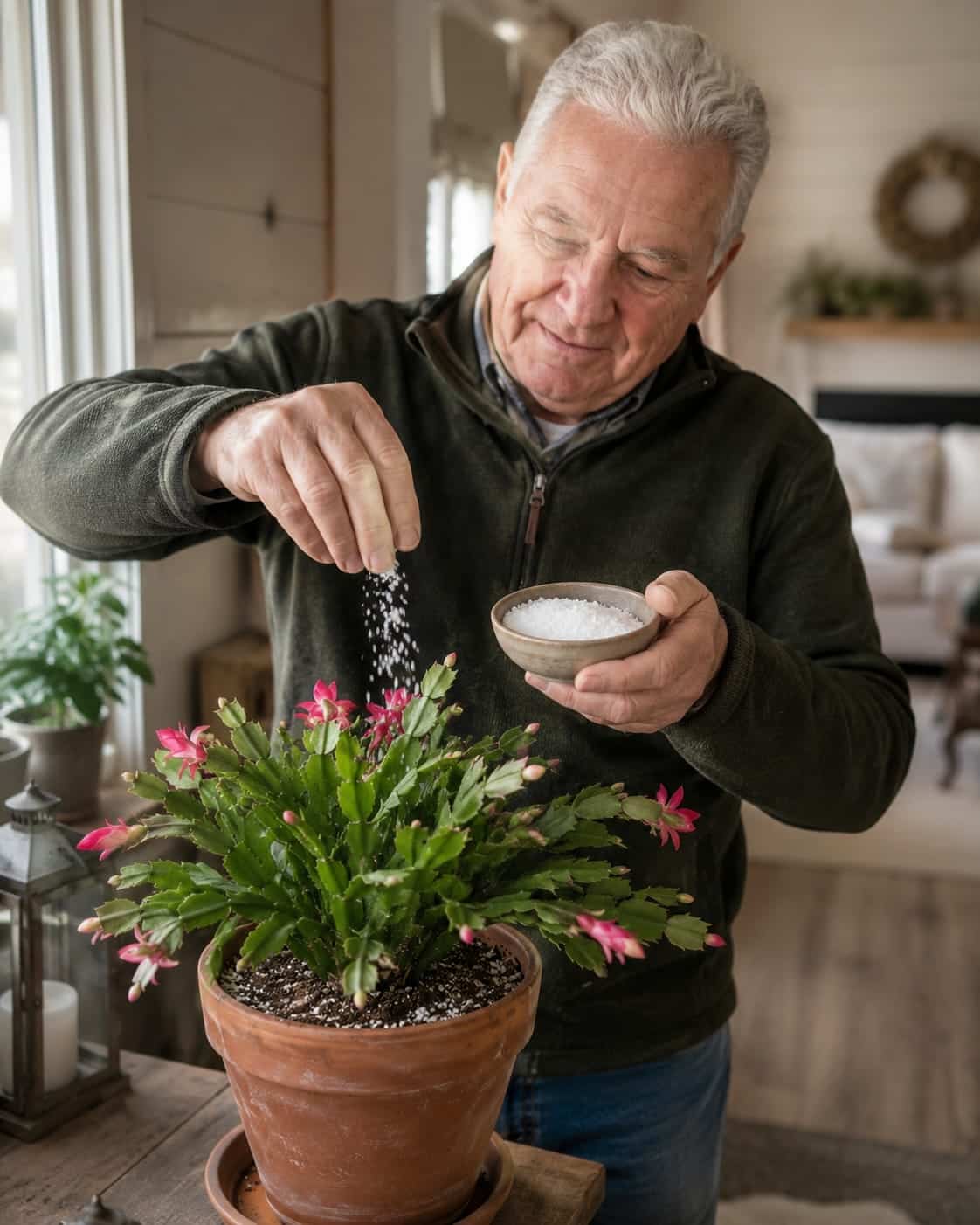
What are the white crystals being sprinkled on Christmas cactus?
They are best interpreted as Epsom salt, but it should be dissolved in water and used very lightly. Do not use table salt.
Can Epsom salt help Christmas cactus bloom?
It may support plant health if magnesium is low, but blooms depend mainly on long dark nights, cooler temperatures, bright indirect light, and stable care.
How much Epsom salt should I use?
Use 1/4 teaspoon dissolved in 1 quart of water. Apply only occasionally.
Can I sprinkle dry Epsom salt directly on the soil?
It is safer to dissolve it first. Dry crystals can create concentrated spots that may stress roots.
Can I use table salt?
No. Table salt can damage roots and harm the plant.
Can I use sugar instead?
No. Sugar can attract pests, feed mold, and create soil problems.
How often should I use Epsom salt on Christmas cactus?
No more than once every 4 to 6 weeks during active growth, and not during heavy bloom or when the plant is stressed.
Why is my Christmas cactus not blooming?
It likely needs longer nights, cooler temperatures, better light, or more stable watering. Lack of blooms is usually not caused by missing Epsom salt.
Why are buds falling off?
Bud drop can happen from sudden movement, inconsistent watering, hot dry air, cold drafts, or stress during bud formation.
When should I prune Christmas cactus?
Prune after flowering is finished. Pinching back segments encourages branching and can create more bloom points later.
Final Thoughts
The image of white crystals being sprinkled onto a Christmas cactus is eye‑catching, but this trick needs careful explanation. The smart version is not table salt, not sugar, and not a heavy layer of random powder. The only reasonable version is a tiny amount of Epsom salt used as a mild magnesium supplement, and even that should be dissolved in water and applied sparingly.
Christmas cactus blooms because it receives the right seasonal signals. Long nights, cooler temperatures, bright indirect daytime light, and stable watering are the real keys. A plant that gets those conditions can produce a beautiful display of buds and flowers. A plant that does not get those conditions may refuse to bloom no matter what crystals are added to the soil.
Use the white crystal trick as a small support, not the foundation of care. Keep the plant in airy soil. Use a pot with drainage. Water when the top inch dries. Feed lightly in spring and summer. Prune after blooming to encourage branching. In fall, give the plant long dark nights and cooler temperatures. Once buds appear, avoid moving or stressing it.
With that routine, your Christmas cactus can become fuller, stronger, and more generous with blooms. The flowers will not come from one magic sprinkle. They will come from understanding the plant’s rhythm and giving it the right care at the right time. Used wisely, a gentle Epsom salt solution may support the process, but the true magic is simple, patient, seasonal care.