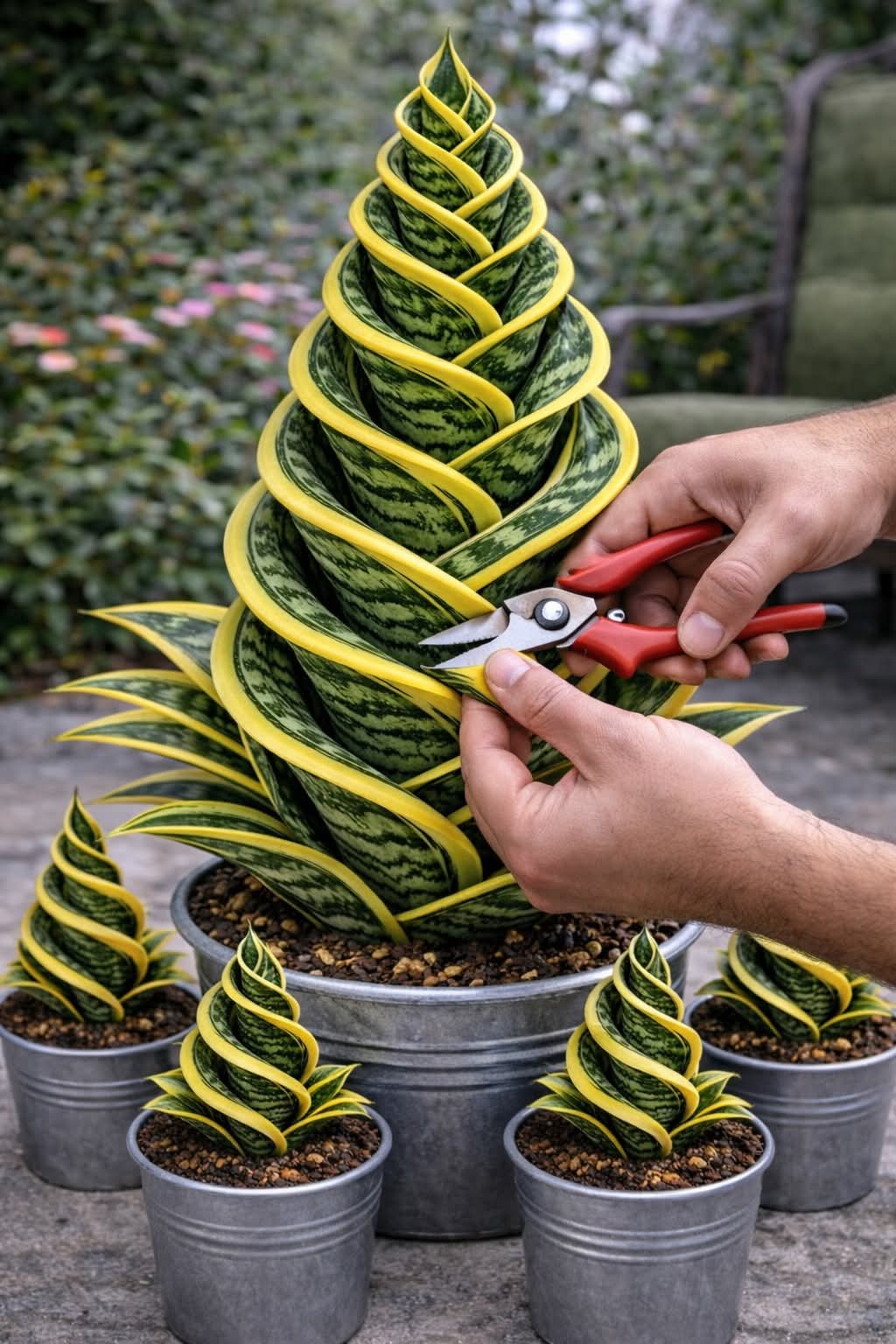
Let’s be honest: snake plants are already beloved for their easy-care nature and architectural leaves. But if you want to take your plant collection to the next level, spiral snake plants are where it’s at. Some of these varieties grow in mesmerizing curls all on their own, while others can be gently trained into a graceful spiral shape with a little patience.
In this guide, I’ll introduce you to 10 of the best spiral snake plant varieties — both naturally spiraling types and those that are perfect for training. Plus, I’ll share tips on how to care for them and shape them yourself.
Let’s dive in.
🌿 Naturally Spiraling Varieties (No Training Required)
These varieties already grow in a naturally twisted, curled, or fan‑shaped pattern, making them the perfect low‑effort choice for that sculptural look.
- Sansevieria ‘Twisted Sister’ (Gold Twist Snake Plant)
If you want a plant that naturally curls and spirals without any shaping, this compact variety is perfect. You’ll spot it easily by its short, wavy leaves with bold yellow edges and deep green centers. The leaves curve and twist lengthwise as they emerge from the base, forming a tight rosette cluster.
· Size: About 10–15 inches tall, 8–10 inches wide.
· Light: Bright, indirect sunlight. Color becomes stronger with enough light.
· Water: Let the top inch of soil dry out before watering.
· Pro Tip: Rotate the pot once a month to keep the curl symmetrical.
- Sansevieria ‘Hahnii’ (Bird’s Nest Snake Plant)
This dwarf variety forms compact rosettes that mimic a coiled or circular plant base. It doesn’t form perfect spirals, but the combination of dark green leaves and pale yellow spots makes it a beautiful centerpiece for a dining table or work desk.
· Size: 6–10 inches tall.
· Light: Tolerates low light but thrives in bright, indirect light.
· Water: Very drought‑tolerant; water only when soil is completely dry.
- Sansevieria cylindrica ‘Boncel’ (Starfish Snake Plant)
This compact cultivar features robust, cylindrical leaves that spiral outward, creating a fascinating fan‑like display. The dark green leaves are adorned with lighter green bands, and the plant grows in a fan‑shaped rosette, resembling a starfish.
· Size: Up to 2 feet tall, 1 foot wide.
· Light: Bright, indirect light. Avoid harsh afternoon sun.
· Water: Extremely drought‑tolerant; water once every 2–3 weeks in summer, once a month in winter.
· Pro Tip: Use a pot with drainage holes to prevent root rot.
- Sansevieria ‘Spiral Queen’
This hybrid variety is aptly named the “Queen” with its royal curls that stand out among the rest. It has a compact growth pattern, making it perfect for table corners or work desks.
· Size: Compact, ideal for small spaces.
· Light: Bright, indirect light.
· Water: Let soil dry completely between waterings.
- Sansevieria ‘Fernwood Mikado’
This variety grows with thin, round leaves that come up like a little fountain. It doesn’t spiral much at first, but over time, you’ll notice a gentle coil forming as it grows taller. Its leaves have tiger‑like stripes, giving them a textured look.
· Size: Moderate, fits nicely in small spaces.
· Light: Bright, indirect light.
· Water: Keep soil slightly more evenly moist than the usual snake plant, but still let the potting medium dry out well before saturating again.
· Pro Tip: Plant three small ‘Fernwood’ in one low, wide pot at different heights to make the spiral effect look fuller without any shaping.
🌿 Varieties Perfect for Training into Spirals
These varieties don’t naturally spiral, but their flexible leaves make them excellent candidates for training.
- Sansevieria cylindrica (African Spear Plant)
This plant has long, cylindrical leaves that are naturally easier to train into a spiral compared to flatter‑leafed varieties. It also comes in pre‑trained “braided” or “spiral” forms sold at nurseries.
· Size: Up to 2–3 feet tall.
· Light: Bright, indirect light.
· Water: Very drought‑tolerant; water only when soil is completely dry.
· Pro Tip: Buy a young plant, as older leaves are stiffer and harder to bend without snapping.
- Dracaena angolensis (Dragon Fingers)
This variety has several shoots braided tightly into a neat spiral column, often sold as “Dragon Fingers.” It stays compact for years and adds a clean, sculptural look to any shelf or desk.
· Size: Compact, stays small for years.
· Light: Bright, indirect light.
· Water: Very drought‑tolerant; skip watering occasionally without harm.
· Pro Tip: Use a tall, narrow pot to match its upright style and highlight the spiral bundle perfectly.
- Sansevieria francisii
This rare plant naturally has a spiral growth pattern. It’s a great candidate for shaping, and you can use a spiral frame to guide its leaves into a neat coil.
· Size: Moderate.
· Light: Bright, indirect light.
· Water: Let soil dry out between waterings.
· Pro Tip: This variety responds well to gradual training methods.
- Dracaena ‘Laurentii’
This classic variety of tall snake plant with yellow leaf margins can develop flowing spirals when trained or when grown under uneven lighting conditions. You’ll need a bit of space to showcase this beauty as it can reach up to 6 feet in optimal conditions.
· Size: 3–4 feet tall indoors, up to 6 feet in optimal conditions.
· Light: Bright, indirect light.
· Water: Low water needs; let soil dry completely.
· Pro Tip: Use a support frame to guide the tall leaves into a spiral as they grow.
- Sansevieria ‘Bantel’s Sensation’ (White Snake Plant)
This striking variety has narrow, white‑striped leaves that grow up to 3 feet tall. While not naturally spiraling, its slender, flexible leaves make it a good candidate for gentle shaping.
· Size: Up to 3 feet tall.
· Light: Bright, indirect light.
· Water: Low water needs; let soil dry completely.
· Pro Tip: Its slower growth rate makes it ideal for gradual training over several months.
🌱 How to Train Your Snake Plant into a Spiral Shape
If you’ve chosen a variety that doesn’t naturally spiral, don’t worry — with a little patience and the right technique, you can train it yourself. Remember, the spiral is manually trained by carefully guiding the young, flexible leaves around a cylindrical form and letting the plant grow into that shape over time.
Here’s a step‑by‑step guide:
Step 1: Choose the Right Plant
Start with a young snake plant. The leaves of older plants are stiff and can break if you bend them too much. Varieties like Sansevieria cylindrica, ‘Laurentii’, or ‘Zeylanica’ work well.
Step 2: Get a Support Frame or Trellis
You can find pre‑made spiral training frames, or DIY one using sturdy wire or a reshaped tomato cage. Push the central stake of the frame into the soil, close to the plant’s base — be gentle to avoid damaging the roots or leaves.
Step 3: Shape Your Plant
Gently bend the leaves in the direction of your spiral. Don’t rush this step; snake plant leaves can snap if forced. Use soft plant ties like Velcro or foam‑covered wire to secure them without cutting into the leaves. Start with the longest, most flexible leaves first, tying them to the frame from the base up.
Step 4: Encourage Even Growth
Rotate your plant regularly so that all sides get equal light and grow evenly instead of leaning in one direction. Since snake plants grow slowly indoors, expect to keep the ties on for a few months before seeing a noticeable spiral shape.
Step 5: Be Patient
Training takes time — often several months. The gradual twist method, where you rotate the leaves a few degrees at a time over weeks, works well. Mark the direction of your twist on the pot rim with a small arrow to stay consistent.
Can Banana Peels Really Boost Orchid Growth? Continue to Page 2
Discover the safer method, the real risks, and the smart orchid care details that many gardeners miss on the first page.