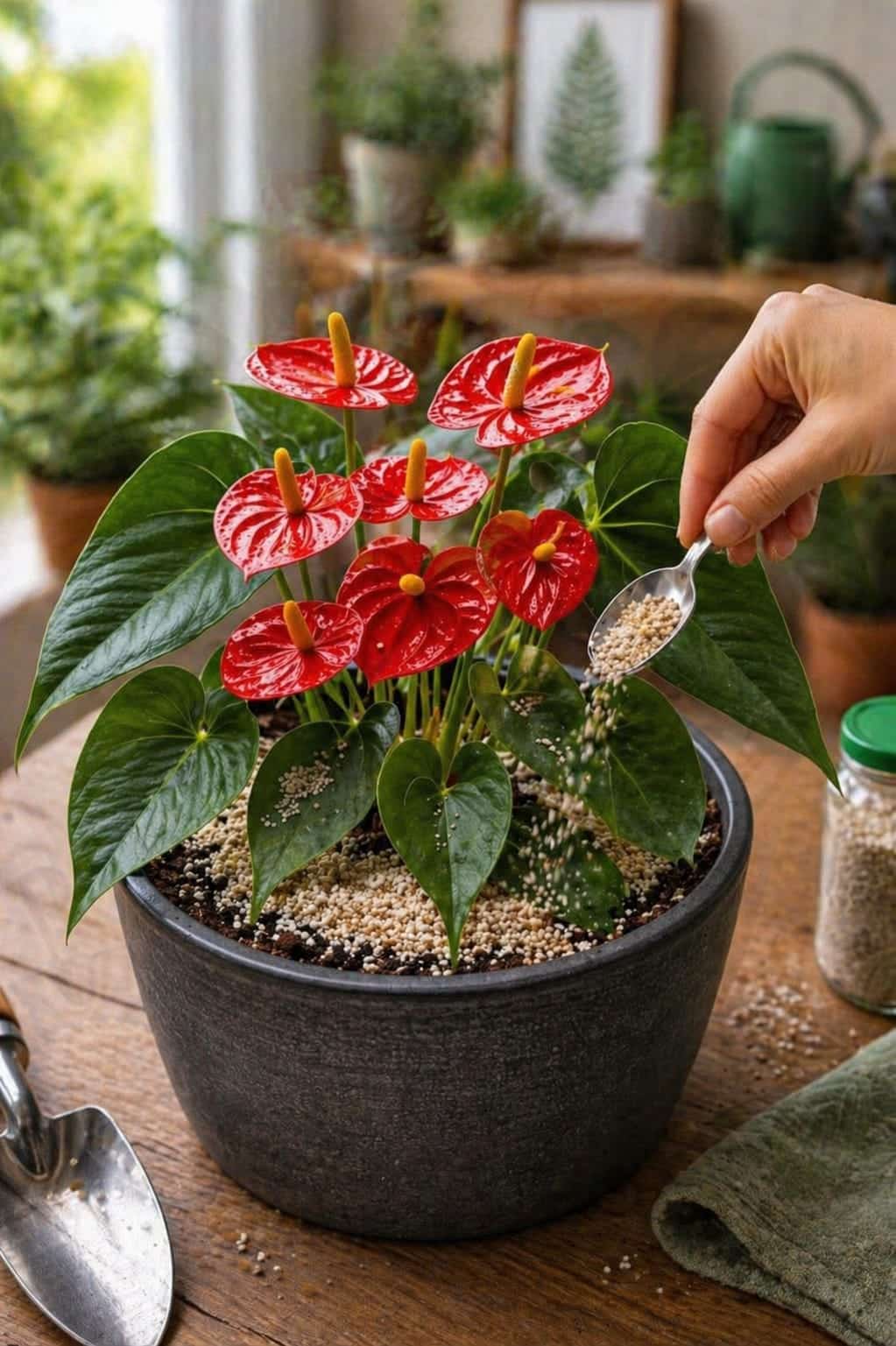
Anthuriums are one of the most eye‑catching houseplants you can own. Their glossy, heart‑shaped leaves and vibrant, waxy blooms in shades of red, pink, white, and even purple instantly elevate any space. They bring a touch of the tropics to living rooms, offices, and bathrooms. But keeping them blooming consistently? That is where many plant lovers struggle.
You water them regularly. You place them near a window. Yet the flowers become sparse, smaller, or stop appearing altogether. Then you see a viral video or social media post: someone sprinkling small granules or “magic powder” onto the soil of a stunning, blooming anthurium. The caption promises: “Do this and your anthurium will explode with flowers.”
It looks easy. It looks effective. But does this simple trick really boost blooms? And is it safe for your plant? In this guide, we will uncover what those granules usually are, how they can help, the risks of using them incorrectly, and — most importantly — the proven care routine that keeps anthuriums thriving and flowering year after year.
Why This “Simple Trick” Looks So Effective
The visual is powerful: a healthy, blooming anthurium with glossy leaves and bright red spathes, granules added neatly on top of the soil, and a clean, styled setup. It creates the idea that “this is the secret behind all those flowers.”
But just like most plant trends, the truth is a bit deeper. The granules are rarely a magic powder or an unknown ingredient. They are almost always a slow‑release fertilizer or balanced nutrient pellets designed to feed plants over time. When used correctly, they can absolutely help. However, they are not a shortcut. A struggling anthurium will not be saved by fertilizer alone.
In this article, we will separate the hype from the horticulture. You will learn what those granules really are, how they benefit anthuriums, the risks of overusing them, and the complete care routine that turns a surviving anthurium into a blooming showpiece.
What Those Granules Usually Are (No Mystery)
In most viral plant videos, the granules or “magic powder” are not random kitchen spices or unknown chemicals. They are almost always:
· Slow‑release fertilizer pellets – Such as Osmocote, Jobe’s, or a generic balanced formula (e.g., 10‑10‑10 or 14‑14‑14).
· Balanced nutrient pellets – Designed for houseplants or blooming plants, often with added micronutrients.
· Mineral‑enriched plant food – Sometimes formulated specifically for anthuriums or aroids.
These are not mysterious hacks. They are commercially available, plant‑safe products that release nutrients gradually over weeks or months. When sprinkled on the soil surface and watered in, they provide a steady supply of essential elements.
Why Slow‑Release Fertilizer Works for Anthuriums
Anthuriums are not heavy feeders, but they do need consistent nutrition to produce those iconic flowers. A slow‑release fertilizer provides:
· Nitrogen (N) – For healthy, glossy leaf growth.
· Phosphorus (P) – The key nutrient for flower production (bloom booster).
· Potassium (K) – For overall plant strength, root health, and disease resistance.
· Micronutrients – Iron, magnesium, calcium, etc., which prevent yellowing and support metabolism.
The advantage of slow‑release granules is that you apply them once every few months, and the plant gets a steady, low dose of nutrients with each watering. This is much safer than liquid fertilizers, which can burn roots if overused.
Why Fertilizer Can Help Anthuriums Bloom More
Anthuriums are tropical perennials. In their native rainforest environment, they receive a constant supply of organic matter from decomposing leaves and consistent moisture. Indoors, potting mix eventually becomes depleted. Without enough phosphorus and potassium, the plant may grow leaves but will not produce flowers.
How Nutrients Support Blooming:
· Phosphorus – Directly stimulates flower bud formation. A fertilizer with a higher middle number (e.g., 10‑20‑10) encourages blooming.
· Potassium – Improves stem strength and flower longevity.
· Magnesium – Essential for chlorophyll production; helps leaves stay green and photosynthesize efficiently.
· Calcium – Supports cell wall development, leading to stronger stems and healthier blooms.
When you add slow‑release granules, you are essentially replenishing the soil’s nutrient bank. Over several weeks, the plant absorbs these nutrients and can redirect energy from leaf growth to flower production.
But Here’s the Important Part ⚠️ (Fertilizer Is Not a Cure‑All)
Fertilizer is helpful — but only if the basics are already right. If your anthurium is struggling due to low light, overwatering, poor drainage, or low humidity, adding more nutrients will not fix the problem. In fact, it can make things worse by stressing the roots further.
Think of fertilizer as a vitamin supplement for a healthy person. It helps you thrive, but it does not cure a disease. Similarly, anthuriums need the right environment first. Only then can a nutrient boost make a difference.
Signs Your Anthurium Needs Better Care Before Fertilizer:
· Yellowing leaves (usually overwatering or poor drainage).
· Brown, crispy leaf edges (low humidity or fluoride in tap water).
· Drooping stems even when soil is moist (root rot).
· No new leaves for months (too little light).
· White crust on soil surface (salt buildup from over‑fertilizing).
If you see any of these, fix the underlying issue before adding granules.
What Actually Makes an Anthurium Bloom More (The Full Formula)
To get more flowers, focus on these essentials first. These are the proven, non‑negotiable factors that anthuriums need to produce those stunning, long‑lasting blooms.
- Bright Indirect Light (The #1 Bloom Trigger)
Anthuriums need bright, filtered light to bloom. Too little light, and they will grow leaves but no flowers. Too much direct sun, and the leaves will scorch.
· Ideal placement: East‑facing window, or a south/west window with a sheer curtain.
· How much: 10–12 hours of bright indirect light daily.
· Signs of too little light: Dark green leaves, long stems reaching toward light, no blooms.
· Signs of too much light: Yellow or bleached leaves, brown spots.
If your anthurium has never bloomed for you, moving it closer to a window is the single most effective change you can make.
- Proper Watering (Not Too Wet, Not Too Dry)
Anthuriums like consistently moist soil, but they hate soggy roots. Overwatering leads to root rot, which stops flowering.
· Water when the top inch of soil feels dry – Stick your finger in.
· Water thoroughly until it runs from the drainage holes. Empty the saucer.
· In winter, water less often (every 7–10 days).
Use room‑temperature, filtered water if possible. Hard tap water can cause brown leaf tips.
- High Humidity (60–80% is Ideal)
Anthuriums are tropical plants. They thrive in humid environments. Dry indoor air (especially in winter) reduces flowering and causes leaf edges to crisp.
· Use a humidifier near the plant.
· Place the pot on a pebble tray with water (the pot should not sit in the water).
· Group plants together to create a microclimate.
· Mist lightly in the morning (do not mist the flowers).
- Well‑Draining Soil (Prevents Root Rot)
Anthuriums need a light, airy potting mix that allows water to flow through quickly.
· Best mix: 2 parts all‑purpose potting soil + 1 part perlite + 1 part orchid bark.
· Avoid: Heavy garden soil or moisture‑retentive mixes.
· Always use a pot with drainage holes.
Healthy roots are the foundation of healthy blooms.
- Balanced Feeding (Where Granules Come In)
Once the environment is right, a light feeding routine supports flowering.
· Slow‑release granules: Apply once every 2–3 months during spring and summer. Use a balanced formula (10‑10‑10) or one with higher phosphorus (10‑20‑10).
· Liquid fertilizer: Use a half‑strength balanced fertilizer every 2–4 weeks during active growth.
· Do not fertilize in fall and winter – the plant rests.
Continue to Page 2
Continue to page 2 for more details about this article and the key points many readers miss on the first page.