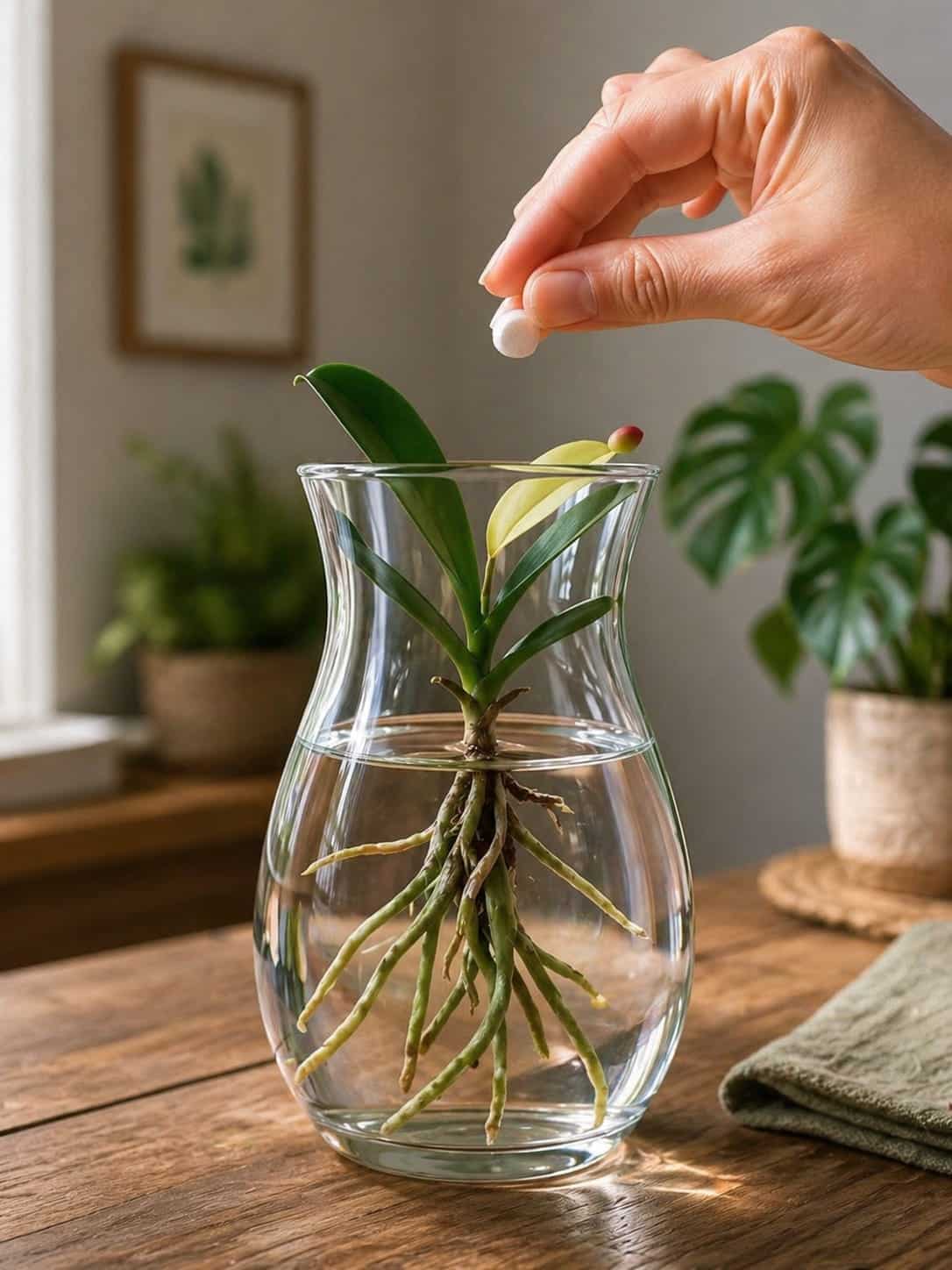
Orchids are elegant, delicate, and sometimes… frustrating. They are among the most popular flowering houseplants, prized for their long‑lasting blooms and exotic beauty. But when they stop blooming, when their roots look weak and shriveled, or when the leaves turn yellow, many plant lovers start searching for simple solutions. That is why viral tricks — like dropping a small tablet into the water for orchids — have caught so much attention.
It looks effortless. It feels scientific. The image of a clear glass vase, visible roots, and a single tablet being added as a “boost” creates the impression that one simple step will transform your orchid. But is it actually helping your orchid, or is it just another internet illusion?
In this guide, we will uncover what that tablet might be, the risks of using random additives in orchid water, why water culture is already a delicate balance, and — most importantly — the proven, science‑backed care that will keep your orchid’s roots healthy and its blooms coming back year after year.
Why This Trick Looks So Convincing
The image tells a powerful story: a clean glass vase with visible roots, clear water suggesting purity and control, and a tablet being added like a “boost.” It creates the impression that a single tablet can transform your orchid. But plants — especially orchids — do not work like instant formulas.
Orchids are epiphytes. In nature, they grow attached to trees with their roots exposed to air and rain. Their roots are adapted to absorb water quickly and then dry out. When we grow them in pots or in water culture, we are already introducing stress. Adding unknown tablets without understanding their composition can cause more harm than good.
The viral videos rarely explain what the tablet is. They do not show the weeks of proper care that came before. They do not disclose that the plant may have been recently repotted or given better light. The tablet gets the credit, but the real improvement — if any — likely came from something else.
What That Tablet Might Be (And What It Actually Does)
In videos like this, the tablet is rarely explained clearly. It could be any number of substances, each with very different effects — and not all are safe for orchids.
- Aspirin (Acetylsalicylic Acid)
Some gardeners use aspirin to boost plant immunity. It contains salicylic acid, which can trigger a defense response in some plants. However, aspirin is not a fertilizer, and its effects on orchids are not well studied. Too much aspirin can lower the pH of the water and stress the roots.
- Vitamin Tablets (B‑Complex, Vitamin C, etc.)
Human vitamins are not formulated for plants. They may contain binders, sugars, and dosages that are far too high for delicate orchid roots. Vitamins can also encourage bacterial growth in standing water.
- Fertilizer Tablets (Slow‑Release or Water‑Soluble)
These are the most plausible beneficial tablets. A balanced, orchid‑specific fertilizer tablet can provide nutrients. However, for orchids in water culture, even these need to be used at very low concentrations. A whole tablet in a small vase is likely far too strong.
- Mineral Supplements (Calcium, Magnesium, etc.)
Some tablets contain calcium or magnesium, which are important for cell wall structure and chlorophyll production. But orchids usually get these from tap water or potting mix. Adding a supplement without a known deficiency is unnecessary and can cause buildup.
- Epsom Salt (Magnesium Sulfate) in Tablet Form
Epsom salt can correct magnesium deficiency, but it is not a general fertilizer. Use only if specific deficiency symptoms appear (yellowing between leaf veins).
👉 The bottom line: Without knowing exactly what the tablet is, you should never add it to your orchid’s water.
The Risk of Using Random Tablets in Orchid Water
Orchids are sensitive plants, especially their roots. Unlike many houseplants, orchid roots are covered with a spongy tissue called velamen that absorbs water and nutrients quickly but also needs to dry out. They are not designed to sit in water with unknown chemicals.
Using unknown tablets in water can lead to:
· Chemical imbalance – Sudden changes in pH or nutrient concentration can shock the roots.
· Root burn – Concentrated salts from tablets can desiccate and kill tender root tips.
· Bacterial growth – Tablets may contain binders or sugars that feed harmful bacteria, clouding the water and rotting roots.
· Cloudy or stagnant water – This is a sign of microbial overgrowth, which starves roots of oxygen.
· Damaged root systems – Once roots are damaged, they cannot absorb water or nutrients, leading to leaf loss and plant decline.
👉 Orchid roots need clean, oxygen‑rich conditions — not unpredictable additives. Even if the tablet is a genuine orchid fertilizer, the dosage is critical. A whole tablet meant for a gallon of soil mix in a small vase of water is almost certainly too strong.
Why Water Culture Orchids Are Already Sensitive
Growing orchids in water (often called “water culture” or “semi‑hydro”) is a method some orchid enthusiasts use, but it is not without challenges. In nature, orchid roots are exposed to air. When we submerge them in water, we reduce oxygen availability.
Roots in water culture need:
· Clean water – No stagnation, no microbial growth.
· Air circulation – Some growers use an air stone to oxygenate the water.
· Regular water changes – At least once a week to prevent rot.
· Very dilute nutrients – Full‑strength fertilizer will burn roots.
Adding random tablets disrupts this delicate balance. Even a small change in pH or salt concentration can trigger root rot. If you choose to grow orchids in water, the safest approach is to use plain, filtered water and change it frequently. No tablets.
When “Tablet Tricks” Seem to Work (The Real Reason)
Sometimes people see improvement after using a tablet — but the reason is often different. The improvement is usually from better care — not the tablet itself.
Common reasons for a plant’s improvement that have nothing to do with the tablet:
· The plant was recently cleaned or repotted – Removing dead roots and old bark can make a plant look healthier overnight.
· Water was refreshed – Simply changing stagnant water to fresh, oxygenated water helps roots recover.
· Roots were already recovering – Orchids often go through cycles of root growth; a new root tip may appear coincidentally after the tablet was added.
· Light or temperature improved – The owner may have moved the plant to a brighter spot without mentioning it.
· The plant was due to bloom – Orchids bloom seasonally; the tablet had nothing to do with it.
The tablet gets the credit, but the real work was done elsewhere.
Continue to Page 2
Continue to page 2 for more details about this article and the key points many readers miss on the first page.