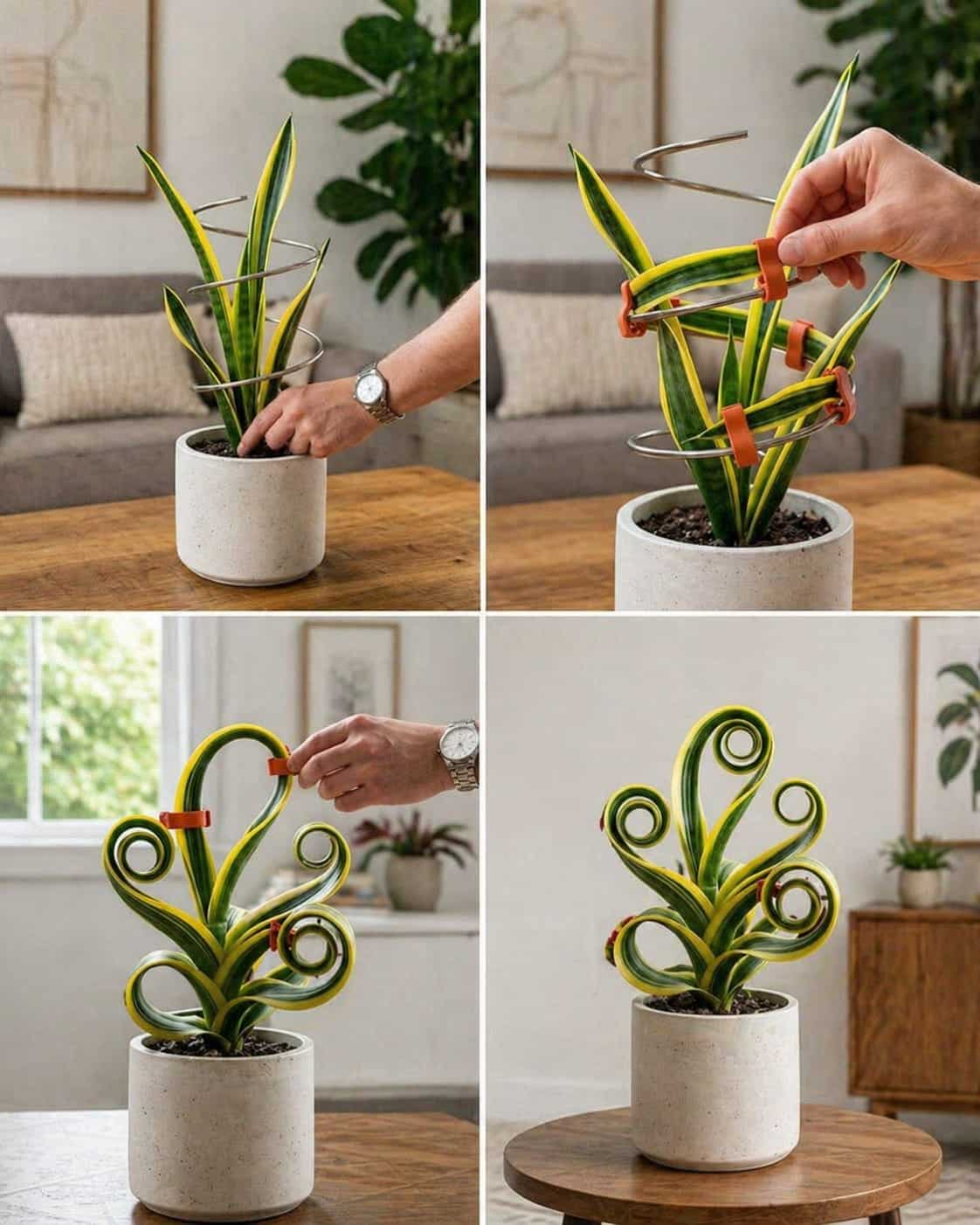
Houseplants are no longer just background greenery. Today, plant lovers are turning ordinary indoor plants into living sculptures, natural centerpieces, and creative design pieces that make a room feel stylish and personal. One of the most eye-catching plant styling ideas is training a snake plant into unique shapes using gentle supports, soft ties, and patient shaping.
Snake plants are already beautiful on their own. Their upright sword-like leaves, bold green centers, yellow edges, and clean architectural form make them one of the most popular indoor plants for modern homes. But when those leaves are guided into curves, loops, spirals, and artistic waves, the plant becomes something completely different. It becomes a living design object.
The image of a snake plant trained with metal guides and soft clips looks almost futuristic. Instead of stiff leaves standing straight upward, the plant develops elegant curls and sculptural loops. It looks like a mix between bonsai, modern art, and houseplant styling. This trick is perfect for anyone who wants a plant that looks custom-made, creative, and surprising.
But there is one important thing to understand before trying it: snake plant leaves are thick and can break if forced too quickly. The secret is not harsh bending. The secret is slow training. You guide the leaves little by little, support them gently, and allow the plant to adjust over time. Done carefully, this styling method can create a stunning plant display without ruining the health of the plant.
In this complete guide, you will learn what plant training is, why snake plants are good candidates for sculptural shaping, what tools you need, how to train leaves safely, how to create spiral and loop designs, how to care for the plant afterward, and what mistakes to avoid. If you want to turn a simple houseplant into a unique piece of living decor, this is the guide for you.
What Does It Mean to Train a Plant into Unique Shapes?
Training a plant means gently guiding its growth or position so it develops a desired form. This can be done with stakes, ties, wires, frames, trellises, clips, or supports. Gardeners have trained plants for centuries. Vines are trained on arches, fruit trees are trained against walls, bonsai trees are shaped with wire, and climbing plants are guided around moss poles or trellises.
With a snake plant, training is a little different because the leaves are not flexible vines. They are thick, upright, succulent-like leaves that naturally grow straight. That means the goal is not to twist them aggressively like a soft climbing plant. Instead, the goal is to create decorative curves using young, flexible leaves and gradual support.
Plant training is both practical and artistic. It can help a plant fit a certain space, improve its display shape, or create a dramatic focal point. In the case of a snake plant, it is mostly decorative. You are turning the plant into a sculptural houseplant that looks unusual and intentional.
This method works best when you respect the plant’s natural structure. Instead of forcing every leaf into an extreme shape, you work with the direction the leaves already want to move. The most beautiful trained plants often look like they grew that way naturally, even though careful guidance was involved.
Why Snake Plants Are Great for Creative Styling
Snake plants are excellent for creative styling because they are strong, slow-growing, and naturally architectural. Their leaves already have a bold shape, so even a small curve or twist can create a dramatic effect. Unlike soft trailing plants, snake plants hold their shape well once positioned carefully.
Another reason snake plants are popular for styling is their toughness. They tolerate indoor conditions better than many other plants. They do not need constant watering, they handle dry air, and they can survive in a range of light levels. This makes them easier to maintain as decorative plants.
Their slow growth is also an advantage. A fast-growing vine might quickly outgrow a design, but a snake plant changes slowly. Once you create a shape, it can remain attractive for a long time with only small adjustments.
Snake plants also look especially good in modern containers. A gray concrete pot, terracotta pot, matte ceramic planter, or minimalist black container can make the sculptural leaves look even more artistic. When shaped into loops or spirals, the plant becomes more than greenery. It becomes a centerpiece.
Can You Really Bend Snake Plant Leaves?
You can guide snake plant leaves into curved shapes, but you must do it carefully. Mature snake plant leaves are stiff and can split, crease, or snap if bent too hard. Younger leaves are more flexible and easier to shape. This is why the best time to begin training is when the plant is actively growing and producing fresh leaves.
The safest approach is gradual shaping. You do not take a straight leaf and force it into a tight spiral in one day. Instead, you introduce a soft curve, hold it gently with support, and wait. After days or weeks, you can adjust the curve a little more if the leaf is responding well.
Some snake plant varieties are easier to train than others. Plants with shorter, slightly softer, or naturally arching leaves are better candidates than tall, rigid, mature varieties. Variegated snake plants with yellow edges can look especially striking when shaped because the bright border highlights every curve.
The key is patience. If the leaf resists, stop. A living plant is not wire or plastic. It needs time to adapt.
Best Types of Snake Plants for Shaping
Not all snake plants are equally suited for dramatic shaping. Some grow very upright and stiff, while others form shorter rosettes or softer leaves. If you want to train a snake plant into curls, loops, or decorative curves, choose a plant with younger leaves and a compact growth habit.
Some good options include compact snake plant varieties, young variegated snake plants, bird’s nest snake plants, and plants with naturally slightly curved growth. Cylindrical snake plants can also be trained, but they are usually braided or arranged rather than curled into broad loops.
If you already have a tall mature snake plant, you can still create a unique design, but the results may be more subtle. You might guide the outer leaves outward slightly, use a decorative metal support, or train new pups as they grow. For dramatic loops and spirals, younger plants are usually easier.
A good beginner project is to start with a medium-sized snake plant that has several fresh leaves. This gives you enough material to create a visible design without risking an old, expensive specimen.
Tools You Need to Train a Snake Plant
You do not need complicated tools to train a snake plant, but the tools should be gentle. Anything that touches the leaf should be smooth, soft, and adjustable. Harsh wire, tight string, or sharp clips can damage the plant.
Useful tools include:
- Soft plant ties
- Flexible coated garden wire
- Small plant clips with soft edges
- Metal or plastic shaping frames
- Thin stakes or rods
- Decorative spiral supports
- Clean pruning scissors
- A stable pot with drainage
- Well-draining cactus or succulent soil
- Optional decorative stones for the surface
The support frame is especially important if you want a clean spiral or loop shape. The leaf can be guided around the frame instead of being bent sharply by hand. This reduces stress on the plant and creates a smoother curve.
If using wire, choose coated wire and avoid wrapping it tightly around the leaf. The wire should act as a guide, not a clamp. The plant should be supported, not squeezed.
Start with a Healthy Plant
Before shaping your snake plant, make sure it is healthy. A stressed plant should not be trained. If the leaves are soft, yellowing, wrinkled, mushy, or damaged, solve the care problem first. Training adds physical stress, and a weak plant may not handle it well.
A healthy snake plant should have firm leaves, stable color, no rotten smell from the soil, and roots that are not sitting in soggy mix. The pot should have drainage holes. The soil should dry between waterings.
If the plant is in poor soil, repot it into a fast-draining mix and wait a few weeks before training. If it has root rot, remove the damaged roots, repot, and let the plant recover. If it is dehydrated, water properly and allow it to regain firmness before bending any leaves.
The healthier the plant is at the beginning, the better the final result will look.
Step-by-Step: How to Train Your Snake Plant into Unique Shapes
Step 1: Choose the Design
Before touching the plant, decide what kind of shape you want. Do you want elegant loops? A spiral shape? A gentle wave? A modern sculptural form with leaves bending in different directions? Having a design in mind helps you avoid random bending.
Look at the natural direction of the leaves. Some may already lean slightly. These are good candidates for shaping because they are already moving in a direction you can use. Do not force every leaf to match perfectly. A natural-looking design often includes variation.
Step 2: Select the Right Leaves
Choose leaves that are young, flexible, and healthy. Avoid leaves that are old, cracked, very stiff, or already damaged. Start with only one or two leaves if you are a beginner. Once you understand how the plant responds, you can shape more.
Fresh leaves near the center may be easier to guide, but they can also be delicate. Handle them gently. Outer leaves may be stronger but less flexible. Test each leaf with a light touch before deciding.
Step 3: Clean the Leaves
Wipe the leaves with a damp cloth before training. This removes dust and lets you inspect the leaf surface clearly. Clean leaves also look better in the final display.
Do not use oils or leaf shine products before shaping. They can make the leaves slippery and may leave residue. Plain water is enough.
Step 4: Place the Support Frame
Insert the shaping frame, wire guide, or stake into the pot carefully. Do not damage the roots if possible. Push the support into the soil near the edge of the pot rather than directly through the center root mass.
If you are using a spiral wire frame, position it so the leaves can naturally follow the curve. The frame should be stable. If it wobbles, the leaf may move too much and become stressed.
Step 5: Begin Gentle Bending
Hold the leaf near the base with one hand and gently guide the upper part toward the support with the other. Never bend sharply from one point. The curve should be spread along the length of the leaf.
If the leaf feels like it is resisting strongly, stop. Try a smaller curve or choose a younger leaf. A snake plant leaf should never be forced into a tight bend in one movement.
Step 6: Secure the Leaf Softly
Use soft plant ties, flexible clips, or coated supports to hold the leaf in place. The tie should be loose enough that you can slide it slightly. If it presses deeply into the leaf, it is too tight.
For a loop shape, secure the leaf at two or three gentle points rather than one tight point. This spreads pressure and creates a smoother curve.
Step 7: Let the Plant Adjust
After the first shaping session, leave the plant alone for several days. Do not keep adjusting it every hour. The plant needs time to settle. Place it in bright indirect light and avoid overwatering.
Check the ties every few days. If the leaf is pinched, loosen the tie. If the leaf is bending unevenly, adjust gently. Watch for soft spots, cracks, or discoloration.
Step 8: Adjust Gradually Over Time
After one or two weeks, you can gently increase the curve if the leaf looks healthy. Small adjustments over time are much safer than one dramatic bend. This is how the most beautiful trained shapes are created.
Continue adjusting until you reach the desired form. Depending on the design, this may take several weeks or months.
How to Create a Spiral Shape
A spiral shape is one of the most popular designs because it looks dramatic and artistic. To create a spiral, use a rounded guide or flexible coated wire shaped into a loose coil. The coil should be wide, not tight. Tight spirals are more likely to damage the leaf.
Guide the leaf around the outside of the spiral support. Use soft ties at several points. Do not wrap the leaf tightly like ribbon. Instead, allow it to follow a broad, graceful curve. The spiral should look natural and flowing.
For the best effect, train several leaves in different spiral sizes. A tall central loop can become the main feature, while smaller side spirals create balance. This creates the sculptural look seen in designer plant displays.
Remember that a snake plant spiral is built slowly. If you want a dramatic curl, start with a gentle bend and gradually deepen it. Patience protects the plant.
How to Create Loop Shapes
Loop shapes are easier than tight spirals and often safer for beginners. To make a loop, guide a flexible leaf into a large rounded curve and secure it to a support. The loop can point upward, sideways, or outward depending on your design.
Large loops look elegant and modern. Small tight loops can look cute but are harder on the leaf. If you are new to plant shaping, begin with large loops. They create a strong visual effect without requiring extreme bending.
Loops work especially well with variegated snake plants because the yellow leaf edge traces the curve like a bright outline. This makes the design more visible from across the room.
How to Create a Wave Shape
A wave shape is one of the safest styles because it does not require tight bending. Instead of curling the leaf into a circle, you guide it into a soft S-curve or flowing wave. This gives the plant movement while keeping the leaves closer to their natural form.
Use two or three supports placed at different heights. Gently guide the leaf around them, creating a smooth wave. Secure loosely with soft ties. This style is perfect for people who want a unique plant without risking dramatic damage.
Wave shapes look especially beautiful in minimalist pots because the plant appears calm, flowing, and sculptural.
How Long Does Plant Training Take?
Training a snake plant into unique shapes takes time. A simple gentle curve may be created in one session, but a more dramatic spiral or loop design usually takes several weeks or months. The plant’s age, variety, leaf thickness, and growing conditions all affect the timeline.
Do not rush the process. The slower you train the plant, the healthier and more natural the final shape will look. Rushed training often causes creases, cracks, or broken leaves.
Think of this project like shaping bonsai or training a vine. The process is part of the beauty. You are not just decorating a plant; you are building a living form over time.
How to Care for a Trained Snake Plant
After shaping, the plant still needs normal snake plant care. In fact, good care becomes even more important because the plant is now part of a display. Healthy leaves hold shapes better and look more beautiful.
Place the plant in bright indirect light. Snake plants tolerate low light, but brighter light encourages stronger growth and better color. Avoid harsh direct sun if the plant is not used to it, especially after shaping.
Water only when the soil is dry. Snake plants are prone to root rot if overwatered. A styled plant should never sit in wet soil. Always use a pot with drainage holes and empty the saucer after watering.
Keep the plant warm and away from cold drafts. Snake plants dislike cold, especially when soil is damp. A stable indoor environment helps the plant remain firm and healthy.
Continue to Page 2
Continue to page 2 for more details about this article and the key points many readers miss on the first page.