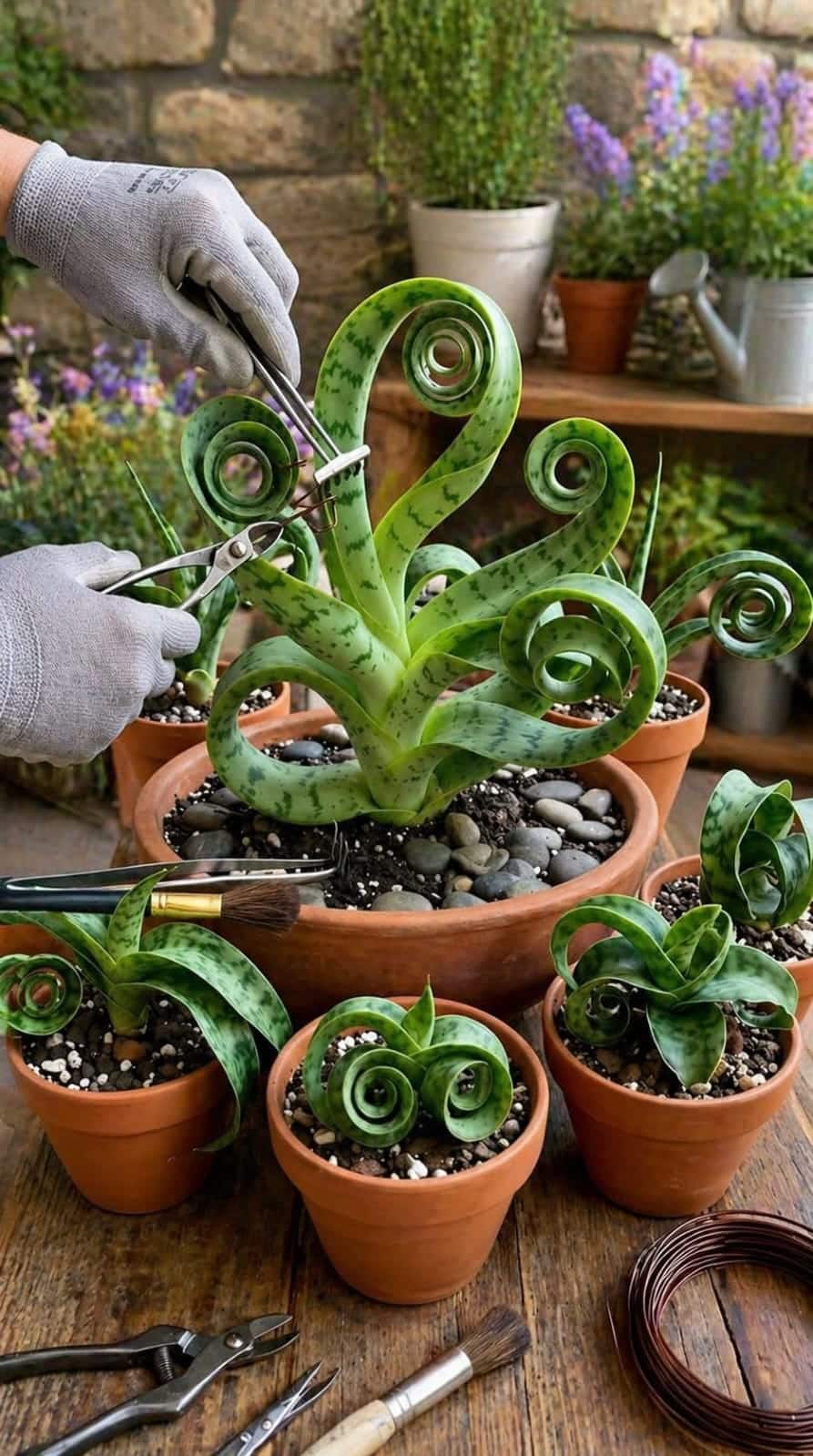
Snake plants are already among the most dramatic houseplants you can grow, but when shaped into elegant spirals, soft curls, and artistic loops, they become true living sculpture. Their upright form, bold variegation, and thick succulent leaves make them perfect for creative styling. That is why spiral snake plants have become such a fascinating trend in indoor gardening and plant décor. They look modern, unusual, and surprisingly luxurious, turning an ordinary pot on a windowsill into a conversation piece.
If you have ever seen a snake plant trained into a swirling spiral shape, you already know how eye-catching it can be. The leaves twist and curl in graceful arcs, giving the plant a designer look that feels halfway between botanical art and home décor. Many people assume that only florists or plant professionals can create that look, but with the right method, patience, and gentle handling, you can shape your own snake plant into a spiral-inspired masterpiece at home.
The key to this trick is understanding how snake plant leaves behave. Snake plants are hardy, architectural, and slow-growing. Their leaves are thick and sturdy, which means they do not bend as easily as vines or soft foliage plants. Because of that, spiral styling is not about forcing the plant overnight. It is about training the leaves gradually, choosing the right plant, guiding the growth carefully, and supporting the shape until it becomes visually balanced and stable.
This article explains exactly how to transform your snake plant into a stunning spiral shape, what kind of snake plant works best, what tools you need, how to train the leaves without damaging them, how to maintain the sculpted look, and what mistakes to avoid. If you want a beautiful, artistic plant that looks like it belongs in a designer home, this is one of the most satisfying houseplant projects you can try.
Why a Spiral Snake Plant Looks So Special
A regular snake plant is admired for its clean vertical lines. It is neat, symmetrical, and modern. But a spiral snake plant adds movement. Instead of standing stiffly upright, the leaves flow in curves, loops, and circular turns that create an almost sculptural effect. This movement gives the plant more personality and makes it look intentionally styled rather than simply grown.
Spiral shaping works especially well in minimalist interiors, contemporary living rooms, bright offices, and creative spaces where plant styling matters just as much as plant health. A spiral snake plant can become the focal point of a side table, shelf, or plant corner. Even one curled leaf can create visual impact, but several trained leaves together can produce a truly dramatic effect.
Another reason this look is so appealing is that it makes the plant feel rare and custom-made. Many houseplants are beautiful, but a spiral snake plant feels personal. It reflects effort, creativity, and a bit of patience. Rather than simply buying a plant and placing it in a pot, you are actively shaping it into living art.
Can Any Snake Plant Be Turned Into a Spiral?
In theory, many snake plants can be styled, but some are better suited than others. If you want the best chance of creating a beautiful spiral or curled form, choose a younger snake plant with flexible leaves rather than an old, very rigid plant with thick mature blades. Younger growth bends more easily and responds better to gentle training.
Compact or medium-sized snake plants are often easier to work with than extremely tall ones. Very tall leaves can be harder to control and more likely to crease if bent too sharply. A plant with several separate leaves or pups gives you more design options because you can shape some leaves more dramatically while allowing others to remain more natural.
Some snake plant varieties lend themselves especially well to decorative shaping. Standard Dracaena trifasciata types, often still called Sansevieria, can be trained into soft curves if done patiently. Cylindrical snake plant varieties can also be styled beautifully, though they tend to create braided or structured designs rather than broad leaf spirals. For the dramatic curled look seen in many decorative photos, broad-leaf snake plants often create the most eye-catching effect.
It is important to remember that the spiral look is usually a trained presentation style, not the plant’s natural growth habit. That means your success depends on technique and patience more than on finding a magical variety that spirals by itself.
What You Need to Create a Spiral Snake Plant
Before you begin shaping, gather the right materials. This makes the process smoother and helps you avoid handling the leaves too roughly.
Basic Supplies
- A healthy snake plant with flexible leaves
- A pot with drainage holes
- Well-draining succulent or cactus mix
- Soft plant ties, floral tape, or stretchy garden tape
- Thin plant supports, bamboo sticks, or shaped wire supports
- Soft cloth or foam padding for protection
- Clean pruning snips or scissors
- Optional decorative stones for the soil surface
- Optional terracotta or ceramic pot for display
The most important thing here is to use soft ties rather than string or hard wire directly against the leaves. Snake plant leaves are sturdy, but they can scar if tied too tightly. The goal is to guide the leaf, not cut into it.
Choose the Right Plant Before You Start
A healthy plant is essential for any shaping project. Do not try to spiral-train a plant that is weak, mushy, severely underwatered, or recovering from root rot. Training puts slight physical stress on the plant because you are altering the way the leaves sit. A strong plant handles this much better than a struggling one.
Look for a snake plant with firm leaves, healthy coloring, and no major brown soft spots. The leaves should feel solid, not wrinkled or loose at the base. If the plant has newly emerging pups, that is often a good sign. It means the root system is active and the plant is growing well.
If your snake plant is badly overcrowded, you may want to divide and repot it first. A clean, balanced plant is easier to style than a pot packed with uneven growth. Repotting into fresh well-draining soil can also help the plant stay healthier during the training process.
The Secret to a Beautiful Spiral Shape
The real secret is gradual training. A spiral snake plant is not created by suddenly twisting a leaf into a tight circle. That would likely crack or crease the leaf. Instead, you create the look step by step. You gently curve the leaf, support that curve, let the plant adjust, then refine the shape over time.
Think of it like shaping ribbon rather than bending a metal rod. You are encouraging the leaf into a new visual position while respecting its natural stiffness. Some leaves will curve more easily than others. Some may only accept a soft arc rather than a full spiral. That is completely fine. A collection of elegant curls and loops often looks more natural and artistic than forcing every leaf into identical circles.
The best spiral snake plants usually have a handcrafted look. They are balanced, sculptural, and intentional, but they do not look violently manipulated. That balance is what makes them so attractive.
Step-by-Step: How to Train a Snake Plant Into a Spiral Shape
Step 1: Water the Plant Lightly the Day Before
A leaf that is extremely dry can be more brittle, while a leaf that is overwatered may be overly turgid and more vulnerable to damage if handled roughly. A light, normal watering the day before you work with the plant helps keep the leaves at a good condition for gentle shaping.
Do not soak the soil heavily just before training. You do not want the pot to remain soggy. Snake plants always prefer a slightly dry, airy root environment.
Step 2: Select the Leaves You Want to Shape
You do not need to shape every leaf. In fact, it is often better to choose just a few key leaves first. Pick the healthiest, most flexible leaves and decide which direction you want them to curve. Some may spiral inward, some may loop outward, and some may remain more upright to balance the composition.
Visualize the finished plant before you start. A beautiful spiral design usually has flow. The leaves should guide the eye around the plant rather than looking random or cramped.
Step 3: Create a Gentle First Curve
Using your hands, very gently guide a leaf into a soft curve. Do not force a tight curl immediately. Support the leaf with one hand near the base and guide the upper portion slowly with the other hand. If you feel strong resistance, stop. The first bend should be mild.
You can use a soft support such as padded wire, a bamboo loop, or a shaped guide placed near the leaf. Secure the leaf loosely with soft plant tape or ties. The tie should hold the leaf in position without squeezing it.
This first stage is about introducing the leaf to a new direction, not creating a perfect spiral on day one.
Step 4: Add More Curve Gradually
After several days or a week, if the leaf looks healthy and uncreased, you can gently increase the curve. Reposition the support slightly and create a deeper arc. Over time, this can turn into a loose spiral or loop. Work slowly. A leaf that is asked to move a little at a time is much more likely to hold a graceful shape.
If you want a dramatic spiral, guide the upper half of the leaf into a rounded turn while keeping the base more natural. This creates a sculptural curl without putting too much pressure on the lower section, which must remain strong and stable.
Step 5: Repeat with Other Leaves
Once you understand how one leaf responds, begin shaping the others. Vary the size and direction of the curls so the plant looks artistic rather than mechanical. Some leaves may form open loops, others tighter swirls, and others soft S-shaped curves.
Leave enough space between shaped leaves so each one remains visible. Overcrowded spirals can look messy. A good design gives each curl room to be appreciated.
Step 6: Refine the Overall Composition
As more leaves are trained, step back and study the plant from different angles. Does it look balanced from the front? Does one side feel too heavy? Is one loop too tight compared to the rest? Small adjustments make a big difference.
This is where spiral styling becomes both gardening and design. You are not only keeping the plant alive; you are shaping how it is seen in the room.
Continue to Page 2
Continue to page 2 for more details about this article and the key points many readers miss on the first page.