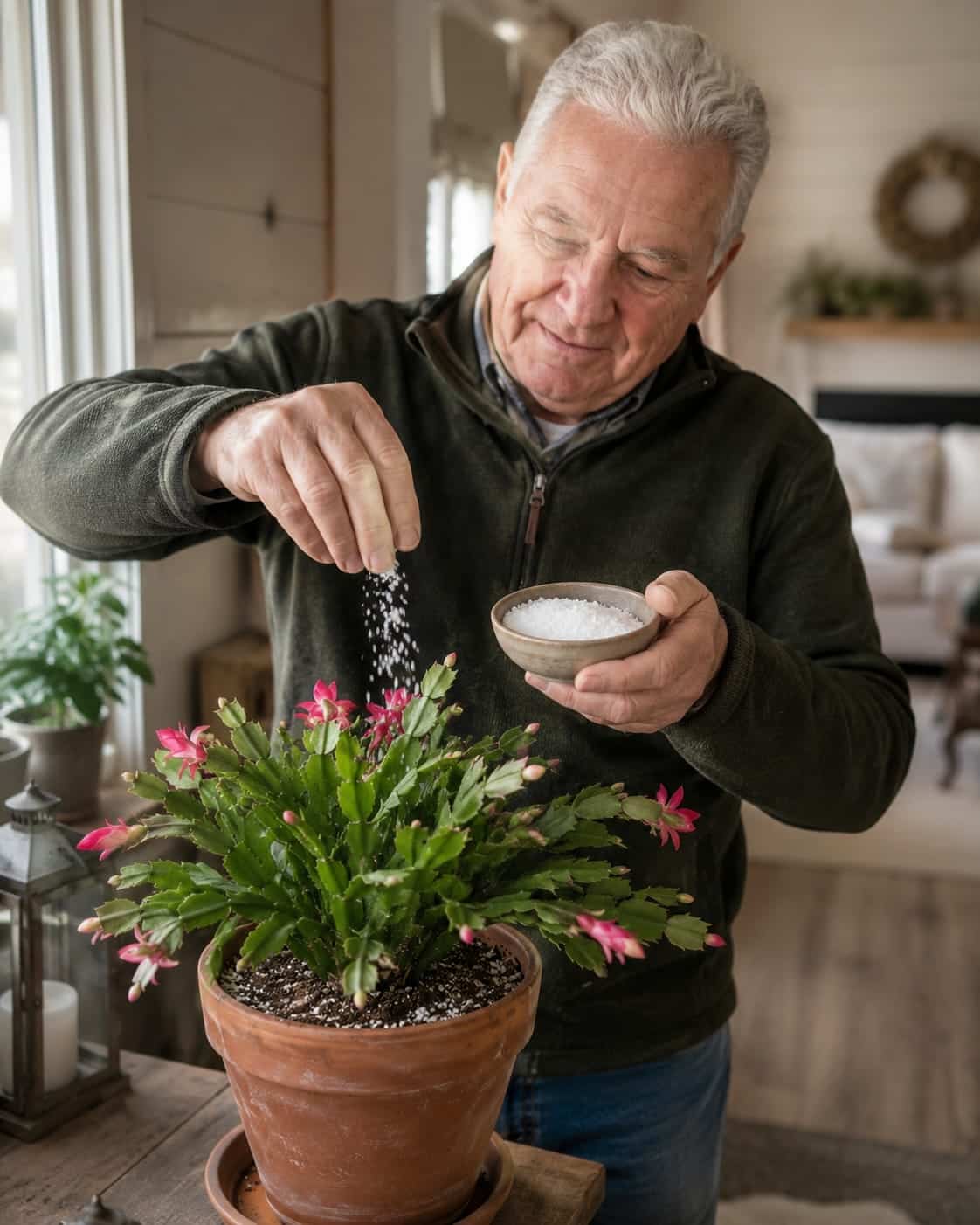
Christmas cactus is one of those houseplants that can make an ordinary windowsill feel magical. For most of the year, it sits quietly with its flat green segmented stems, looking simple and modest. Then, when the season is right, it suddenly covers itself in bright dangling blooms. Pink, red, white, coral, lavender, or peach flowers appear at the tips of the stems like little holiday lanterns. A healthy Christmas cactus in full bloom can become the most beautiful plant in the room.
But many homeowners know the frustration: the plant is alive, green, and growing, yet it produces only a few buds. Sometimes it forms buds and drops them before they open. Sometimes one side blooms while the rest stays plain. Sometimes the stems look thin, tired, or sparse. That is when people start looking for simple tricks to encourage fuller flowering.
In the image, a hand is sprinkling white crystals over the soil of a Christmas cactus. The plant is sitting near a window in a terracotta pot, and the white crystals are being added around the soil surface. This kind of image often makes people think of salt, sugar, Epsom salt, perlite, or some kind of blooming booster. The safest and most useful interpretation for Christmas cactus care is Epsom salt used in a very small, diluted way, or a light mineral supplement used with caution. Epsom salt is magnesium sulfate, and magnesium can support chlorophyll production and general plant function when a plant is truly deficient.
However, this is where smart plant care matters. You should not pour handfuls of white crystals onto a Christmas cactus. You should not use table salt. You should not sprinkle sugar. You should not coat the soil with a thick layer of any white powder. Christmas cactus roots are sensitive, and too many dissolved minerals can burn roots, stress the plant, and make bud drop worse.
The correct version of this trick is gentle: use a tiny amount of Epsom salt dissolved in water, apply it only during the active growing season or before the bud‑setting period, and never use it as a replacement for the true flowering triggers: cooler nights, longer darkness, bright indirect light, correct watering, and a slightly snug pot.
This guide explains what the white crystals may be, how to use them safely, what not to use, why Christmas cactus blooms, how to encourage more buds, and how to keep your plant full, fresh, and decorative indoors without harming the roots.
What Plant Is in the Image?
The plant in the image appears to be a Christmas cactus, often grouped with holiday cactus plants. These plants are commonly sold as Christmas cactus, Thanksgiving cactus, or Easter cactus depending on their bloom time and stem shape. Many store‑bought “Christmas cactus” plants are actually Thanksgiving cactus, but the care is very similar for most home growers.
Holiday cactus plants are not desert cacti. They are tropical epiphytic cacti that naturally grow in humid, shaded forest environments, often attached to trees or rocks where their roots get air, moisture, and organic matter. This means they do not want the same care as a dry desert cactus. They like bright indirect light, airy soil, careful moisture, and good drainage.
A healthy Christmas cactus usually has:
- Firm green segmented stems
- New growth at the tips during the growing season
- No mushy base
- No sour smell from the soil
- Roots that are not sitting in soggy mix
- Flower buds at the stem tips when conditions are right
- A full cascading shape as it matures
The plant in the image has green segmented stems and several pink blooms. It looks generally healthy and decorative. The white crystals are being shown as a bloom‑support trick, but the trick must be used carefully because Christmas cactus can be sensitive to excess salts in the soil.
What Are the White Crystals?
The white crystals in the image could be interpreted several ways. Some people might think they are table salt. Others might assume they are sugar. In plant‑care content, white crystals are often used to represent Epsom salt, which is magnesium sulfate. Epsom salt is sometimes used by gardeners as a magnesium supplement for certain plants.
For Christmas cactus, the safest possible version of this idea is not sprinkling dry crystals heavily on the soil. The safer method is dissolving a very small amount of Epsom salt in water and applying it occasionally, away from regular fertilizer applications.
The white crystals should not be:
- Table salt
- Rock salt
- Sugar
- Baking soda
- Bleach powder
- Detergent powder
- Strong fertilizer granules applied randomly
These can damage roots, change the soil chemistry, attract pests, or create toxic buildup. If you use anything white and crystalline near houseplants, you need to know exactly what it is.
Important Warning: Do Not Use Table Salt
This warning deserves its own section because many people see white crystals and think of salt. Do not sprinkle table salt on Christmas cactus. Table salt contains sodium chloride, and sodium can damage plant roots, dehydrate tissues, and make soil unhealthy for houseplants. It will not encourage blooms. It can cause stress, leaf shriveling, root burn, and decline.
If you have already placed table salt on a Christmas cactus, remove the top layer of soil immediately. If salt has been watered in, flush the pot thoroughly with clean water and let it drain completely. If the plant begins to wilt or the soil smells strange, repotting may be necessary.
When plant growers talk about Epsom salt, they are not talking about kitchen salt. Epsom salt is magnesium sulfate. Even then, it should be used sparingly.
What Epsom Salt Can Do for Christmas Cactus
Epsom salt contains magnesium and sulfur. Magnesium plays a role in chlorophyll, which helps plants process light. In some cases, a plant lacking magnesium may show pale growth, yellowing between veins, or weak performance. A small magnesium supplement can help if the plant actually needs it.
For Christmas cactus, a very diluted Epsom salt solution may support:
- Greener stem segments when magnesium is low
- General plant vigor during active growth
- Healthy energy storage before bloom season
- Better response to proper light and temperature conditions
- Stronger overall plant appearance when used correctly
But Epsom salt is not a magic bloom switch. Christmas cactus bloom is controlled mostly by light cycle, temperature, plant maturity, and general health. Magnesium may support the plant, but it does not replace the environmental cues that tell the plant to form buds.
What Epsom Salt Cannot Do
Epsom salt cannot force a Christmas cactus to bloom if the plant is receiving the wrong light cycle. It cannot fix overwatering. It cannot repair root rot. It cannot make a weak plant instantly full. It cannot replace balanced fertilizer. It cannot overcome a hot room, constant nighttime light, or stress from being moved during bud formation.
Epsom salt cannot fix:
- Bud drop from sudden movement
- Bud drop from inconsistent watering
- Bud drop from dry heat
- No blooms caused by too much night light
- No blooms caused by warm nights
- Root rot from soggy soil
- Weak growth from old compacted soil
- Low light during the growing season
This is why smart homeowners use the white crystal trick only as a tiny supporting step, not the main blooming method.
The Safe Epsom Salt Method for Christmas Cactus
The safest method is to dissolve Epsom salt in water first. This distributes it more evenly and reduces the risk of concentrated crystals burning roots.
Gentle Epsom Salt Solution
- 1 quart room‑temperature water
- 1/4 teaspoon Epsom salt
Stir until fully dissolved. Use this solution only on a healthy Christmas cactus, and only when the soil is already ready for watering.
For a larger, mature plant, this is enough for one light watering. For a small pot, use only part of the solution and discard the rest. Do not save it for weeks. Make it fresh when needed.
How to Apply It Step by Step
Step 1: Confirm the Plant Is Healthy
Before applying any supplement, check the plant. The stems should be firm, not wrinkled from severe dehydration and not mushy from overwatering. The soil should not smell sour. The base should not be rotting. If the plant is severely stressed, do not add minerals. Fix the stress first.
Step 2: Check the Soil Moisture
Do not apply the solution to wet soil. Christmas cactus likes moisture more than desert cactus, but it still needs good drainage. Apply the Epsom salt solution only when the top inch of soil feels dry and the plant is due for watering.
Step 3: Dissolve Completely
Make sure the crystals are fully dissolved in water. Do not let undissolved crystals sit on top of the soil or against the stems.
Step 4: Pour Around the Soil
Pour gently onto the potting mix around the plant. Avoid pouring directly over the stem joints or crown. The goal is to water the roots lightly, not soak the entire plant.
Step 5: Let Excess Drain
The pot must have drainage holes. Let extra water drain out completely. Empty the saucer after watering. Christmas cactus roots can rot if they sit in standing water.
Step 6: Do Not Repeat Too Often
Use this solution only once every 4 to 6 weeks during active growth, and stop once buds are well formed. Do not use it every week. Do not combine it with fertilizer on the same day.
Can You Sprinkle Dry Epsom Salt on the Soil?
It is better not to sprinkle dry crystals directly onto a Christmas cactus pot. Dry crystals can create concentrated mineral pockets when they dissolve. These concentrated spots may stress roots. If you want to use Epsom salt, dissolve it in water first.
If you still want a surface method, use only a tiny pinch and water it in thoroughly, but the dissolved method is safer and more controlled.
How Often Should You Use Epsom Salt?
For Christmas cactus, less is better. Use it only occasionally, and only if the plant appears to benefit from it.
A safe schedule:
- Spring: once after new growth begins
- Summer: once if the plant is actively growing
- Early fall: once before bud‑setting conditions begin
- Bud stage: avoid unnecessary supplements
- Winter bloom period: do not apply unless there is a clear reason
Never use Epsom salt every time you water. Mineral buildup can become a problem in pots.
How Christmas Cactus Actually Forms Buds
To understand how to encourage more blooms, you need to understand how the plant decides to flower. Christmas cactus forms buds when it receives the right combination of darkness and cooler temperatures. This is the real bloom secret.
Most holiday cactus plants need several weeks of:
- Longer nights
- Reduced artificial light at night
- Cooler evening temperatures
- Bright indirect light during the day
- Steady but not excessive moisture
If your plant sits in a room where lights stay on late every night, it may not receive the darkness signal it needs. If the room is too warm at night, bud formation may be weaker. If the plant dries out severely or is overwatered, buds may drop.
The Real Bloom Formula
If you want more buds, focus on this simple formula:
Bright indirect daytime light + long dark nights + cooler temperatures + steady watering + no sudden stress.
The white crystal trick can support plant vigor, but this bloom formula is what matters most.
Best Light for Christmas Cactus
Christmas cactus likes bright indirect light. Near an east‑facing window is often ideal. A bright north window can work. A south or west window may be too intense unless filtered by a sheer curtain.
Too much direct sun can cause reddish or yellowish stress tones on the stems. Too little light can cause weak growth and fewer flowers.
Good light signs include:
- Firm green stems
- Steady new growth
- Compact healthy segments
- Bud formation during the right season
Poor light signs include:
- Thin weak stems
- Pale growth
- Few or no buds
- Plant stretching toward the window
How to Trigger More Buds Naturally
Step 1: Start in Early Fall
Begin preparing your Christmas cactus about 6 to 8 weeks before you want blooms. This gives the plant time to receive the seasonal signal.
Step 2: Give Long Nights
Place the plant somewhere it receives about 12 to 14 hours of darkness each night. This does not mean total laboratory darkness, but it should not be exposed to bright lamps, kitchen lights, or TV glow all evening.
Step 3: Keep Nights Cool
Cooler nights help encourage bud formation. A room that gets slightly cooler at night is ideal. Avoid placing the plant near heaters, fireplaces, or hot vents.
Step 4: Provide Bright Indirect Daylight
During the day, give bright indirect light. The plant needs daytime energy to support bud development.
Step 5: Water Carefully
Do not let the plant become bone dry for long periods, but do not keep it soggy. Water when the top inch feels dry.
Step 6: Avoid Moving the Plant Once Buds Form
Christmas cactus can drop buds when moved suddenly to a new location with different light, temperature, or humidity. Once buds appear, keep conditions stable.
Why Christmas Cactus Drops Buds
Bud drop is one of the most common problems. It can happen even when the plant formed buds successfully. Usually, bud drop is caused by environmental stress.
Common causes include:
- Sudden change in location
- Dry soil followed by heavy watering
- Overwatering
- Hot dry air
- Cold drafts
- Low humidity
- Too much fertilizer during bud stage
- Plant being rotated or moved repeatedly
- Poor drainage
If your plant has buds, keep the routine calm. Do not experiment with strong tonics at that stage.
Best Soil for Christmas Cactus
Christmas cactus needs a mix that holds some moisture but drains well. It is not happy in dense soil that stays wet for days. It also does not want extremely dry desert cactus soil that repels water too quickly.
Simple Christmas Cactus Soil Mix
- 2 parts high‑quality potting mix
- 1 part orchid bark
- 1 part perlite or pumice
This creates a light, airy mix that allows roots to breathe while still holding enough moisture.
If your plant is in old compacted soil, no white crystal trick will solve the problem. Refreshing the soil may be more helpful than adding supplements.
Best Pot for Christmas Cactus
Christmas cactus often blooms better when slightly snug in its pot. A pot that is too large can hold excess moisture and encourage root problems. Choose a pot with drainage holes and a size only slightly larger than the root ball.
Terracotta pots, like the one in the image, can be helpful because they breathe and allow soil to dry more evenly. However, terracotta also dries faster, so check moisture regularly.
Watering Christmas Cactus Correctly
Christmas cactus is not a plant you should ignore for months like some succulents. It prefers more regular moisture than desert cactus, especially during active growth and bud formation.
Water when the top inch of soil feels dry. Water thoroughly, then let excess drain. Do not let the pot sit in water.
During active growth, it may need water once a week or every 10 days depending on conditions. During cooler months, it may need less. Always check the soil rather than following a strict calendar.
Continue to Page 2
Continue to page 2 for more details about this article and the key points many readers miss on the first page.