Orchids are some of the most beautiful plants you can grow at home. Their elegant flowers, glossy leaves, sculptural roots, and long blooming period make them feel special in any indoor garden. A healthy orchid can bloom for weeks or even months, bringing color and softness to a windowsill, patio, balcony, or bright room.
But orchids can also be frustrating. One plant may bloom beautifully, while another sits with only leaves. Some orchids lose flowers too quickly. Others grow weak roots, pale leaves, or dry flower spikes. After the blooms fade, many people wonder what they can do to help the plant flower again and keep its blooms fresh for longer.
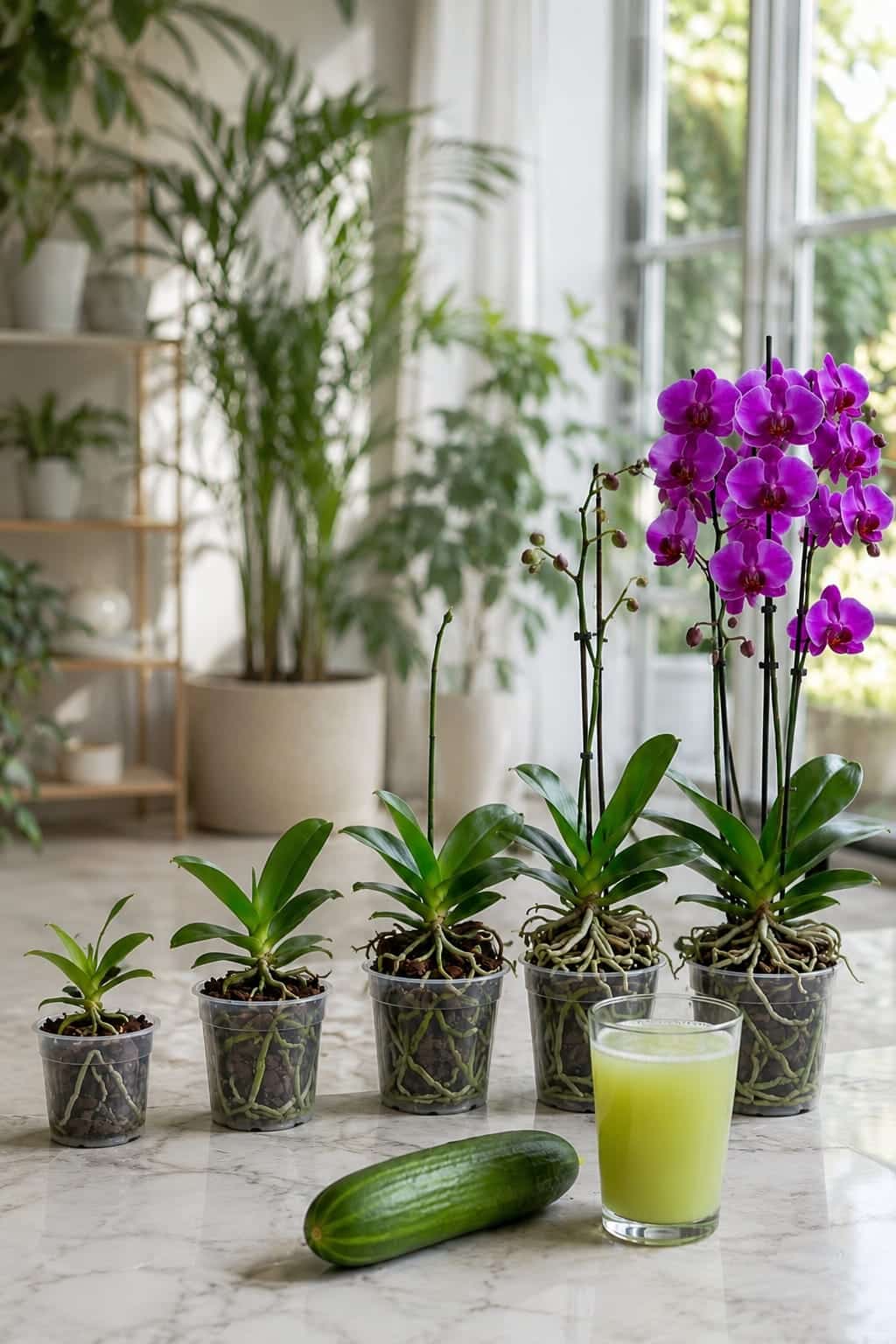
The image shows a row of orchids in clear pots, from small young plants to mature blooming orchids. In front of them is a fresh cucumber and a glass of pale green cucumber juice. This suggests a natural orchid-care trick using cucumber water. Cucumber is mostly water, but it also contains small amounts of minerals and gentle plant-friendly compounds. Many plant lovers use cucumber water as a mild homemade tonic to refresh roots, support hydration, and encourage a healthy growing routine.
However, cucumber water must be used carefully. It is not a magic bloom booster. It will not make orchids flower immediately by itself. It will not fix rotten roots, poor light, compacted bark, or incorrect watering. If cucumber juice is too thick, old, fermented, or used too often, it can attract fungus gnats, cause sour smells, encourage mold, and harm the root environment.
The safest way to use cucumber for orchids is to make a very diluted cucumber water, strain it well, and apply it occasionally to the orchid potting medium when the plant is already due for watering. It should never replace bright indirect light, healthy roots, good airflow, fresh orchid bark, and proper orchid fertilizer.
This guide explains how cucumber water may help orchids, how to prepare it safely, how often to use it, when to avoid it, and what truly makes orchids bloom longer and rebloom more reliably.
Why Orchids Need a Gentle Routine
Most common indoor orchids, especially Phalaenopsis orchids, are not grown like ordinary houseplants. They should not be planted in dense potting soil. Their roots need air, moisture, and drainage at the same time. In nature, many orchids grow attached to trees, where their roots receive rain, airflow, and quick drying.
This is why orchids are usually grown in bark, moss, clay pellets, or a chunky orchid mix. Their roots must be able to breathe. If the potting medium becomes dense, old, soggy, or broken down, the roots can rot.
When orchid roots are healthy, the plant can support leaves, flower spikes, and long-lasting blooms. When the roots are damaged, the flowers fade faster, leaves become limp, and the plant may stop blooming.
Any homemade trick, including cucumber water, must respect this root system. The goal is not to soak the plant with rich kitchen liquid. The goal is to provide a very mild, clean, occasional support without suffocating or contaminating the roots.
What Cucumber Water Can Do for Orchids
Cucumber is naturally high in water. It also contains small amounts of potassium and other trace minerals. When blended or soaked in water, cucumber creates a mild green liquid that some plant owners use as a natural hydration support.
For orchids, cucumber water may help as a gentle root rinse or occasional moisture boost. It may support a fresh root environment when used very lightly. It may also be useful for orchids that are healthy but seem slightly tired after blooming.
But cucumber water is not fertilizer. It does not provide complete nutrition. It does not contain a predictable balance of nitrogen, phosphorus, potassium, calcium, magnesium, and trace elements in the way orchid fertilizer does.
Cucumber water is best understood as a mild natural supplement. It may support a good care routine, but it cannot replace the real foundations of orchid health.
Can Cucumber Water Make Orchids Flower Immediately?
No. Cucumber water cannot force orchids to flower immediately. The phrase sounds exciting, but orchid blooming is controlled by plant maturity, root health, light, temperature, and energy reserves.
A mature orchid with healthy roots and good light may bloom again when the season and conditions are right. A weak orchid with poor roots will not bloom just because cucumber water is added.
For many Phalaenopsis orchids, blooming is encouraged by bright indirect light and, in many cases, a slight nighttime temperature drop for several weeks. The plant also needs enough stored energy from healthy leaves and roots.
Cucumber water may help keep a healthy orchid hydrated and supported, but it is not the bloom trigger. If your orchid is not flowering, first check light, roots, bark quality, and temperature.
🌸 Bloom secret: Healthy roots, bright indirect light, and a gentle nighttime temperature drop (for Phalaenopsis) matter far more than any homemade tonic.
Can Cucumber Water Make Orchid Flowers Last Longer?
Cucumber water may help indirectly if the plant is healthy and slightly dehydrated, but it will not preserve flowers like a chemical flower preservative. Orchid flowers last longer when the whole plant is stable.
To keep orchid flowers lasting longer, avoid sudden temperature changes, cold drafts, hot direct sun, dry air, and overwatering. Keep the plant in bright indirect light and water properly when the roots need it.
If roots are dry and the plant is thirsty, proper watering can help flowers last better. A very diluted cucumber water may be used occasionally as part of that watering routine, but plain water is usually enough.
The best way to extend orchid blooms is not to feed the flowers directly. It is to keep the roots and leaves healthy while the plant is flowering.
Why Thick Cucumber Juice Can Be Risky
The glass in the image looks like cucumber juice. For orchids, thick cucumber juice should not be poured directly into the pot. Thick organic juice can leave residue around the roots and inside the bark.
If the juice contains pulp, it can collect in the potting medium. As it breaks down, it may smell sour, attract fungus gnats, or encourage mold. Orchid bark should stay clean and airy, not coated with vegetable residue.
This is especially important in clear orchid pots. The roots need light, air, and drainage. If organic liquid sits inside the pot, the environment can become stale and unhealthy.
Always dilute cucumber juice heavily and strain it very well. The final mixture should be watery, not thick. It should smell fresh, not fermented.
The Safest Cucumber Water Recipe for Orchids
To make cucumber water safely, use fresh plain cucumber and clean water. Do not use cucumber mixed with salt, sugar, vinegar, lemon, spices, oil, or salad dressing.
Cut a few thin slices of cucumber and place them in two cups of clean room-temperature water. Let the slices soak for one to two hours. Then remove the cucumber pieces completely.
For a slightly stronger version, blend a small piece of peeled cucumber with two cups of water, then strain the liquid through a fine strainer or cloth. After straining, dilute the liquid with two more cups of plain water.
The final cucumber water should be very light green and thin. It should not contain pulp. It should not feel sticky. It should not smell sour.
Use it fresh the same day. Do not store cucumber water for several days. Old cucumber water can ferment and become unsafe for indoor orchids.
How to Apply Cucumber Water to Orchids
Use cucumber water only when the orchid is already due for watering. Check the roots and potting medium first. If the roots are still green and the bark is damp, wait. If the roots look silvery and the bark is mostly dry, watering may be needed.
Pour the diluted cucumber water through the potting medium, not into the crown of the orchid. The crown is the center where the leaves meet. Water sitting there can cause crown rot.
Let the liquid run through the pot and drain completely. Do not let the orchid sit in cucumber water. Empty any saucer or decorative container afterward.
After using cucumber water, return to plain water for future waterings. Do not repeat too often.
How Often Should You Use Cucumber Water?
Cucumber water should be used rarely. Once every four to six weeks during active growth is enough if you choose to use it. Many orchids do not need it at all.
Do not use cucumber water weekly. Do not use it every time you water. Do not use it as the main feeding routine. Too much organic liquid can create mold, odor, and root problems.
During winter or low-light periods, use it even less or skip it completely. Orchids use less water when growth slows, and organic liquids can stay in the potting medium too long.
The safest routine is simple: plain water most of the time, orchid fertilizer when needed, and cucumber water only as an occasional mild supplement.
When Cucumber Water May Help
Cucumber water may help when an orchid is healthy, actively growing, and slightly tired after a bloom cycle. It can be used as a gentle refresh after flowers fade and the plant begins focusing on roots and leaves again.
It may also be useful for an orchid with firm leaves and healthy roots that simply needs an occasional natural hydration boost. If the plant is already in good condition, a mild cucumber rinse may support the routine without causing harm.
Cucumber water is safest for orchids in fresh, airy bark with good drainage. It should not be used in old broken-down bark that already stays too wet.
The best candidate is a stable orchid, not a sick orchid.
When You Should Avoid Cucumber Water
- Do not use if the orchid has root rot – rotten roots need trimming and fresh potting medium, not vegetable water.
- Do not use if the bark is wet – orchids need airflow and drying between waterings.
- Do not use if the pot smells sour or moldy – this means the root zone is already unhealthy.
- Do not use if fungus gnats are present – organic liquids can make gnat problems worse.
- Do not use if the plant is newly repotted with damaged roots – let it recover with plain water first.
- Do not use old, fermented, salted, sweetened, or pulpy cucumber liquid.
The Real Secret to Orchid Flowers
The real secret to orchid flowers is healthy roots and proper light. A mature orchid needs enough bright indirect light to create energy. Without enough light, the plant may grow leaves but refuse to flower.
Place orchids near a bright window. East-facing windows are often excellent. A south or west window may work if filtered by a sheer curtain. Avoid harsh direct afternoon sun that can burn the leaves.
Healthy roots are just as important. Orchid roots should be firm. Many Phalaenopsis roots turn green when wet and silvery when dry. Mushy brown roots are a warning sign.
If the roots are healthy and light is strong, the orchid has a much better chance of producing new flower spikes.
Continue to Page 2
Continue to page 2 for more details about this article and the key points many readers miss on the first page.