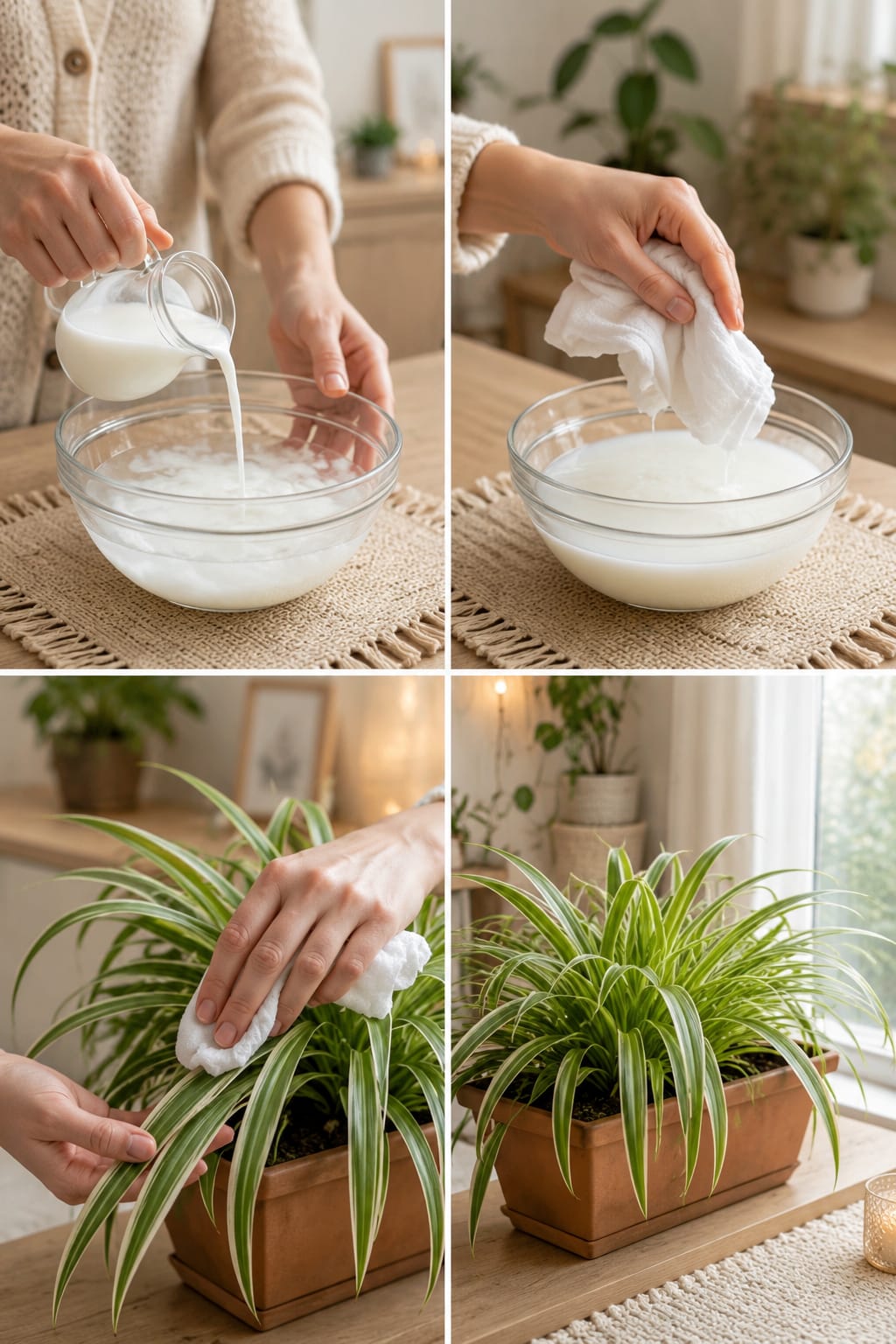
Spider plants are some of the easiest and most rewarding houseplants to grow indoors. Their long arching leaves, soft green-and-white stripes, and graceful fountain shape make them perfect for windowsills, shelves, hanging baskets, plant stands, kitchen counters, and bright living room corners. A healthy spider plant can make any room feel fresher, softer, and more natural.
One simple care trick many plant lovers enjoy is wiping spider plant leaves with a very weak milk water mixture. The goal is not to “feed” the leaves with milk or create an artificial shine. The real purpose is gentle cleaning. Spider plant leaves collect dust easily because they are long, narrow, and often grow in dense clumps. Dust can dull their color, block light, and make the plant look tired. A soft cloth dipped in a diluted milk water mixture can help lift dust and leave the leaves looking cleaner and brighter.
This trick must be used carefully. Milk should never be used thick, undiluted, sweetened, flavored, or poured heavily into the plant. Too much milk can smell bad, attract pests, or leave sticky residue. The safest version is very weak, used occasionally, and followed by gentle wiping so no liquid sits on the leaves.
Why Spider Plant Leaves Need Cleaning
Spider plants grow many thin leaves from the center of the plant. Over time, dust settles between the leaves and along the stripes. This dust layer can make the plant look dull and can reduce how much light reaches the leaf surface.
Clean leaves help the plant absorb light better. Since spider plants use light to make energy, cleaner leaves can support stronger growth. The plant also looks more decorative when the white stripes are bright and the green areas look fresh.
Leaf cleaning is especially useful for indoor spider plants near windows, kitchens, heaters, open shelves, or busy rooms where dust collects quickly.
What Is the Milk Water Cleaning Trick?
The milk water cleaning trick is a simple leaf-care method. A small amount of plain milk is mixed with plenty of water. A soft cloth is dipped into the mixture, squeezed until damp, and used to wipe the leaves gently.
The mixture should be very light. It should not feel creamy. It should not drip heavily. The cloth should be damp, not soaked.
This is not a fertilizer routine. It is not meant to replace watering, soil care, or proper feeding. It is only a gentle cleaning method for leaves.
Safe Milk Water Recipe
Use only plain unsweetened milk. Do not use chocolate milk, sweetened milk, condensed milk, cream, flavored milk, or milk with additives.
- Mix 1 tablespoon of plain milk with 1 cup of clean water.
- Stir well.
- Dip a soft cloth into the mixture.
- Squeeze the cloth until it is only damp.
- Wipe the leaves gently from base to tip.
- Use a second cloth with plain water if any residue remains.
For extra safety, use even more water. A weaker mixture is better for indoor plants.
How Often to Use This Trick
Use the milk water wipe only once every 4 to 6 weeks, or only when the leaves look dusty. It should not be part of every watering day.
Most of the time, plain water on a soft cloth is enough. Milk water is optional. If your plant is already clean and healthy, there is no need to use it often.
If you notice any smell, sticky feel, spots, or pests after using it, stop and switch back to plain water only.
Why the Cloth Must Be Damp, Not Wet
A wet cloth can leave too much liquid on the leaves. Spider plant crowns can hold moisture between leaves, and trapped moisture may encourage rot or fungal problems.
A damp cloth gives you control. It removes dust without soaking the plant. After wiping, the leaves should look clean but not dripping wet.
Always avoid pouring milk water into the center of the plant.
How to Wipe Spider Plant Leaves Correctly
Support each leaf with one hand and wipe gently with the other. Move from the base of the leaf toward the tip. This follows the natural direction of growth and reduces tearing.
Spider plant leaves can bend easily, so do not pull hard. If a leaf is tangled with others, separate it gently before wiping.
Work slowly around the plant until the main leaves are clean. You do not need to wipe every tiny new leaf in the center.
What Not to Do
- Do not pour milk directly onto the plant.
- Do not use thick milk mixtures.
- Do not leave leaves wet overnight.
- Do not use milk water on a plant with pests.
- Do not use it on damaged or rotting leaves.
- Do not use sweetened or flavored milk.
- Do not wipe too roughly.
- Do not let milk water sit in the crown.
The trick should leave the plant cleaner, not wetter or sticky.
Can Milk Water Feed Spider Plants?
Milk water is not a complete fertilizer. It may contain tiny amounts of nutrients, but it does not provide balanced plant food. Spider plants need proper light, water, soil, and occasional diluted fertilizer for real growth support.
Do not rely on milk water to make a spider plant grow faster. Think of it as a cleaning trick, not a feeding trick.
If you want stronger growth, use a balanced liquid houseplant fertilizer at half strength during spring and summer.
Best Light for Spider Plants
Spider plants grow best in bright indirect light. Good light keeps the leaves strong, striped, and full. If the plant sits in low light for too long, the stripes may fade and the plant may grow slowly.
A bright window with filtered light is ideal. Morning sun can be helpful, but harsh afternoon sun can burn the leaves, especially through hot glass.
If the plant has pale leaves, weak growth, or fewer white stripes, move it to a brighter spot.
Watering Spider Plants Correctly
Spider plants prefer lightly moist soil, but they do not like staying soggy. Water when the top inch of soil feels dry. Then water thoroughly until excess water drains from the bottom.
Empty the saucer after watering. Standing water can cause root problems.
Spider plants have thick roots that store moisture, so they can tolerate slight dryness better than constant wetness.
Signs Your Spider Plant Needs Water
- Leaves look slightly dull
- Soil feels dry on top
- Pot feels lighter
- Leaf tips begin to curl slightly
- Plant looks less firm than usual
Water deeply, then let the soil dry slightly again before the next watering.
Signs of Overwatering
- Yellow leaves
- Soft base
- Wet soil for many days
- Bad smell from the pot
- Fungus gnats
- Brown mushy roots
- Leaves collapsing from the center
If these signs appear, stop extra treatments and check the soil. A spider plant in soggy soil needs better drainage, not more liquid.
Best Soil for Spider Plants
Spider plants do well in a light, well-draining indoor potting mix. The soil should hold some moisture but not become muddy.
A good mix can include:
- Indoor potting soil
- Perlite
- Coco coir
- Fine bark
- A small amount of compost
If the soil stays wet too long, add more perlite or bark. If it dries too quickly, add a little coco coir.
Why Drainage Matters
A spider plant pot should have drainage holes. Without drainage, water collects at the bottom and causes root stress. This is especially important if you clean leaves near watering day because extra moisture can build up around the plant.
If you use a decorative pot without holes, keep the spider plant inside a nursery pot with drainage and place it inside the cover pot. After watering, remove standing water.
Brown Leaf Tips on Spider Plants
Brown tips are very common on spider plants. They can happen from dry air, hard tap water, fertilizer buildup, low humidity, inconsistent watering, or too much direct sun.
To reduce brown tips:
- Use filtered or rested water if tap water is harsh.
- Avoid strong fertilizer.
- Keep watering consistent.
- Protect from hot direct sun.
- Trim brown tips with clean scissors.
- Clean dust from leaves gently.
Once a tip turns brown, it will not turn green again, but trimming can make the plant look neater.
Humidity for Spider Plants
Spider plants enjoy moderate humidity but do not need extreme tropical conditions. Normal home humidity is usually fine. If the air is very dry, the leaf tips may brown faster.
To improve humidity, group plants together, use a humidifier, or place the plant in a bright bathroom or kitchen. Avoid heavy misting if airflow is poor.
Feeding Spider Plants
Spider plants are moderate feeders during active growth. Use a balanced liquid houseplant fertilizer at half strength once every 4 to 6 weeks in spring and summer.
Do not overfeed. Too much fertilizer can cause brown tips and weak growth. In fall and winter, feed less or stop if growth slows.
Milk water leaf cleaning does not replace fertilizer.
How to Encourage Spider Plant Babies
Spider plants produce baby plantlets when they are mature and happy. To encourage babies, give bright indirect light, consistent watering, and light feeding during active growth.
A slightly snug pot can also encourage plantlets. Do not move the plant into a huge pot too soon.
When babies appear, you can leave them hanging for decoration or root them in water or soil.
Cleaning Before Styling
Clean leaves make spider plants look better in decor displays. After wiping dust away, the striped leaves appear brighter and more polished. This is useful before placing the plant on a shelf, table, windowsill, or plant stand.
Let the leaves dry naturally in bright indirect light. Do not place the plant in harsh sun immediately after wiping.
Indoor Decor Ideas
Spider plants are perfect for soft, natural indoor styling. Their arching leaves add movement and freshness without looking heavy.
- Place one in a terracotta pot on a windowsill.
- Use a rectangular planter for a full kitchen display.
- Hang it in a macrame hanger near filtered light.
- Place it on a bookshelf so leaves can spill over the edge.
- Use a white ceramic pot for a clean modern look.
- Group it with pothos and peace lilies for a lush corner.
The striped leaves pair beautifully with wood, clay, white walls, woven baskets, and soft neutral decor.
Continue to Page 2
Continue to page 2 for more details about this article and the key points many readers miss on the first page.