Anthuriums are some of the most striking flowering houseplants you can grow indoors. Their glossy heart-shaped leaves, upright flower stems, and colorful waxy spathes make them look tropical, elegant, and expensive. A healthy Anthurium can brighten a windowsill, decorate a side table, or become the centerpiece of a plant shelf with very little effort.
But when an Anthurium begins to slow down, the change can be disappointing. The leaves may lose their shine. New growth may appear smaller. The plant may stop producing flowers. The red, pink, or white spathes may fade too quickly. When this happens, many plant lovers start looking for a simple home remedy that can help the plant look lush again.
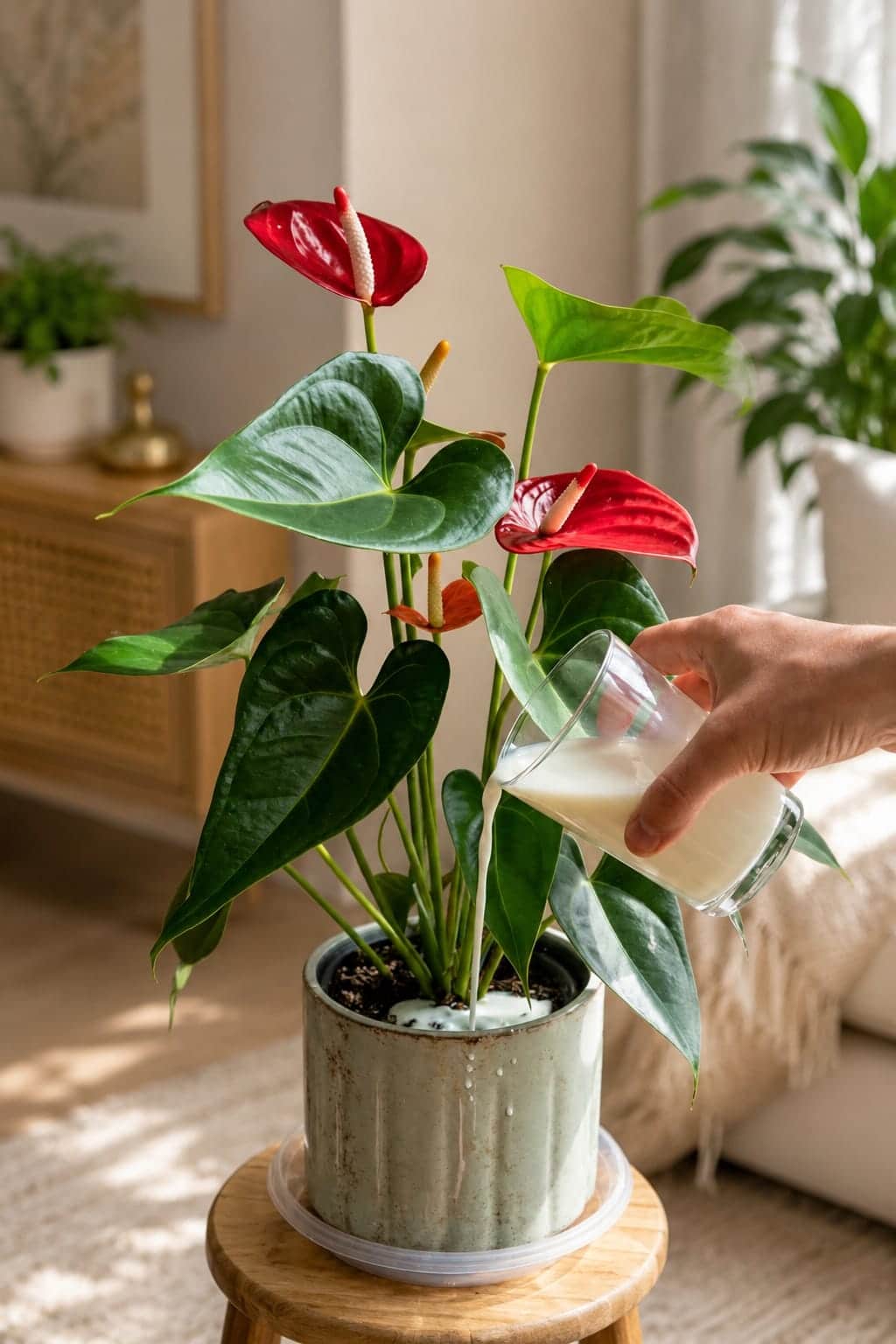
The image shows an Anthurium being watered with a white liquid that looks like milk. This kind of plant-care trick is popular because milk is a familiar kitchen ingredient, and many people believe it can help plants grow stronger. Milk contains small amounts of calcium, proteins, sugars, and other compounds, so it is often presented online as a natural tonic for leaves and growth.
However, milk must be used very carefully on indoor plants. It is not a miracle fertilizer. It will not instantly make an Anthurium bloom. It will not fix root rot, low light, poor drainage, compacted soil, or overwatering. If used too often or poured into the pot undiluted, milk can sour, smell bad, attract fungus gnats, encourage mold, and stress the roots.
Used correctly, a very diluted milk-water mixture may be used occasionally as a gentle calcium-support routine for a healthy Anthurium. But it should never replace proper Anthurium care. The real secret to lush leaves and faster growth is bright indirect light, an airy potting mix, correct watering, good drainage, humidity, clean leaves, and balanced feeding.
This guide explains how to use milk safely for Anthurium, when it may help, when to avoid it, and what care steps truly encourage strong roots, glossy leaves, and long-lasting blooms.
Why Anthuriums Need Careful Feeding
Anthuriums are tropical plants, but they are not ordinary plants that enjoy heavy, wet soil. Many common indoor Anthuriums grow naturally in loose organic material where their roots receive both moisture and air. Their roots are adapted to breathe. This is why they dislike dense potting soil that stays wet for too long.
A healthy Anthurium needs a balance of moisture and oxygen around the roots. If the potting mix is too compact, the roots can suffocate. If the pot stays wet, the roots may rot. If the roots are damaged, the plant cannot absorb water or nutrients properly, no matter what homemade liquid you pour into the pot.
This is why milk water must be treated as an optional supplement, not a rescue solution. A weak milk mixture may provide a small amount of calcium and organic material, but the plant still needs the right growing environment first.
If your Anthurium is struggling, check the basics before using milk. Is the plant getting bright indirect light? Does the pot have drainage holes? Is the soil airy and chunky? Are the roots healthy? Is the plant being watered too often? These questions matter more than any kitchen trick.
What Milk Can Do for Plants
Milk contains water, calcium, proteins, fats, sugars, and trace nutrients. Calcium is important for plant cell structure, and healthy calcium movement can support strong growth. This is one reason milk is sometimes discussed in plant care.
Some gardeners also use heavily diluted milk sprays outdoors for certain leaf issues, but indoor Anthuriums require more caution. What works in an outdoor garden with sunlight, airflow, rain, and soil microbes can become risky in a small indoor pot.
In a container, milk can break down and create odor if used too heavily. It can feed bacteria and fungi in ways that are not always beneficial. It can also attract fungus gnats or other pests if the soil stays damp.
For Anthuriums, milk should never be used thick or straight from the glass. If used at all, it must be diluted heavily with water and applied only occasionally.
Can Milk Make Anthurium Grow Faster?
Milk cannot force an Anthurium to grow fast. Anthurium growth depends mostly on light, warmth, humidity, healthy roots, proper watering, and balanced nutrition. If those conditions are weak, milk will not solve the problem.
However, a very diluted milk-water mixture may support a healthy plant slightly by adding a small amount of calcium and organic matter. This effect is subtle. It should not be expected to create dramatic overnight growth.
If your Anthurium is growing slowly, the first thing to check is light. Anthuriums can survive in moderate indoor light, but they grow better in bright indirect light. A plant kept too far from a window may produce fewer leaves and flowers.
The second thing to check is the potting mix. If the mix is dense and wet, roots struggle. A struggling root system cannot support fast growth. Repotting into an airy mix often helps more than milk water.
Milk water may be a small optional helper for an already healthy plant. It is not the main growth secret.
Can Milk Help Anthurium Bloom?
Milk does not directly make Anthuriums bloom. Anthurium flowers are produced when the plant has enough energy, healthy roots, and the right conditions. Bright indirect light is the most important bloom factor.
If your Anthurium has green leaves but no flowers, it may need more brightness. Place it near a bright window with filtered light. Avoid harsh direct afternoon sun, which can scorch the leaves and spathes.
Balanced nutrition also supports blooming. A diluted flowering houseplant fertilizer used during active growth is more reliable than milk. Fertilizer provides nutrients in measured amounts. Milk does not.
A weak milk-water mixture may support general plant health in a small way, but it should not be treated as a bloom booster. If your Anthurium is not flowering, improve light, roots, watering, and feeding first.
🌸 Bloom secret: Bright indirect light is the real key to Anthurium flowers. Milk is only a very occasional supplement, never a substitute for good light.
Why Pouring Straight Milk Into the Pot Is Risky
The image shows a white liquid being poured into the Anthurium pot. If that liquid is straight milk, it is too strong for regular plant care. Straight milk can sour in the soil, especially if the potting mix stays damp.
Sour milk in a pot can create an unpleasant smell. It may encourage mold on the soil surface. It may attract fungus gnats, ants, or other pests. It may also disturb the delicate balance around the roots.
Anthuriums do not like heavy organic buildup in the root zone. Their roots need air. A thick liquid that leaves residue can make the potting mix less fresh and more prone to microbial problems.
Milk should never be poured directly from the glass into the pot. The safer method is a very weak dilution, used rarely, and only when the plant is healthy and the soil is ready for watering.
The Safest Milk Water Ratio for Anthurium
The safest beginner ratio is one part milk to ten parts water. This means the mixture should be mostly water with only a small amount of milk. For example, mix one tablespoon of milk into about ten tablespoons of water, or one small splash of milk into a large cup of water.
For an even safer routine, use one teaspoon of milk in one cup of water. The final mixture should look very pale, not thick and white.
Use plain milk only. Do not use flavored milk, chocolate milk, sweetened milk, condensed milk, cream, plant-based sweetened drinks, or milk with additives. Sugar and flavorings can attract pests and create soil problems.
Low-fat or skim milk is usually safer than full-fat milk because it leaves less fatty residue in the potting mix. The goal is a mild rinse, not a rich feeding.
How Often Should You Use Milk Water?
Milk water should be used rarely. For Anthurium, once every six to eight weeks during active growth is enough if you choose to use it. Many Anthuriums do not need it at all.
Do not use milk water weekly. Do not use it every time you water. Do not use it as a replacement for fertilizer. Frequent milk use can cause odor, mold, pests, and root stress.
During winter or low-light periods, skip milk water. The plant uses less water and grows more slowly during these times, so organic liquids are more likely to sit in the pot and sour.
If your Anthurium is healthy, glossy, and blooming, keep the routine simple. Too many treatments can disturb a plant that is already doing well.
Step-by-Step: How to Use Milk Water Safely
Step 1: Check the Soil First
Before using milk water, check the potting mix. Anthuriums should be watered when the top inch of the mix begins to dry. If the soil is still damp, wait.
Never add milk water to wet soil. This increases the chance of sour smells, fungus gnats, and root problems.
Step 2: Prepare a Very Weak Mixture
Mix one teaspoon of plain milk into one cup of room-temperature water. Stir well. The mixture should be thin and pale.
Do not use cold milk straight from the refrigerator. Cold liquid can shock roots. Let the mixture reach room temperature before applying.
Step 3: Apply to the Soil Only
Pour the diluted milk water gently around the soil surface. Avoid pouring it directly onto the leaves, flowers, stems, or crown. Anthurium leaves and spathes should stay clean.
Step 4: Let the Pot Drain
The pot must have drainage holes. Allow extra liquid to drain completely, then empty the saucer. Do not let the plant sit in standing milk water.
Step 5: Watch for Problems
Over the next few days, check the pot. If the soil smells sour, if mold appears, or if fungus gnats show up, stop using milk water and return to plain water.
When Milk Water May Be Useful
Milk water may be useful for a healthy Anthurium that is actively growing and planted in an airy, well-draining mix. It may act as a very mild occasional supplement.
It may be considered if the plant has been producing new leaves and you want to support general growth gently. It may also be used after a blooming cycle, when the plant is rebuilding energy for future growth.
Milk water is safest when the plant is stable, the roots are healthy, and the pot dries at a normal rate. It should never be used on a plant that is already struggling badly.
The Anthurium in the image looks generally healthy, with glossy leaves and red spathes. A plant like that may tolerate a weak milk-water treatment occasionally. A sick plant should not receive it.
When You Should Avoid Milk Water
- Do not use if the soil is wet. Anthuriums are sensitive to root rot, and extra liquid can make wet soil worse.
- Do not use if the pot smells sour. A sour smell means something is already breaking down badly in the soil.
- Do not use if fungus gnats are present. Milk can make the pot more attractive to gnats if moisture remains high.
- Do not use if there is mold on the soil surface. Mold usually means the pot is too damp or airflow is poor.
- Do not use if the plant has yellowing leaves, soft stems, or root rot. Diagnose and fix the root problem first.
Milk Water Is Not Fertilizer
Milk water is not a complete fertilizer. It does not provide all the nutrients an Anthurium needs in a reliable balance. It may contain calcium and tiny amounts of other nutrients, but it is unpredictable.
If your Anthurium needs feeding, use a balanced houseplant fertilizer diluted to half strength. A fertilizer designed for flowering tropical plants can also work well. Follow the label carefully and avoid overfeeding.
Do not use fertilizer and milk water on the same day. Too many inputs at once can overload the potting mix and stress the roots.
Think of milk water as an optional occasional supplement. Fertilizer is the real feeding method when nutrition is needed.
The Real Secret to Lush Anthurium Leaves
The real secret to lush Anthurium leaves is bright indirect light, healthy roots, and humidity. Anthuriums need enough light to produce energy. Without enough light, leaves may grow slowly and flowers may stop appearing.
Place the plant near a bright window. Filtered light is ideal. Harsh direct sun can scorch leaves, but a dark corner will slow growth.
Healthy roots are just as important. Anthuriums need an airy mix that allows oxygen around the roots. If the roots are sitting in dense wet soil, leaves will eventually suffer.
Humidity helps leaves stay smooth and glossy. Dry air can cause brown edges and dull foliage. A humidifier, pebble tray, or grouping plants together can help.
Continue to Page 2
Continue to page 2 for more details about this article and the key points many readers miss on the first page.