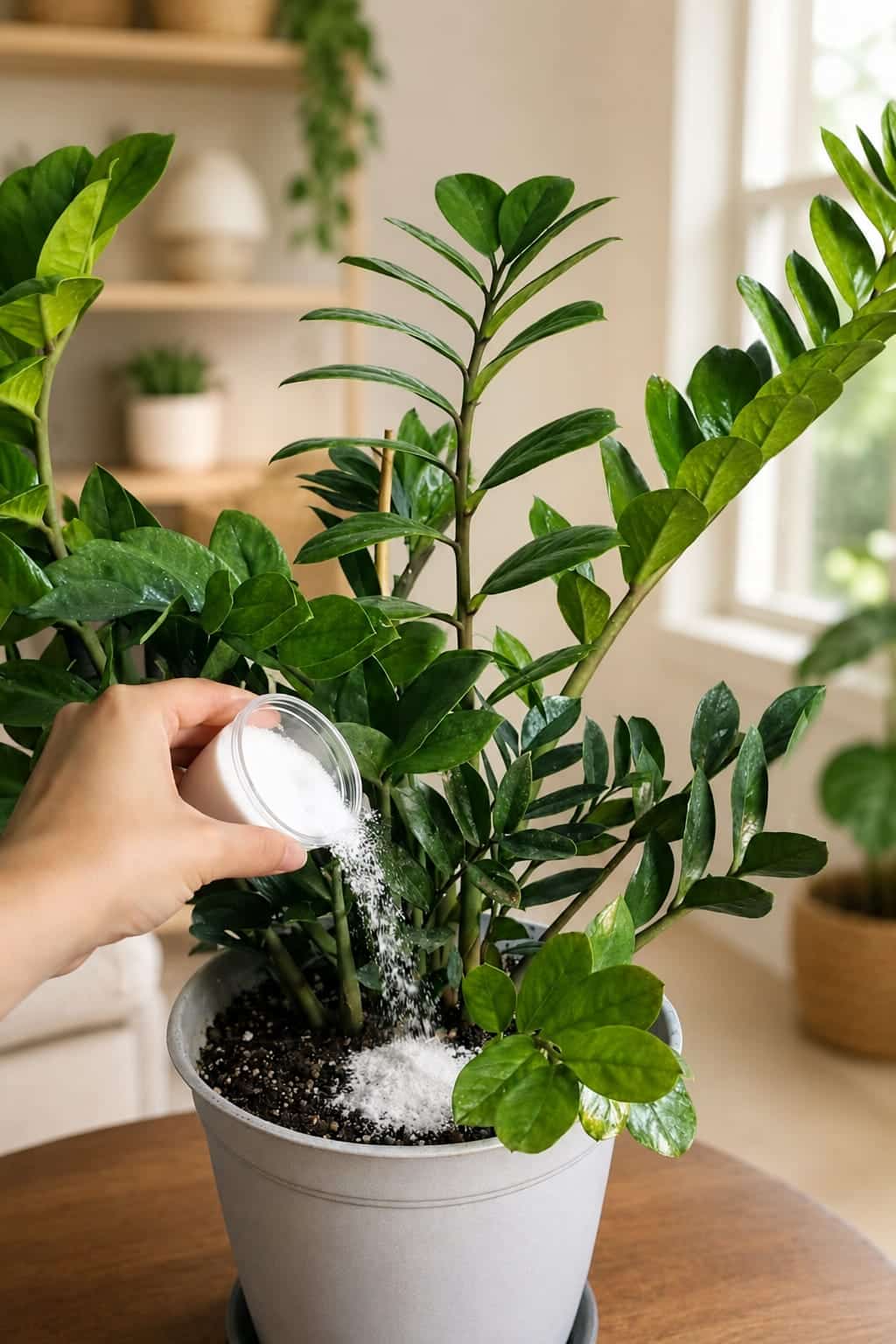
The Real Secret to ZZ Plant Growth
The real secret to a healthy ZZ plant is not Epsom salt. It is proper watering and drainage. ZZ plants store water in underground rhizomes. These rhizomes allow the plant to survive dry periods, but they can rot if the soil stays wet.
For strong growth, allow the soil to dry out before watering again. Water thoroughly when needed, then let the pot drain. This wet-dry cycle keeps the roots healthier than frequent small watering.
Bright indirect light is the second major secret. ZZ plants can survive in lower light, but they grow better when they receive more brightness. A plant near a bright window will usually produce new shoots more often than one in a dark corner.
Good soil is the third secret. A ZZ plant needs a mix that drains well and does not stay soggy. If the soil is dense and heavy, growth will slow and rot becomes more likely.
Best Light for ZZ Plants
ZZ plants tolerate low light, which makes them popular for offices and darker rooms. But if your goal is faster and fuller growth, low light is not ideal. A ZZ plant in low light may survive for years but grow very slowly.
For better growth, place the plant in bright indirect light. A spot near an east-facing window can be excellent. A few feet back from a bright south or west window can also work if direct sun is not too harsh.
Avoid strong direct afternoon sun, especially if the plant is not used to it. Harsh sun can scorch the leaves. If you want to move the plant to brighter light, do it gradually.
More light means the plant can use water and nutrients more effectively. This makes any feeding routine, including Epsom salt, safer and more useful.
How to Water a ZZ Plant Correctly
Water a ZZ plant only when the soil is dry or nearly dry. This may mean watering every two to four weeks in many homes, but the exact timing depends on light, temperature, pot size, and soil mix.
Do not water on a strict schedule. Always check the soil first. The top may look dry while the bottom is still moist, especially in a large pot.
When it is time to water, water deeply until excess drains out. Then empty the saucer. The plant should never sit in water.
During winter or in low light, water much less often. The plant grows slowly and uses less moisture during that time.
Best Soil for ZZ Plants
ZZ plants need a well-draining potting mix. A regular indoor potting mix may hold too much moisture if used alone, especially in a large pot. To improve it, add perlite, pumice, coarse sand, or small bark chips.
A cactus or succulent mix can also work well, especially if it still contains enough organic matter to support roots without staying wet.
The mix should feel loose and airy. After watering, it should drain freely and not remain heavy for many days.
If your ZZ plant has been in old compacted soil for a long time, repotting into a fresh airy mix may help more than any supplement.
Choosing the Right Pot
A ZZ plant pot must have drainage holes. This is one of the most important care rules. A decorative pot without drainage can trap water around the roots and rhizomes.
If you love a decorative container, use it as a cover pot. Keep the ZZ plant in a nursery pot with drainage holes inside the decorative pot. Remove the nursery pot when watering, let it drain, and then place it back.
The pot should not be too large. A pot that is much bigger than the root system holds excess soil, and excess soil holds excess moisture. ZZ plants prefer a pot that gives roots room without surrounding them with too much wet mix.
A slightly snug pot is often better than an oversized one.
Signs Your ZZ Plant Is Healthy
A healthy ZZ plant has firm upright stems and glossy green leaves. The leaves should feel smooth and sturdy, not soft or mushy. The soil should dry between waterings and should not smell sour.
New growth may appear as a fresh shoot pushing up from the soil. This shoot often looks lighter green at first, then darkens as it matures. ZZ plants may produce new shoots slowly, so do not worry if growth is not constant.
Healthy rhizomes below the soil are firm and thick. They are the plant’s storage system. Protecting them from rot is the key to long-term success.
If the plant is stable, glossy, and firm, it may not need Epsom salt at all.
Signs Your ZZ Plant Is Overwatered
Overwatering is the most common ZZ plant problem. Warning signs include yellow leaves, soft stems, mushy bases, wet soil that does not dry, and a sour smell from the pot.
If the plant is yellowing while the soil is wet, do not add Epsom salt. Do not fertilize. Do not water again. The roots may already be stressed.
Remove the plant from the pot if the problem continues. Check the rhizomes. Healthy rhizomes are firm. Rotten rhizomes are soft, dark, and sometimes foul-smelling.
Cut away rotten parts with clean tools. Repot firm healthy sections into fresh, dry, well-draining soil.
Signs Your ZZ Plant Is Underwatered
Although ZZ plants tolerate drought, they can still become too dry if neglected for a long time. Signs include wrinkled stems, dull leaves, dry leaf edges, and soil pulling away from the sides of the pot.
If the plant is underwatered, plain water is the first solution. Do not start with Epsom salt. Rehydrate the plant gently with room-temperature water and let it drain.
If the soil has become extremely dry and water runs straight through, water slowly in stages. You can also bottom-water briefly, then let the pot drain fully.
Once the plant stabilizes, return to a normal watering routine.
Can Epsom Salt Fix Yellow Leaves?
No. Epsom salt will not turn yellow ZZ plant leaves green again. Yellow leaves usually indicate overwatering, old age, root stress, or sometimes nutrient issues. The cause must be identified first.
If one old lower leaf turns yellow slowly, it may simply be aging. If many leaves turn yellow at once, check the soil and roots immediately.
If yellowing is caused by wet soil, Epsom salt can make things worse by adding more liquid and minerals to an already stressed plant.
Remove yellow leaves once they are fully damaged, and focus on preventing more yellowing through better care.
Can Epsom Salt Fix Brown Tips?
Epsom salt usually does not fix brown tips. Brown tips can be caused by underwatering, overfertilizing, mineral buildup, dry air, root stress, or physical damage.
If brown tips are caused by mineral buildup, adding Epsom salt may make the problem worse. In that case, flushing the soil with plain water or repotting may be better.
Brown tips will not turn green again. You can trim them with clean scissors if you want a neater appearance.
The goal is to prevent new brown tips by improving watering, soil, and fertilizer habits.
Can Epsom Salt Make ZZ Leaves Shinier?
Epsom salt does not directly shine leaves. ZZ plant leaves are naturally glossy when healthy and clean. If they look dull, dust may be the reason.
Wipe leaves gently with a damp cloth every few weeks. This removes dust and helps the plant absorb light better. Do not use oils, milk, mayonnaise, or commercial shine products that leave heavy residue.
Healthy shine comes from clean leaves, good light, proper watering, and healthy roots.
If new leaves are pale, check light and nutrition, but do not assume Epsom salt is always the answer.
Should You Fertilize a ZZ Plant?
ZZ plants do not need much fertilizer, but they can benefit from light feeding during active growth. Use a balanced houseplant fertilizer diluted to half strength or less once or twice in spring and summer.
Do not fertilize in winter if the plant is not actively growing. Do not fertilize a plant with root rot or wet soil.
If you use fertilizer, you may not need Epsom salt. A balanced fertilizer usually provides more complete nutrition.
Too much feeding is more harmful than too little. ZZ plants grow slowly and prefer a gentle routine.
Can Epsom Salt Replace Fertilizer?
No. Epsom salt cannot replace fertilizer. It provides magnesium and sulfur only. It does not provide the full nutrient profile that plants need.
If your ZZ plant truly needs feeding, use a balanced houseplant fertilizer. Epsom salt should be used only as a rare supplement if magnesium support seems helpful.
Do not combine strong fertilizer and Epsom salt at the same time. This can overload the soil with minerals.
Keep feeding simple. A ZZ plant does not need complicated mixtures.
⚠️ Important: Overusing Epsom salt can lead to mineral buildup, brown tips, and root stress. Always dilute, use rarely, and never apply to wet or rotting soil.
What to Do If You Used Too Much Epsom Salt
If you sprinkled a heavy amount of Epsom salt onto the soil, remove as much as possible from the surface. Use a spoon to lift away the crystals and any heavily affected topsoil.
If the pot has drainage holes and the soil is not already soggy, flush the pot with plain room-temperature water. Let the water drain fully. Empty the saucer afterward.
If the plant begins yellowing, wilting, or smelling sour, remove it from the pot and inspect the roots. Repot into fresh well-draining soil if needed.
After using too much Epsom salt, avoid all fertilizer and supplements for a while. Let the plant recover with simple care.
A Simple ZZ Plant Growth Routine
Place the ZZ plant in bright indirect light. It can tolerate low light, but better light encourages stronger growth.
Use a pot with drainage and a well-draining soil mix. Water only when the soil is dry or nearly dry. Let the pot drain completely.
Clean leaves with plain water and a soft cloth. Feed lightly during spring or summer if the plant is actively growing.
Use Epsom salt only rarely, and only as a weak dissolved solution. Do not sprinkle large amounts directly onto the soil.
This simple routine will keep the plant healthier than constant treatments.
Common Mistakes to Avoid
- Sprinkling a heavy layer of Epsom salt directly onto the soil – a weak dissolved solution is safer.
- Using Epsom salt as complete fertilizer – it is only magnesium sulfate.
- Using it on wet soil – ZZ plants must dry between waterings.
- Using it on a plant with root rot – rotten roots must be removed and the plant repotted.
- Expecting fast growth – ZZ plants naturally grow slowly.
- Keeping the plant in low light and hoping supplements will make it grow – light matters more.
- Using a pot without drainage – drainage is essential for ZZ plant health.
Frequently Asked Questions
Is Epsom salt good for ZZ plants?
It can be used rarely and lightly if the plant needs magnesium, but it is not necessary for most ZZ plants. Proper light, watering, and drainage are more important.
Can I sprinkle Epsom salt directly on ZZ plant soil?
It is safer not to. Dry crystals can create concentrated spots. Dissolve a small amount in water first and apply only when the plant needs watering.
How much Epsom salt should I use?
Use half a teaspoon dissolved in one gallon of water. For small plants, use one-quarter teaspoon per gallon.
How often should I use Epsom salt?
Use it rarely, about once every two to three months during active growth if needed. Many ZZ plants do not need it at all.
Can Epsom salt make a ZZ plant grow faster?
Not directly. ZZ plant growth depends mostly on bright indirect light, healthy roots, correct watering, and time. Epsom salt may only support growth if magnesium is lacking.
Can Epsom salt fix yellow leaves?
No. Yellow leaves usually come from overwatering, root stress, old age, or other care problems. Check soil and roots first.
Can Epsom salt replace fertilizer?
No. It provides magnesium and sulfur only. Use a balanced houseplant fertilizer during active growth if the plant needs feeding.
What should I do if I used too much?
Remove visible crystals, flush the soil with plain water if the pot drains well, and avoid more supplements. Repot if the plant begins to decline.
🌿 Epsom salt is a rare supplement, not a magic growth booster. For a healthy ZZ plant, focus on bright indirect light, fast-draining soil, a pot with drainage, and careful watering. Use Epsom salt only sparingly and always diluted – and let consistent care do the real work.