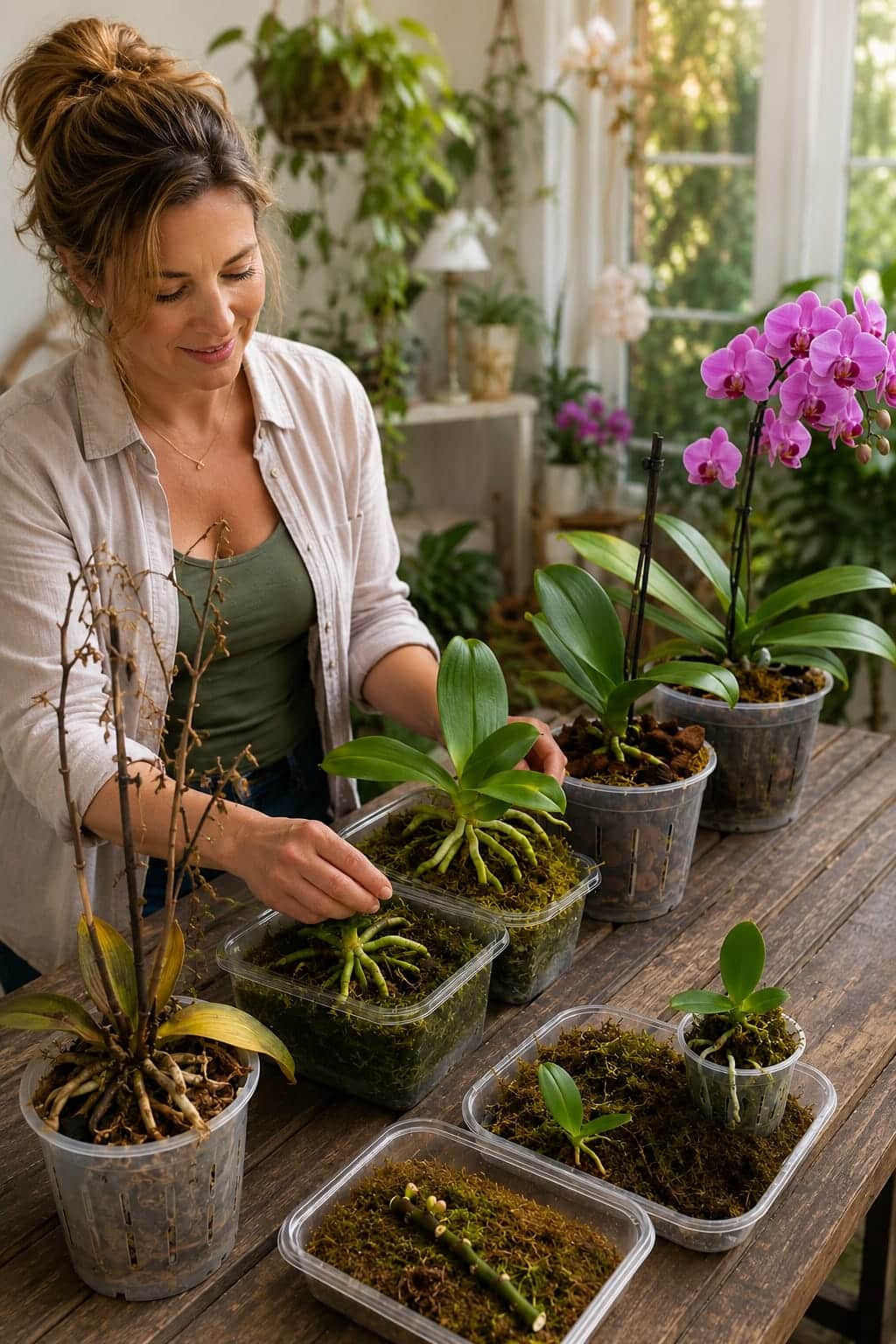
Step 11: Repot the Orchid Correctly
Place the orchid in the pot so the crown sits above the medium. Do not bury the crown. Gently arrange the roots inside the pot and add bark around them. Tap the pot lightly to settle the bark, but do not pack it tightly.
The plant should be stable. If it wobbles, use a stake or clip to hold it in place. Stability matters because new root tips can be damaged if the plant moves too much.
Add a light layer of moss on the surface only if needed for humidity. Do not smother the base. Too much moss can keep the crown and roots too wet.
After repotting, place the orchid in bright indirect light and avoid strong treatments for a while. The plant needs time to adjust.
Step 12: Create a Humidity Recovery Setup for Weak Orchids
The image shows orchids in clear plastic containers with moss. This kind of setup can help weak orchids by providing higher humidity around the roots and leaves. It is especially useful for orchids with few roots, but it must be done carefully.
Use moist moss, not soaking wet moss. The orchid should not sit in water. If roots are constantly wet, rot can return. The container should have some airflow. A completely sealed wet environment can lead to mold.
If using a mini greenhouse or plastic box, open it daily for fresh air. Keep it in bright indirect light. Never place a sealed plastic container in direct sun because it can overheat quickly.
Humidity helps reduce stress, but airflow prevents rot. Both are necessary.
How Long Does Root Recovery Take?
Orchid recovery takes time. After trimming and repotting, the plant may look unchanged for several weeks. This is normal. Orchids are slow plants, especially when recovering from root loss.
After a few weeks, you may see small green root tips emerging from the base. This is one of the best signs of recovery. New leaves may follow later.
A common timeline is 30 to 60 days for visible root progress, but it can be shorter or longer depending on the plant’s condition, temperature, light, and humidity. Do not expect every orchid to recover at the same speed.
If the crown stays firm and the roots do not rot further, the plant is moving in the right direction. Flowers should not be expected until the orchid has rebuilt strength.
Should You Water Immediately After Repotting?
This depends on the condition of the roots. If the orchid has many healthy roots and was repotted into dry bark, you can water lightly and let the pot drain. If many roots were cut away, it may be better to wait a short time before heavy watering.
After the first watering, allow the bark to begin drying before watering again. Do not keep the medium constantly wet. The plant needs moisture, but it also needs oxygen.
Use room-temperature water. Let water run through the bark and drain fully. Empty any saucer or outer pot after watering.
Do not water on a strict schedule. Look at the roots and bark. If roots are green, wait. If roots are silver and bark is nearly dry, water.
Light After Orchid Recovery
A recovering orchid needs bright indirect light. Light gives the plant energy to produce new roots and leaves. Too little light slows recovery, while harsh direct sun can burn or dehydrate the plant.
An east-facing window is often suitable. A bright room with filtered light can also work. If the leaves are very dark green, the plant may need more light. If they are yellow or scorched, the light may be too intense.
Do not place a weak orchid in hot direct sun after repotting. It may lose moisture faster than its damaged roots can replace it.
Good light is one of the most important recovery tools. No homemade treatment can replace it.
Fertilizing After Orchid Recovery
Do not fertilize heavily right after trimming and repotting. Damaged roots are sensitive. Strong fertilizer can burn them or create mineral buildup.
Wait until the plant shows signs of new root growth. Once new roots appear, use a very diluted orchid fertilizer. Many growers use fertilizer at one-quarter or half strength during active growth.
Garlic water is not fertilizer. Moss is not fertilizer. Cinnamon is not fertilizer. A recovering orchid eventually needs balanced nutrition, but only after it has roots that can use it.
Feed gently and observe the plant. More fertilizer does not mean faster recovery.
Using the Old Flower Spike for Propagation (Realistic)
The prompt mentions reusing the flower spike for propagation. This is a popular orchid experiment, but it should be presented carefully. Phalaenopsis flower spike propagation is possible in some cases, but it is not guaranteed. Many cut spikes simply dry out and do not produce new plants.
A flower spike may contain dormant nodes. Under the right conditions, a node can sometimes produce a keiki, which is a baby orchid plant. However, this requires a healthy node, high humidity, warmth, patience, and sometimes specialized keiki paste. Even then, success is not certain.
If the spike is completely brown and dry, it is not suitable for propagation.
How to Prepare a Flower Spike Cutting
If you want to try propagation, select a green, healthy section of spike with at least one dormant node. Cut the section with sterile scissors. Trim the ends cleanly.
Some growers remove the thin outer covering over the node to expose it slightly. This should be done carefully, because damaging the node will prevent growth.
The cut ends can be sealed with a tiny amount of wax to reduce moisture loss, but avoid coating the node itself. The node must remain able to grow.
Place the spike section in a humid but clean environment. It should not be submerged in water. Too much moisture can rot the cutting.
Using Moist Moss for Spike Propagation
A common method is to place the spike section on moist sphagnum moss inside a clear container. The moss should be damp, not wet. The container should hold humidity but still allow occasional airflow.
Open the container regularly to prevent mold. Keep it in bright indirect light, not direct sun. Warmth helps, but overheating can kill the cutting.
Mist only when the moss begins to dry. Do not keep the spike soaking wet. Mold is one of the biggest problems with this method.
If a small shoot appears after several weeks, continue maintaining humidity carefully. Root growth must develop before any new plant can be potted separately.
🌱 Realistic expectation: Spike propagation is slow and uncertain. Many spikes will never produce a keiki. The main orchid plant should always be your priority.
Why Some Orchids Recover Faster Than Others
Not all orchids recover at the same speed. A plant with several healthy roots may bounce back quickly after repotting. A plant with no roots may take months to show progress. A plant with crown damage may not recover at all.
Temperature matters. Orchids grow faster in warm, stable conditions. Cold rooms slow root growth. Light matters too. Bright indirect light supports energy production.
Humidity can help, but only with airflow. A humid, stagnant environment can cause mold. A dry environment can dehydrate a rootless orchid. Balance is key.
Patience matters most. Constantly unpotting the orchid to check roots can damage new growth. Once the plant is set up correctly, disturb it as little as possible.
Common Mistakes to Avoid
- Throwing away the orchid just because flowers faded – flower loss is normal. Check roots and crown first.
- Cutting healthy roots – firm silver roots are often alive. Remove only mushy, hollow, rotten roots.
- Using strong garlic water – orchids need gentle treatment. Strong homemade mixtures can stress roots.
- Sealing a weak orchid in a wet container with no airflow – humidity helps, but stagnant wetness causes rot.
- Expecting new blooms too soon – a recovering orchid needs roots and leaves before flowers.
- Using regular soil – orchids need airy bark or orchid mix.
- Overwatering after repotting – fewer roots mean less water absorption, so the plant must not stay wet.
A Realistic 45-Day Recovery Plan
In the first few days, focus on cleaning and repotting. Remove old flowers, trim dead roots, rinse the plant, and place it in fresh bark or a humidity recovery setup.
During the first two weeks, keep the orchid in bright indirect light. Avoid fertilizer and strong treatments. Watch for further rot, but do not disturb the plant unnecessarily.
By weeks three to six, look for signs of stabilization. The crown should remain firm. Leaves may still look wrinkled, but they should not collapse further. If conditions are good, new root tips may begin forming.
After about 45 days, some orchids may show new roots or leaves. Others may need more time. Recovery is not always fast, but any fresh root growth is a positive sign.
How to Know the Orchid Is Ready to Bloom Again
An orchid is ready to bloom again only after it has rebuilt strength. Look for healthy roots, firm leaves, and active growth. A new flower spike usually emerges from between the leaves when the plant has enough energy.
If the orchid has just recovered from severe root loss, do not try to force flowering. Give it a full growth cycle. Let it produce roots and leaves first.
To encourage future blooming, provide bright indirect light and a slight nighttime temperature drop for several weeks. Use diluted orchid fertilizer during active growth, then reduce feeding when appropriate.
Flowers are the result of a strong plant. Focus on strength first.
Frequently Asked Questions
Can an orchid recover after losing all flowers?
Yes. Losing flowers is normal. An orchid can recover and bloom again if the crown is healthy and the roots are alive.
Should I cut the flower spike after blooming?
If the spike is brown and dry, cut it near the base. If it is green and the plant is healthy, you may leave it or cut above a node. For weak orchids, cutting the spike helps the plant focus on recovery.
Can garlic water help orchids grow new roots?
Garlic water may be used as a mild occasional rinse, but it is not a guaranteed root-growth treatment. Healthy roots depend more on fresh bark, correct watering, light, humidity, and time.
How long should I soak orchid roots in garlic water?
If you use garlic water, keep it very diluted and soak for only 10 to 15 minutes. Weak orchids should not be exposed to strong solutions.
Can I use the old flower spike to grow a new orchid?
Sometimes, if the spike is still green and has dormant nodes, but success is not guaranteed. Many spikes dry out without producing keikis.
What is the best medium for recovering orchids?
Fresh orchid bark is usually best for Phalaenopsis orchids. Some humidity setups use damp moss, but it must not stay soaking wet.
Should I fertilize immediately after repotting?
No. Wait until the orchid shows signs of new root growth. Then use a very weak orchid fertilizer.
How long does orchid recovery take?
Recovery can take weeks to months. Some orchids show new roots in 30 to 60 days, while others take longer.
🌿 A wilted orchid after flowering is not a lost cause. With clean pruning, fresh bark, bright indirect light, careful watering, and realistic patience, many orchids can grow new roots and return to beautiful bloom cycles. Garlic water and spike propagation are optional experiments – the real recovery lies in steady, gentle care.