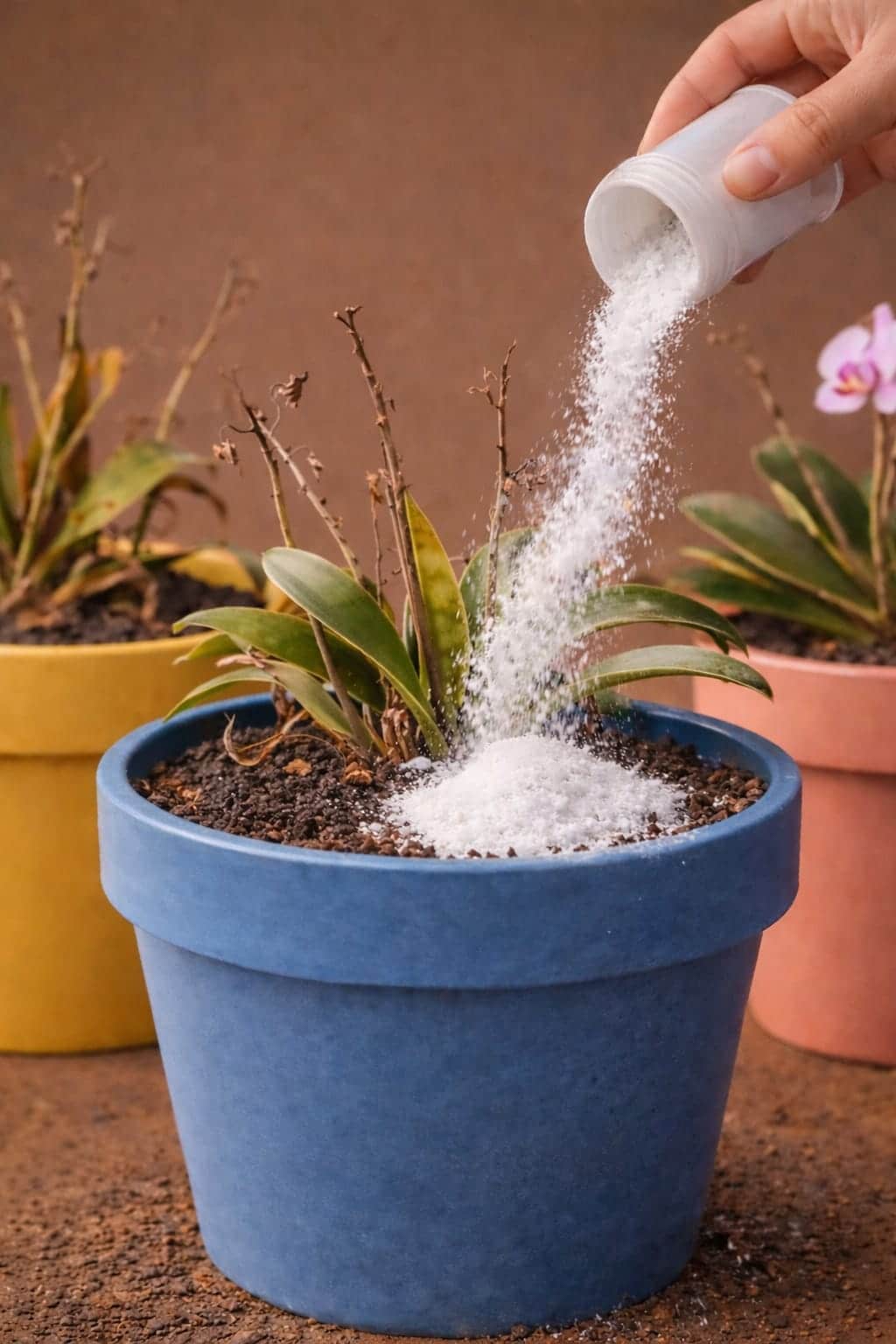
Why People Use Powder on Weak Orchids
Homeowners and hobby growers usually sprinkle a powder on orchids for one of three reasons:
- To Support Damaged Roots or Cuts
If dead roots or damaged tissue have been trimmed away, a dry powder like cinnamon is sometimes used lightly on cut areas to help keep them drier and prevent fungal entry. This is a legitimate use.
- To Give a Light Nutrient Boost
If the powder is a real orchid fertilizer or a mineral supplement (like Epsom salt), it may help support new growth when used correctly. However, most powdered fertilizers need to be dissolved in water, not sprinkled dry.
- To Address Surface Issues
Some powders are used because growers believe they help discourage mildew, fungus, or damp surface problems. Cinnamon and sulfur can help with minor surface mold, but they do not fix underlying root rot.
That does not mean the powder is what saves the orchid. Usually, the real recovery comes from fixing the environment around the roots.
What Actually Helps Weak Orchids Recover (Step‑by‑Step Rescue)
If your orchid looks weak, do not reach for a powder first. Follow this proven rescue protocol.
Step 1 – Check the Roots First (This Is Non‑Negotiable)
Gently remove the orchid from its pot. Knock away old bark. Examine the roots.
Healthy orchid roots are:
· Firm to the touch
· Green when wet, silvery when dry
· Plump, not flat or hollow
Bad roots are:
· Mushy, soft, or slimy
· Hollow or stringy (the outer sheath slides off)
· Brown, black, or dark gray
· Dried out and completely shriveled
Use clean, sharp scissors to cut away every dead or rotten root. Leave only firm, healthy roots. If more than half the roots are rotten, the orchid is in critical condition but may still be saved.
Step 2 – Remove Dead Leaves and Old Flower Spikes
Cut off any yellow, brown, or mushy leaves at the base. If the flower spike is brown and dry, cut it off near the base. If it is still green, you can leave it or cut it back to a node.
Step 3 – Treat Cut Surfaces (This Is Where Powder Helps)
After trimming, dust the cut ends with cinnamon powder. This is one of the few times a white (or tan) powder is genuinely helpful. Cinnamon acts as a natural antifungal, sealing the wound and preventing rot. Do not use cinnamon on healthy roots — only on cut surfaces.
Step 4 – Repot in Fresh, Airy Bark
Discard the old potting medium. It is likely broken down, acidic, and harboring pathogens.
Best orchid potting mix:
· High‑quality orchid bark (fir or pine)
· Add perlite or charcoal for extra drainage
· Do not use regular potting soil
Choose a pot with lots of drainage holes — clear plastic orchid pots are ideal because they let you see the roots. The pot should be just large enough to hold the root ball (snug, not oversized).
Step 5 – Provide Bright Indirect Light
Place the repotted orchid in a location with bright, indirect light. An east window or a south window with a sheer curtain is perfect. Low light will slow recovery; too much direct sun can burn stressed leaves.
Step 6 – Water Carefully (Less Is More)
After repotting, wait 5–7 days before watering. This gives cut roots time to callus over. Then water thoroughly, letting water run through the pot. Allow the bark to almost dry out before watering again.
· In normal conditions: water every 7–10 days.
· In recovery: err on the side of dryness. Overwatering is the biggest risk.
Step 7 – Consider a Gentle Feed (Liquid, Not Dry Powder)
Once you see new root growth (usually 2–4 weeks after repotting), you can begin a very light feeding routine.
· Use a balanced orchid fertilizer (like 20‑20‑20 or 10‑10‑10) diluted to quarter strength.
· Apply every other week during active growth (spring/summer).
· Never apply dry fertilizer powder directly to the bark — it can burn roots. Always dissolve in water.
If you want to use Epsom salt, dissolve 1 teaspoon per gallon of water and use once a month, alternating with regular fertilizer.
Step 8 – Be Patient
Orchids recover slowly. You may not see visible improvement for 4–6 weeks. New roots come first, then new leaves, then eventually a flower spike. Do not rush.
Can the White Powder Actually Help? (Honest Summary)
Yes — but only in the right situation.
A powder may help if:
· it is the correct product (cinnamon for cuts, diluted Epsom salt for deficiency, proper fertilizer dissolved in water)
· the orchid’s roots are still alive (at least some firm roots remain)
· the bark drains well and is fresh
· the plant is not being overwatered
· it is used lightly and not excessively
A weak orchid can sometimes benefit from a small supportive step like that.
But if the orchid is sitting in soggy, broken‑down bark with rotting roots, no powder will fix the real problem. You must address the root environment first.
The Biggest Mistake People Make
The most common mistake is treating the powder like a cure‑all. People often:
· sprinkle too much (cinnamon can cake and trap moisture)
· use the wrong powder (baking soda on roots is harmful)
· apply it to already wet, unhealthy bark (it just turns to paste)
· ignore the root system (the real problem)
· expect instant blooming (recovery takes months)
That is where things go wrong.
Orchids are not revived by random ingredients. They are revived by restoring healthy roots and stable care.
Signs Your Orchid Is Recovering
Once the real care improves, these are the signs you want to see:
· Firmer leaves – Leaves become turgid, not limp or wrinkled.
· Greener root tips – Active root tips are bright green and growing.
· Fresh root growth – New roots emerge from the base, often silvery with green tips.
· Stronger leaf color – Leaves return to a healthy, medium green.
· More stable upright growth – The plant stands firmly in the pot.
· New spike development later on – After several months, a flower spike may appear.
These signs appear gradually, not overnight. If you see new root growth, you have succeeded.
Which White Powder Should You Actually Keep on Hand?
For orchid care, these three powders are worth having.
- Cinnamon Powder (Most Useful)
· Use for: Dusting cut roots, trimmed leaves, and cut flower spikes. Also for minor surface mold.
· Do not use as: A fertilizer or root stimulant.
· How to apply: Light dusting only. Do not pile on.
- Epsom Salt (Occasionally Useful)
· Use for: Magnesium deficiency (yellowing between leaf veins on older leaves).
· Do not use as: A general fertilizer or cure for root rot.
· How to apply: Dissolve 1 teaspoon per gallon of water. Use once a month.
- Powdered Orchid Fertilizer (Use with Caution)
· Use for: Balanced nutrition when dissolved in water.
· Do not use as: A dry sprinkle on bark.
· How to apply: Follow label directions for dilution. Always water first.
Avoid baking soda, baby powder, flour, or unlabeled “mystery powders.”
Frequently Asked Questions (White Powder on Orchids)
Can I use cinnamon on orchid roots?
Yes, but only on cut ends after trimming rotten roots. Do not dust cinnamon on healthy roots — it can dry them out unnecessarily.
Is Epsom salt good for orchids?
In moderation. Epsom salt provides magnesium. If your orchid shows signs of deficiency, use a diluted solution once a month. It is not a bloom booster or root rot treatment.
Can I sprinkle baking soda on my orchid?
Not recommended. Baking soda raises pH and can damage delicate orchid roots. It is rarely helpful.
How do I know if my orchid needs fertilizer?
If the orchid has been in the same bark for over a year and has not been fed, a light fertilizer can help. Yellowing lower leaves and slow growth are common signs of nutrient deficiency.
Will cinnamon revive a dying orchid?
No. Cinnamon only prevents rot on cut surfaces. It does not provide water, light, or root health. If the orchid is dying from root rot, you must repot and trim roots first.
What is the best way to apply cinnamon to an orchid?
Dip a clean paintbrush or cotton swab into cinnamon powder. Lightly dab onto cut surfaces. Avoid getting cinnamon on healthy roots or into the crown.
Can I mix cinnamon with water and spray it?
Not recommended. Cinnamon does not dissolve well. A dry dusting is more effective and less messy.
How long does it take for a weak orchid to recover?
Root recovery takes 4–8 weeks. New leaves may take 2–3 months. Blooms can take 6–12 months, depending on the orchid’s health and season.
Preventing Weak Orchids (So You Never Need Rescue Powders)
The best cure is prevention. Follow these habits to keep orchids strong.
· Water only when the bark is nearly dry – Stick a wooden skewer into the bark. If it comes out damp, wait.
· Use clear pots with drainage – You can see root color and moisture levels.
· Repot every 1–2 years – Fresh bark prevents decomposition and root suffocation.
· Provide bright indirect light – An east window is ideal. South with sheer curtain also works.
· Keep water out of the crown – Water the bark, not the leaves. If water gets in the crown, dry it with a tissue.
· Fertilize weakly, weekly – Use quarter‑strength fertilizer with every other watering during active growth.
· Maintain good airflow – A small fan on low helps prevent fungal issues.
Final Thoughts
So why are smart homeowners using this white powder on weak orchids?
Because in some cases, a dry powder or light orchid supplement can support recovery — especially cinnamon for cut surfaces or diluted Epsom salt for a specific deficiency.
But the powder is not the magic.
The real secret is:
· healthy roots (trim rot, keep firm roots)
· fresh, airy bark (repot every 1–2 years)
· careful watering (dry between waterings)
· bright indirect light (energy for recovery)
· patience (recovery takes months)
That is what brings a weak orchid back.
And once the roots recover, the rest of the plant usually follows — stronger leaves, better growth, and eventually, beautiful blooms again.
So before you reach for that white powder, check the roots. Repot if needed. Adjust your watering. Then, if you want to use cinnamon on cuts or a gentle diluted feed, do so wisely.
Your orchid will thank you — with firm leaves, active roots, and eventually, those stunning flowers that made you fall in love with orchids in the first place.
Have you tried using a white powder to revive a weak orchid? Share your experience in the comments below. And if you found this guide helpful, save it for later or send it to a fellow orchid lover who needs some rescue truth.