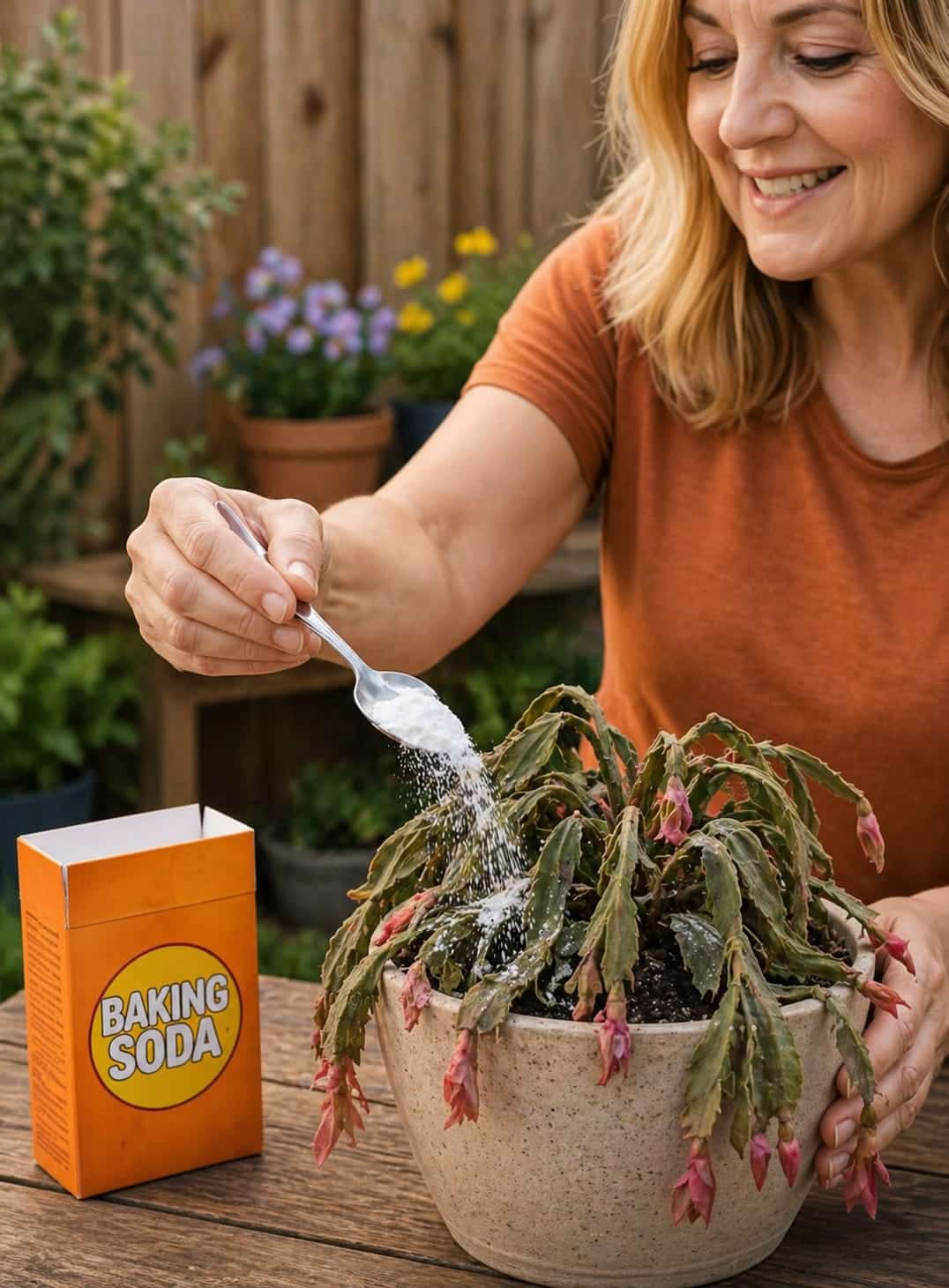
A Christmas cactus can look magical when it is healthy. Its segmented green stems spill over the edge of the pot, pink or white buds form at the tips, and the blooms open just when the home needs color most. It is one of those plants that can become part of a family routine, blooming year after year during the colder months and bringing life to windowsills, tabletops, and cozy corners.
But a struggling Christmas cactus can look dramatic in the opposite way. The stems may droop, wrinkle, soften, turn dull, or hang lifelessly over the pot. Buds may form but never open. Flowers may dry before their time. The plant may look exhausted, as if one more missed watering or one more cold night could finish it completely.
That is why many plant lovers become curious when they see the baking soda trick. In the image, a spoonful of white powder is being sprinkled over a tired Christmas cactus, and the bright orange box of baking soda sits nearby like the secret ingredient. It looks simple, cheap, and powerful. It makes people wonder whether this ordinary kitchen powder can rescue a weak holiday cactus, stop problems in the soil, and help the plant return to blooming.
So what exactly is the baking soda Christmas cactus trick?
The idea is that baking soda can be used in very small amounts as a surface treatment or heavily diluted spray in certain plant-care situations. Some gardeners use baking soda mixtures to help manage mild fungal issues on leaves, while others sprinkle a tiny amount on soil surfaces to freshen a musty pot. Because baking soda is alkaline and has a clean, dry texture, it has become popular in many household plant hacks.
However, Christmas cactus is not a plant that should be covered heavily in baking soda. It is a tropical cactus with sensitive roots, and too much baking soda can disturb the soil, leave residue, and stress the plant. The safest version of this trick is not dumping spoonfuls of powder onto the plant. The safer version is using a tiny pinch only when there is a specific reason, or using a very weak diluted solution as part of a careful rescue routine.
In this complete guide, you will learn what the baking soda Christmas cactus trick is, when people use it, how to use it more safely, when to avoid it, what problems it can and cannot fix, and what your Christmas cactus truly needs to recover and bloom year after year.
What Is the Baking Soda Trick for Christmas Cactus?
The baking soda trick is a homemade plant-care method where baking soda is used in tiny amounts around a plant, usually to address surface issues such as mild mold, stale-smelling soil, or certain fungal-looking problems. It is popular because baking soda is inexpensive, easy to find, and already used for cleaning, deodorizing, and household freshness.
For Christmas cactus, the trick is usually shown as white powder being sprinkled onto the soil or over the plant. The image can look convincing, especially when the plant is drooping and weak. It gives the impression that the powder is a rescue treatment.
But Christmas cactus is not a tough desert cactus that wants dry alkaline conditions all the time. It is a forest cactus. It likes bright indirect light, moderate moisture, loose organic soil, humidity, and a seasonal rest period before blooming. Its roots do not want harsh buildup in the pot.
That means baking soda should be used with caution. It is not a fertilizer. It does not feed the plant. It does not trigger blooms. It does not repair root rot. It should never be used as a regular plant food or heavy soil amendment.
The safest way to understand the trick is this: baking soda may be used sparingly as a temporary surface helper, but the real recovery comes from correcting water, light, soil, drainage, humidity, and temperature.
Why People Try Baking Soda on a Weak Christmas Cactus
People try baking soda because a weak Christmas cactus often looks like it needs immediate help. The stems droop, the buds hang down, and the whole plant may appear tired. When a plant looks that sad, it is natural to want a quick fix.
Baking soda also has a strong reputation in the home. People use it to absorb odors, clean surfaces, freshen refrigerators, and deodorize carpets. Because of that, it feels like a natural option for stale soil or a pot that smells damp.
Some gardeners also use baking soda in diluted sprays for certain fungal problems on outdoor plants. This has made people wonder whether the same ingredient can help indoor houseplants. In small, careful amounts, it may help with very mild surface issues, but it must not be treated as a cure-all.
The reason this trick appears attractive is that it is simple. You do not need to buy anything special. You do not need to repot immediately. You do not need a complicated product. But simple does not always mean safe in large amounts.
For Christmas cactus, a tiny amount may be tolerable in certain situations, but too much can cause more stress. The plant needs a balanced environment, not a thick white coating of kitchen powder.
Can Baking Soda Save a Drooping Christmas Cactus?
Baking soda cannot directly save a drooping Christmas cactus. Drooping usually comes from watering problems, root stress, temperature shock, low humidity, old soil, or a poor light situation. Baking soda does not solve those root causes.
If the plant is drooping because it is thirsty, it needs proper watering, not powder. If the plant is drooping because the roots are rotting in wet soil, it needs root inspection and repotting, not more surface treatment. If the plant is drooping from heat, cold, or sudden movement, it needs stable conditions.
The same limp appearance can happen from opposite causes. A dry Christmas cactus can droop because it lacks water. An overwatered Christmas cactus can also droop because its roots are damaged and cannot absorb water. This is why checking the soil is more important than adding baking soda.
Before using any trick, push your finger into the soil. If the soil is dry and the stems are wrinkled, water correctly. If the soil is wet and the plant is drooping, stop watering and check the roots. Baking soda should not be the first response.
What Baking Soda Can Actually Do
Baking soda may help in limited ways. It can slightly freshen the soil surface if there is a mild musty smell. It may discourage some surface mold when used very sparingly. In diluted spray form, it is sometimes used by gardeners as part of a mild fungal-control approach.
But these benefits are limited. Baking soda does not create strong roots. It does not provide balanced nutrients. It does not make buds form. It does not correct old compacted soil. It does not remove pests hidden under leaves. It does not fix a pot that has no drainage holes.
It also changes the surface environment because baking soda is alkaline. Too much can disturb the potting mix. Christmas cactus generally prefers a slightly acidic to neutral, organic, well-draining mix. A heavy alkaline powder is not something the plant needs regularly.
So baking soda should be used only as a small, occasional helper for a specific issue, not as a routine care product.
What Baking Soda Cannot Fix
Baking soda cannot fix root rot. If the roots are brown, mushy, slimy, or rotten, the plant needs to be removed from the pot. The damaged roots must be trimmed, and the plant must be repotted into fresh, airy soil. A white powder on top of the soil will not repair rotten roots below.
Baking soda cannot fix underwatering. If the plant is dehydrated, it needs proper moisture. A Christmas cactus is not a desert cactus, and it should not be left bone-dry for long periods during active growth or bloom.
Baking soda cannot fix low light. If the plant never blooms or grows weakly, it may need brighter indirect light. No powder can replace light energy.
Baking soda cannot stop bud drop caused by drafts, heat vents, sudden movement, or inconsistent watering. Bud drop usually happens because conditions changed too quickly.
Baking soda also cannot replace fertilizer. If the plant needs nutrients during spring and summer growth, use a balanced houseplant fertilizer diluted to half strength, not baking soda.
Is Baking Soda Safe for Christmas Cactus?
Baking soda can be risky if used heavily. A tiny pinch on the soil surface may not cause harm, but spoonfuls of baking soda sprinkled repeatedly can create buildup and alter the potting environment. It can also leave white residue on stems and soil.
Christmas cactus roots are not designed for salty or alkaline buildup. Baking soda contains sodium, and too much sodium is not good for plant roots. This is one of the biggest reasons not to overuse it.
If you want to try the trick, use the smallest possible amount. Do not cover the plant. Do not pour baking soda into the crown. Do not pack it around the stems. Do not use it every week. Do not use it on a plant already suffering from wet, rotten roots.
For many Christmas cactus problems, it is better to fix the care conditions than to use baking soda at all.
The Safer Baking Soda Soil Surface Method
If your Christmas cactus soil has a very light musty surface or a tiny amount of surface mold, you can try a cautious baking soda method. This should be done only on the soil surface, not all over the plant.
What You Need
- Baking soda
- A small spoon
- Fresh dry potting mix if needed
- A soft brush or cloth
Instructions
- Remove any visible mold or crust from the top of the soil first.
- Let the soil surface dry.
- Sprinkle only a tiny pinch of baking soda over the affected area.
- Do not cover the whole pot heavily.
- Keep the powder away from the base of the stems.
- Improve airflow and reduce watering frequency.
- Replace the top layer of soil if the problem returns.
The amount should be very small. For a medium pot, think of a light pinch, not a spoonful. The goal is not to turn the soil white. The goal is to lightly treat one small surface area while fixing the moisture issue.
The Safer Baking Soda Spray Method
A diluted baking soda spray is sometimes used for mild fungal-looking spots on some plants. For Christmas cactus, it should be used carefully because the segmented stems can hold residue. Always test a small area first.
Ingredients
- 1/4 teaspoon baking soda
- 4 cups water
- Optional: 1 drop mild liquid soap, only if needed to help mixing
- A spray bottle
Instructions
- Mix the baking soda into the water until dissolved.
- Add no more than one tiny drop of mild soap if needed.
- Shake gently.
- Test on one small stem section.
- Wait 24 hours.
- If there is no damage, mist affected areas lightly.
- Do not soak the plant.
- Keep it out of direct sun while the spray dries.
This spray should not be used often. It should not be applied to buds or flowers. It should not run into the soil heavily. If the plant reacts badly, rinse gently with plain water and stop using it.
Why You Should Not Sprinkle a Spoonful Over the Whole Plant
The image of a spoonful of baking soda being sprinkled over a Christmas cactus may look dramatic, but it is not the safest practical method. A spoonful is usually too much for a small or medium potted plant. Powder can settle between stem segments, dry onto the plant, and leave residue.
If baking soda gathers in wet areas, it can become concentrated. If it washes into the soil repeatedly, it can create buildup. If it sits on buds, it may damage delicate tissue or make flowers look dusty.
A Christmas cactus does not need to be coated in powder. If you are trying to handle surface mold, treat the soil surface lightly. If you are trying to handle a fungal issue, use a diluted spray carefully. If the plant is drooping, diagnose the water and roots first.
In most cases, the dramatic spoonful is more for visual effect than for good plant care.
How to Diagnose a Weak Christmas Cactus Before Using Baking Soda
Before adding anything to the pot, look carefully at the plant. Start with the stems. Are they wrinkled and thin? Are they soft and mushy? Are they yellowing? Are buds falling off? Each symptom points to a different issue.
Next, check the soil. Is it dry, damp, soggy, compacted, or sour-smelling? A dry pot with wrinkled stems usually needs water. A wet pot with limp stems may indicate root problems.
Check the pot. Does it have drainage holes? If not, water may be trapped at the bottom. A Christmas cactus likes moisture, but it cannot sit in stagnant water.
Check the location. Is the plant near a heating vent, cold draft, bright direct sun, or dark corner? Temperature and light stress can cause drooping and bud drop.
Only after checking these basics should you decide whether baking soda is needed. Most Christmas cactus problems are solved by better care, not powder.
If the Plant Is Drooping and the Soil Is Dry
If your Christmas cactus is drooping and the soil is dry, the plant may be thirsty. Christmas cactus is a tropical forest cactus, not a desert cactus. It likes the soil to dry slightly between waterings, but it should not stay bone-dry for long periods during active growth or bloom.
Water thoroughly with plain room-temperature water. Let excess drain from the bottom of the pot. Empty the saucer. Then place the plant in bright indirect light and give it time to recover.
Do not sprinkle baking soda on a dehydrated plant as the main treatment. Dehydration needs water. A dry plant may perk up within a day or two, though severely wrinkled stems can take longer.
If the Plant Is Drooping and the Soil Is Wet
If the soil is wet and the Christmas cactus is still drooping, stop watering. This may be a sign of root rot or oxygen-starved roots. Adding baking soda will not fix the problem.
Gently remove the plant from the pot and inspect the roots. Healthy roots should be firm. Rotten roots may be brown, black, mushy, slimy, or smelly. Remove old wet soil and trim damaged roots with clean scissors.
Repot the plant into fresh, airy, well-draining mix. Choose a pot with drainage holes. After repotting, water lightly only if the new soil is dry and the roots are healthy enough. If you trimmed many roots, wait a few days before watering.
Place the plant in bright indirect light and keep conditions stable. This is a true rescue method. Baking soda is not enough for wet-root problems.
If There Is Surface Mold on the Soil
Surface mold usually means the top layer of soil is staying too moist or airflow is poor. It may look alarming, but mild surface mold is often a sign of conditions rather than a direct attack on the plant.
First, remove the moldy top layer. Use a spoon to lift away the affected soil. Replace it with fresh dry mix. Improve airflow around the plant. Let the soil dry a bit more between waterings. Make sure the pot drains well.
A tiny pinch of baking soda may be used on the surface after cleanup, but do not rely on it alone. If the soil stays wet, mold can return. Fixing moisture and airflow is more important.
If Buds Are Falling Off
Baking soda will not stop bud drop. Christmas cactus buds fall because the plant is stressed. Common causes include sudden movement, temperature changes, drafts, overwatering, underwatering, low humidity, or too much fertilizer.
Once buds form, keep the plant stable. Do not move it from room to room. Keep it away from heating vents and cold drafts. Water when the top inch of soil begins to dry, but do not let the pot sit in water. Provide bright indirect light.
If buds are already falling, avoid adding powders or strong sprays. The plant needs stability, not more stress.
Continue to Page 2
Continue to page 2 for more details about this article and the key points many readers miss on the first page.