Anthuriums are some of the most elegant houseplants you can keep indoors. Their heart-shaped leaves, glossy surface, upright stems, and tropical look make them feel expensive and lush even when they are sitting in a simple pot on a table. Some anthuriums are grown for their bright red, pink, white, or purple spathes, while others are loved mostly for their shiny green foliage. Either way, a healthy anthurium can turn a quiet corner into a fresh, tropical display.
But anthuriums can also be a little confusing. They may look beautiful for months and then suddenly slow down. New leaves may come in smaller. The glossy shine may fade. The plant may stop blooming. The soil may stay wet too long. The roots may struggle in heavy potting mix. Many plant owners water more, move the pot around, or try one homemade trick after another without understanding what the plant actually needs.
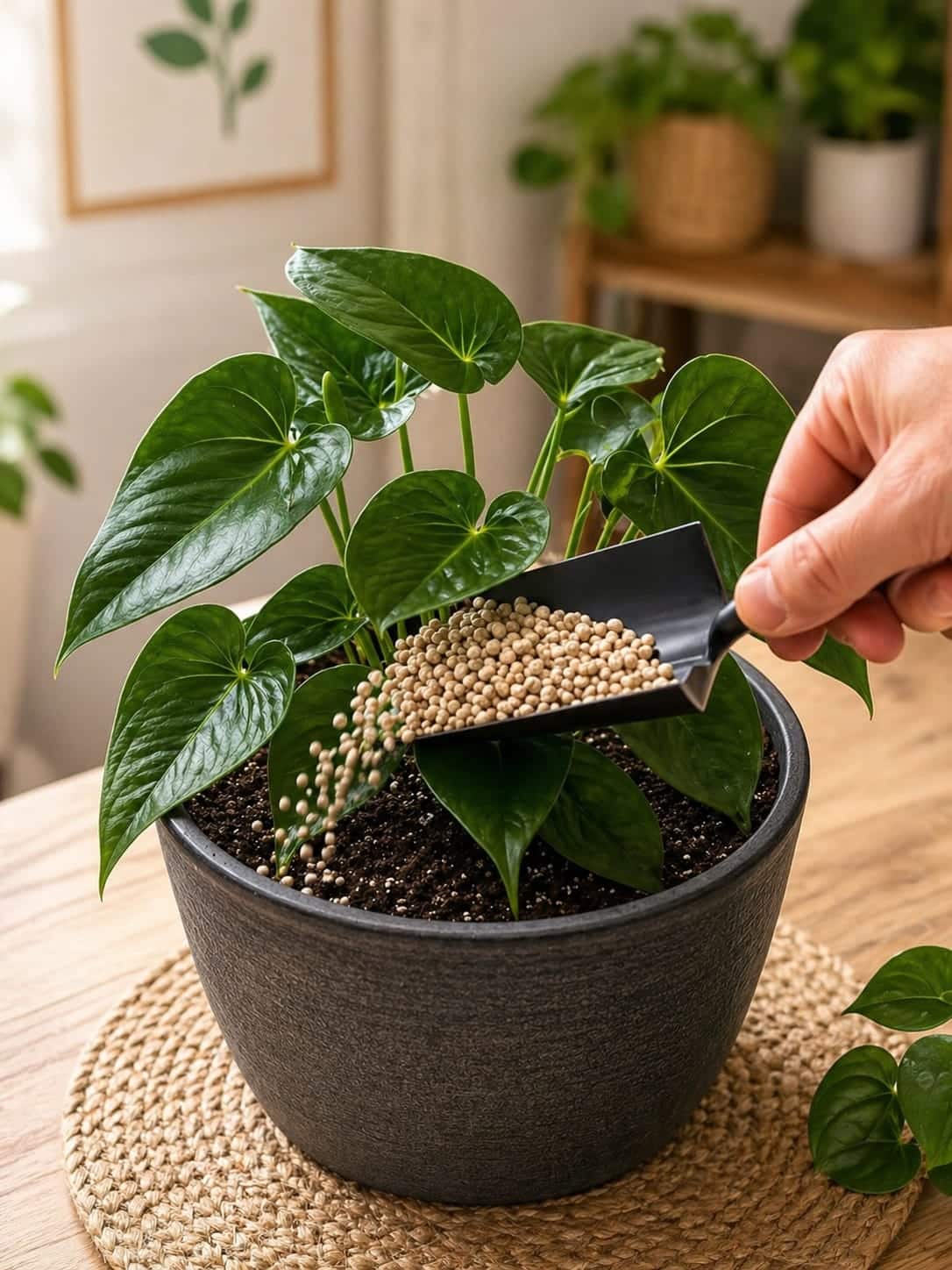
That is why the beige pellet trick is getting attention. In the image, a scoop of small beige pellets is being poured onto the soil around a healthy green anthurium. The leaves look glossy, full, and strong, and the pellets look like a simple secret ingredient that could feed the plant slowly without messy liquid fertilizer. It looks clean, easy, and perfect for people who want a low-maintenance way to support indoor plants.
So what are these beige pellets?
The safest and most useful version of this trick is a gentle slow-release houseplant fertilizer, controlled-release plant food, worm casting pellets, or mild organic fertilizer granules. These small pellets are placed on the soil surface or lightly mixed into the upper layer, where they gradually release nutrients every time the plant is watered. For anthuriums, this can be a convenient way to provide steady support during active growth.
However, the beige pellet trick must be used carefully. Anthuriums are not heavy-feeding garden vegetables. They are tropical houseplants with roots that need air, moisture, and gentle nutrition. Too many pellets can burn roots, cause brown leaf tips, create salt buildup, or push weak growth. The right method is a light application, used at the right time, in a pot with drainage and an airy potting mix.
In this complete guide, you will learn what the beige pellet anthurium trick is, which pellets are safest, how much to use, when to apply them, what mistakes to avoid, and how to combine this method with the real anthurium care routine for glossy leaves, strong roots, and better blooms.
What Is the Beige Pellet Anthurium Trick?
The beige pellet anthurium trick is a slow-feeding method where small plant-safe pellets are added to the soil around an anthurium. These pellets may be slow-release fertilizer beads, organic fertilizer granules, worm casting pellets, or another gentle plant food designed to release nutrients gradually.
The idea is simple. Instead of mixing liquid fertilizer every few weeks, you add a small amount of pellets to the pot. Each time you water, the pellets slowly break down or release nutrients into the potting mix. This gives the plant a steady supply of food without sudden strong doses.
For anthuriums, this can be helpful because they like consistent, gentle care. They do not enjoy extreme swings. Strong fertilizer one week and nothing for months can stress the roots. A small amount of slow-release nutrition can be easier for the plant to handle.
But the trick only works when used in moderation. A scoop full of pellets may look impressive in a photo, but most indoor anthuriums need only a small amount. Too much fertilizer can do more harm than good. The goal is not to cover the soil with pellets. The goal is to add a light, controlled feeding layer that supports the plant without overwhelming it.
Why Anthuriums Benefit From Gentle Feeding
Anthuriums grow naturally in warm tropical environments, often in loose organic material where their roots receive moisture, nutrients, and plenty of air. Indoors, they need a similar balance. They like moisture, but not soggy soil. They like nutrients, but not strong fertilizer. They like humidity, but not stagnant wetness around the roots.
When an anthurium is growing well, it produces shiny new leaves, firm stems, and sometimes colorful spathes. But if the plant is underfed for a long time, new growth can become smaller or slower. Leaves may lose some richness. The plant may seem alive but not vigorous.
A gentle pellet fertilizer can help because it provides nutrients gradually. Instead of giving the plant a sudden liquid fertilizer rush, the pellets feed slowly. This can support leaf development, root activity, and overall plant strength during spring and summer.
Still, feeding is only one part of the picture. Anthuriums cannot use fertilizer properly if they are sitting in heavy wet soil, low light, or a pot without drainage. If the roots are not healthy, fertilizer may make the problem worse. Strong roots come first. Feeding comes after.
What Kind of Beige Pellets Should You Use?
The best beige pellets for anthuriums are pellets made specifically for plants. They should be labeled as houseplant fertilizer, slow-release fertilizer, controlled-release fertilizer, organic plant food, worm casting pellets, or a similar plant-safe product.
A slow-release houseplant fertilizer is the easiest choice for many people. These pellets are designed to release nutrients over time. They usually contain a balanced mix of nitrogen, phosphorus, and potassium, along with smaller nutrients. For anthuriums, choose a gentle product and use a light dose.
Worm casting pellets are a softer organic option. They are usually mild and less likely to burn roots when used correctly. They may also improve the soil surface slightly as they break down. They are a good choice for plant owners who prefer natural amendments.
Organic fertilizer granules can work, but they should be used cautiously indoors. Some organic fertilizers have a strong smell when wet and may attract fungus gnats if overapplied. Choose clean, mild formulas made for containers or houseplants.
Do not use random beige pellets that are not made for plants. Do not use animal feed, cat litter, craft beads, food pellets, seed beads, dried beans, or unknown granules. Only plant-safe products belong in the pot.
Are the Pellets Fertilizer or Soil Decoration?
In a safe plant-care routine, the pellets should be fertilizer or soil amendment, not decoration. Decorative beads or craft pellets may look nice, but they do not feed the plant and may not be safe for soil. Some decorative materials can trap moisture or leach unwanted substances.
If the pellets are slow-release fertilizer, they should be used according to the label. If they are worm casting pellets, they can be used as a mild top-dressing. If they are clay balls or leca, they are not fertilizer; they are used for aeration or semi-hydro growing methods, not as plant food.
This is important because many beige pellets look similar. A scoop of small round pellets could be fertilizer, leca, organic granules, or something else entirely. For anthurium care, always identify the product before using it.
The safest rule is simple: if the package does not clearly say it is safe for plants, do not put it in your anthurium pot.
How Much Pellet Fertilizer Should You Use?
Use less than the photo seems to suggest. A full scoop may look satisfying, but an indoor anthurium usually needs only a small amount. Too much fertilizer can damage roots and cause brown leaf tips.
For a small pot, use only a tiny pinch. For a medium pot, use about 1/4 teaspoon to 1/2 teaspoon, depending on product strength. For a large pot, use about 1 teaspoon at most unless the product label says otherwise. If using worm casting pellets, you can usually use a slightly larger but still light top-dressing because they are gentler than synthetic fertilizer pellets.
Always start with less. You can feed again later if the plant responds well, but it is harder to undo fertilizer burn. Anthuriums prefer light, steady nutrition over heavy feeding.
If the fertilizer label gives a dose for outdoor containers, reduce it for indoor anthuriums. Indoor plants usually grow more slowly than outdoor plants and need less fertilizer.
How to Apply Beige Pellets Correctly
Start by checking the potting mix. It should not be soaking wet, sour-smelling, or compacted. If the soil is unhealthy, fix the soil before feeding. Fertilizer should be used on a plant with a reasonably healthy root zone.
Sprinkle the pellets lightly around the outer soil surface. Keep them away from the direct base of the stems. Anthurium stems emerge from the crown, and concentrated fertilizer near the crown can be stressful. A ring around the outer part of the pot is safer.
After sprinkling, gently scratch the pellets into the top layer of the mix if the product instructions allow it. Do not dig deeply. Anthurium roots can be close to the surface, and rough digging can damage them.
Water normally the next time the plant needs water. Do not drown the pot just to activate the pellets. Slow-release feeding is meant to be gradual. When you do water, let excess liquid drain fully from the bottom of the pot and empty the saucer.
When Is the Best Time to Use the Pellet Trick?
The best time to use beige pellets on an anthurium is during active growth, usually spring and summer. This is when the plant is producing new leaves, roots, and blooms. During this time, gentle feeding can support the plant’s natural growth cycle.
You can also apply a small amount in early fall if the plant is still actively growing in a warm, bright room. But in winter, many anthuriums slow down because light levels drop. When growth slows, the plant needs less fertilizer. Feeding heavily in winter can lead to buildup and root stress.
If your anthurium is under strong grow lights and continues producing new leaves year-round, it may tolerate light feeding more often. But even then, keep the dose gentle.
Do not apply pellets right after repotting if the plant is stressed. Fresh potting mix often contains some nutrients, and disturbed roots need time to settle. Wait a few weeks before feeding after a major repot.
How Often Should You Use Beige Pellets?
How often you use the pellets depends on the product. Some slow-release fertilizers feed for three months. Others feed for six months. Worm casting pellets break down differently and may be refreshed more gently.
Read the product label first. Then use the lightest reasonable schedule for indoor plants. For many anthuriums, a small application every three to four months during active growth is enough. If using worm casting pellets, a light top-dressing every two to three months during the growing season may be fine.
Do not keep adding pellets every week. They are not like water. They continue releasing nutrients over time. Repeated applications can build up and damage roots.
If you are also using liquid fertilizer, reduce or stop liquid feeding when using pellets. Using both at full strength can overfeed the plant.
Can Beige Pellets Make Anthurium Leaves Glossier?
Pellets can support healthy new growth, and healthy anthurium leaves are naturally glossy. But fertilizer alone does not create shine. Leaf gloss comes from the whole care routine: bright indirect light, proper watering, humidity, clean leaves, and healthy roots.
If your anthurium leaves look dull, they may simply be dusty. Wipe them gently with a soft damp cloth. Dust blocks light and makes leaves look flat. Cleaning the leaves often gives an instant improvement.
Do not use fertilizer pellets directly on leaves. Do not crush pellets into water and wipe the leaves. Do not use oil, milk, or leaf-shine sprays unless they are specifically safe for plants. Anthurium leaves are beautiful when clean and naturally healthy.
The pellet trick supports the plant from the root zone. The leaf shine comes later as the plant grows under good conditions.
Can Beige Pellets Help Anthuriums Bloom?
Pellets can help indirectly by feeding the plant during active growth. A well-fed, healthy anthurium with good light is more likely to produce blooms than a neglected plant in depleted soil. But fertilizer pellets do not force blooms by themselves.
Anthurium blooms depend heavily on bright indirect light. Many anthuriums fail to bloom indoors because they are kept in corners that are too dim. They may survive and produce green leaves, but they do not have enough energy to flower often.
If you want more blooms, improve light first. Place the plant near a bright window with filtered light. Avoid harsh direct afternoon sun, which can scorch leaves. Then feed gently during active growth.
A bloom-supporting fertilizer may help if used lightly, but do not overdo it. Too much fertilizer can damage roots and reduce overall plant health. A small, steady feeding routine is better than a strong bloom-pushing dose.
Can Beige Pellets Strengthen Roots?
Pellets can support root growth if the roots are already healthy and the potting mix is airy. Nutrients help the plant build new tissue, including roots. But fertilizer cannot fix rotten roots, compacted soil, or a pot that stays wet too long.
Anthurium roots need oxygen. This is why a chunky potting mix is so important. If the roots are suffocating in dense wet soil, adding pellets may make things worse because the plant cannot use the nutrients properly.
If your anthurium is drooping, yellowing, or smelling sour at the soil level, inspect the roots before feeding. Healthy roots are firm and light-colored. Rotten roots are dark, soft, and may smell bad. Rotten roots need trimming and repotting, not fertilizer.
Pellets are for maintenance and support, not emergency rescue.
The Best Soil Mix for Anthuriums
Anthuriums need an airy, chunky mix. Regular potting soil alone is often too dense and wet. A better mix gives roots moisture and airflow at the same time.
A simple anthurium mix can include:
- 2 parts orchid bark
- 1 part indoor potting mix or coco coir
- 1 part perlite or pumice
- A small amount of horticultural charcoal, if available
This mix is loose, breathable, and quick-draining. It allows fertilizer pellets to release nutrients without sitting in a soggy root zone.
If your anthurium is planted in heavy soil that stays wet for many days, repotting into a chunky mix will help more than any feeding trick. Fertilizer works best when the roots can breathe.
The Best Pot for Anthuriums
Anthuriums should be grown in pots with drainage holes. Drainage is essential because these plants like moisture but hate stagnant water. A pot without drainage can trap water at the bottom and cause root rot.
Choose a pot that is only slightly larger than the root ball. A pot that is too large holds too much mix, and extra mix stays wet longer. Anthuriums like room to grow, but they do not need an oversized container.
If you love a decorative pot without drainage, use it as a cover pot. Keep the anthurium in a nursery pot with holes, place it inside the decorative pot, and remove it for watering. Let it drain completely before putting it back.
Fertilizer pellets should never be used heavily in a no-drainage pot. Without drainage, nutrients and salts can build up and harm the roots.
How to Water After Applying Pellets
After applying beige pellets, water the anthurium normally. Do not overwater to dissolve the pellets faster. The goal is slow release, not instant feeding.
Water when the top inch of the potting mix begins to dry. Pour water slowly and evenly over the mix until some drains from the bottom. Empty the saucer. Then wait until the top layer begins to dry again before watering.
If the potting mix is chunky, the surface may dry quickly while deeper parts stay moist. Check with your finger, a wooden skewer, or by lifting the pot to feel its weight.
Every watering will activate the pellets a little. This is why you do not need to add more pellets often.
Can You Mix Pellets Into Water?
Do not mix slow-release pellets into water unless the product instructions specifically say to do that. Many controlled-release pellets are designed to sit in the soil and release gradually. Crushing or soaking them can release too much fertilizer too quickly.
If you want liquid fertilizer, use a liquid houseplant fertilizer designed to be mixed with water. If you want slow feeding, use pellets as directed.
Trying to turn pellets into a liquid can create an unpredictable strong solution. Anthurium roots are sensitive, so predictable feeding is safer.
Can You Use Too Many Pellets?
Yes, and this is the biggest risk of the trick. Too many pellets can overfertilize the plant. Signs of overfertilizing include brown leaf tips, yellowing leaves, white crust on the soil, wilting even when watered correctly, weak new growth, and root damage.
If you think you used too many pellets, remove as many as possible from the soil surface. If the pot drains well, flush the mix with plain water and let it drain completely. Do not let the plant sit in runoff. Avoid feeding again for several months.
If the soil has a strong fertilizer smell, visible crust, or the plant declines quickly, consider repotting into fresh chunky mix.
Less is safer. Anthuriums respond better to gentle consistency than heavy feeding.
Can You Use Pellets on a Newly Bought Anthurium?
It is usually better to wait. Newly purchased anthuriums may already have fertilizer in the potting mix from the nursery. They may also be adjusting to a new home environment. Adding pellets immediately can be unnecessary.
Give the plant a few weeks to adjust. Watch how it responds to your light and watering routine. If it continues growing and looks healthy, you can apply a small amount during the active growing season.
If the plant is blooming when you buy it, avoid heavy feeding right away. Keep conditions stable so the blooms last. Feed later when new growth begins.
Can You Use Pellets After Repotting?
After repotting, wait before using fertilizer pellets. Repotting can disturb roots, and fresh mix may already contain nutrients. Give the plant at least four to six weeks to settle before feeding, unless the fertilizer product is specifically designed for transplanting and used very lightly.
If you repotted because of root rot, wait even longer. Damaged roots need recovery time. Fertilizer can stress weak roots. Focus first on airflow, drainage, and careful watering.
Once the plant shows signs of new growth, a gentle pellet application can be considered.
Can You Use Beige Pellets on All Anthuriums?
Most common anthuriums can benefit from light feeding, but different varieties may have slightly different needs. Flowering anthuriums grown for red or pink spathes usually respond well to gentle feeding during active growth. Foliage anthuriums with large decorative leaves may also benefit, but they can be more sensitive to root disturbance and fertilizer strength.
For rare or expensive anthuriums, be extra cautious. Use very weak feeding and focus on the right potting mix first. Root health is more important than quick growth.
When in doubt, use less fertilizer than you think you need.
Continue to Page 2
Continue to page 2 for more details about this article and the key points many readers miss on the first page.