African violets are some of the most beloved flowering houseplants in the world. Their soft, rounded leaves form a beautiful rosette, their velvety texture gives them an old-fashioned charm, and their flowers can appear in shades of purple, pink, white, blue, lavender, and even bi-color patterns. A healthy African violet looks like a perfect little bouquet sitting in a pot.
But African violets can also be sensitive. They may stop blooming for months. Their leaves may become dull, pale, or crowded. The center may look tight. The soil may stay too wet. Brown spots may appear on the leaves. The plant may grow lots of foliage but no flowers. Because African violets are known for blooming indoors, it can feel frustrating when they only produce leaves.
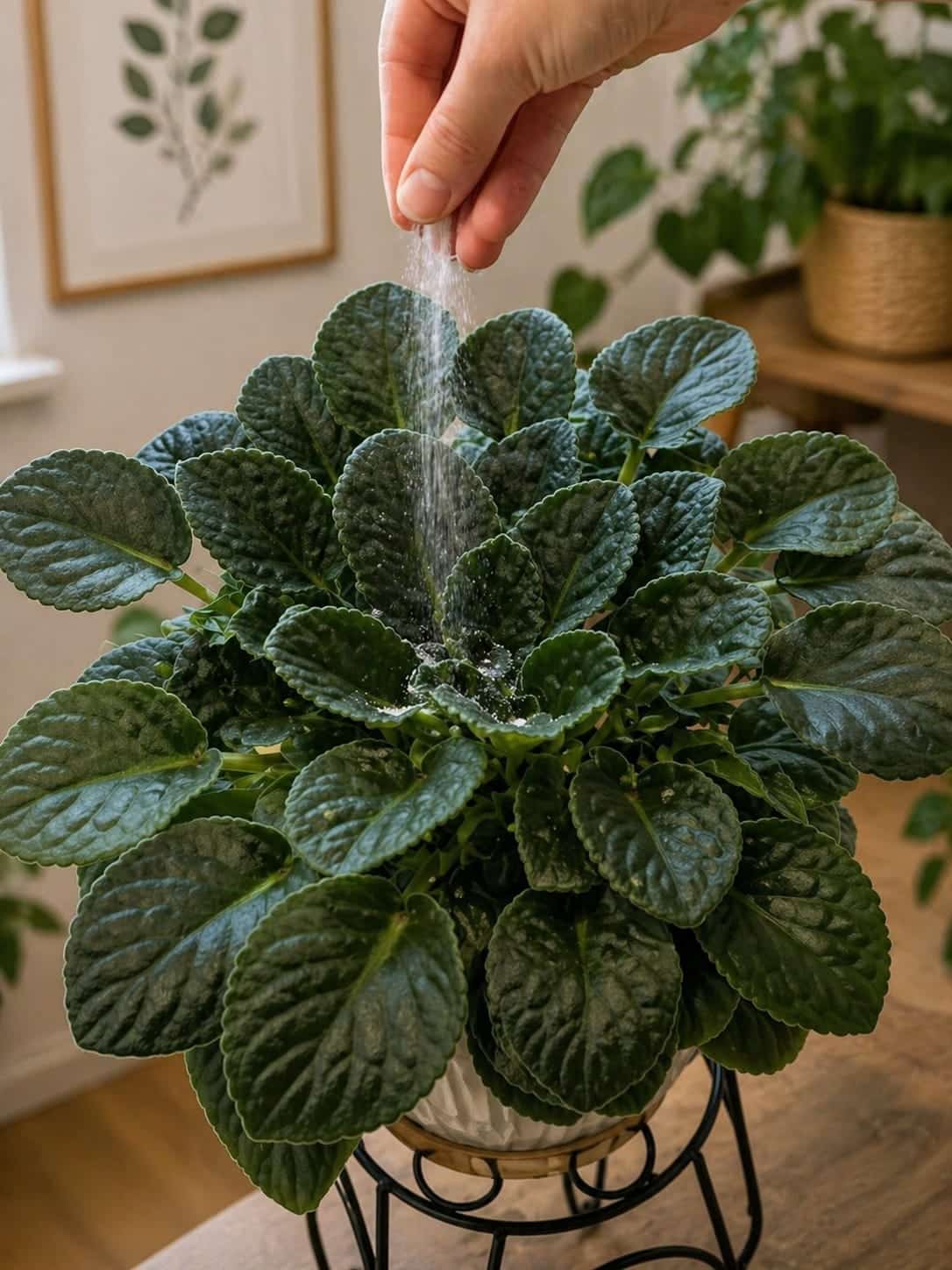
That is why many plant lovers become curious about the “white powder” African violet trick. In the image, a fine white powder is being sprinkled over the center of a lush African violet. The plant looks full, dark green, and healthy, making the powder look like a secret ingredient for strong leaves and beautiful blooms.
So what exactly is this white powder?
The safest and most useful version of this trick is a very small amount of Epsom salt, finely crushed eggshell powder, or African violet fertilizer granules used carefully around the soil, not heavily over the leaves. Many people use Epsom salt because it contains magnesium sulfate, and magnesium helps plants make chlorophyll, which supports rich green growth. Others use eggshell powder as a slow calcium amendment. Some use a white or pale granular fertilizer made specifically for flowering houseplants.
However, African violets need special care. Their leaves are fuzzy and sensitive. Powder should not be allowed to sit heavily on the leaves or collect in the crown. Water or powder trapped in the center of the plant can cause rot. A dramatic sprinkle may look good in a photo, but the safest way to use this trick is to apply a tiny amount to the soil surface or dissolve it properly in water, depending on the ingredient.
In this complete guide, you will learn what the white powder African violet trick is, which powder is safest, how to use it properly, what mistakes to avoid, and what African violets truly need to grow fuller leaves and bloom again and again.
What Is the White Powder African Violet Trick?
The white powder African violet trick is a simple houseplant method where a small amount of a pale, powdery amendment is used to support plant health. The powder may be Epsom salt, finely crushed eggshell powder, or a flowering plant fertilizer. The idea is to give the plant a gentle mineral or nutrient boost so it can produce stronger leaves, healthier roots, and more blooms.
For African violets, the most common version is Epsom salt. Epsom salt is magnesium sulfate. Magnesium is part of chlorophyll, the green pigment plants use for photosynthesis. When a plant has good light and proper care, magnesium can help support rich green foliage.
Another version is eggshell powder. Eggshell powder is mostly calcium carbonate. Calcium supports plant structure, but eggshell powder breaks down slowly. It is more of a long-term soil amendment than a quick fix.
A third version is a proper African violet fertilizer. Some fertilizers come in pale granules or powder form. These are usually more complete than homemade amendments because they provide balanced nutrients.
The important point is that the white powder should not be random. It should be plant-safe, used in a tiny amount, and applied correctly. African violets do not like harsh treatments. They respond best to gentle, consistent care.
Why African Violets Are Different From Many Houseplants
African violets are not like snake plants, jade plants, or peace lilies. They have their own personality. Their leaves are soft and fuzzy. Their roots are fine and delicate. Their crown, the center where new leaves emerge, must stay healthy and dry enough to avoid rot.
These plants like bright indirect light, evenly moist soil, gentle feeding, and a snug pot. They do not like sitting in soggy soil. They do not like cold water on their leaves. They do not like strong direct sun. They do not like overfertilizing.
Because their leaves are fuzzy, anything sprinkled directly over the plant can stick to the leaf surface. Powder can collect in leaf folds and the center crown. If moisture later touches that powder, it can form residue or irritation. This is why the safest white powder method is usually a soil method, not a leaf-coating method.
African violets can bloom beautifully indoors, but they need balance. Too much of any one thing can cause problems. Too much water causes rot. Too much fertilizer burns roots. Too much sun scorches leaves. Too much powder can create buildup.
The Best White Powder Option: Epsom Salt
Epsom salt is often the first white powder people think of for African violets. It is popular because it is inexpensive, easy to find, and commonly used by gardeners as a magnesium supplement. When used carefully, it may help support greener leaves and stronger growth.
But Epsom salt is not a complete fertilizer. It does not provide nitrogen, phosphorus, potassium, or all the micronutrients African violets need. It is only a magnesium and sulfur supplement. If your plant is hungry for balanced nutrition, Epsom salt alone will not be enough.
The safest way to use Epsom salt on African violets is to dissolve it in water, not sprinkle it heavily over the leaves. A very weak solution can be used occasionally during active growth. This allows the plant to receive a gentle supplement without leaving crystals sitting in the crown.
If you choose to sprinkle it dry, use only the tiniest pinch on the soil surface, away from the center of the plant. Do not cover the leaves.
Safe Epsom Salt Recipe for African Violets
This is the gentlest version of the white powder trick using Epsom salt. It is meant to be weak and occasional.
Ingredients
- 1/8 teaspoon Epsom salt
- 4 cups room-temperature water
- A clean watering can or jar
Instructions
- Add 1/8 teaspoon Epsom salt to 4 cups of room-temperature water.
- Stir until fully dissolved.
- Check that the African violet soil is ready for watering.
- Water the soil carefully, avoiding the leaves and crown.
- Let excess water drain away.
- Do not let the pot sit in standing water.
This weak solution can be used once every four to six weeks during active growth if the plant appears healthy. Do not use it every time you water. Do not use it on a stressed, overwatered, or rotting plant.
Can You Sprinkle Dry Epsom Salt on African Violets?
It is safer to dissolve Epsom salt in water, but a tiny dry application can be used on the soil surface if done carefully. The key is to avoid the leaves and the crown.
Use less than a pinch. Sprinkle it around the outer edge of the soil, not in the center of the plant. Then water normally when the plant needs water, allowing the crystals to dissolve into the soil. Never pour a spoonful into the pot. A spoonful is too much for a small African violet.
If Epsom salt lands on the leaves, gently brush it away with a soft dry brush. Do not wet the leaves to remove powder unless necessary, because African violet leaves can develop spots from water sitting on them.
Dry sprinkling looks dramatic, but it is not the best method for this plant. Dissolved and diluted is safer.
Eggshell Powder as the White Powder Trick
Another possible white powder is finely crushed eggshell powder. Eggshell powder is made from clean, dried eggshells ground into a fine powder. It is used as a slow calcium amendment for soil.
For African violets, eggshell powder should be used very lightly. These plants usually do not need a lot of calcium added to the soil, and they prefer a balanced potting mix. Eggshell powder breaks down slowly, so it will not create quick results.
If you want to use eggshell powder, make sure it is clean and finely ground. Do not use fresh eggshell pieces with egg residue. That can smell bad and attract pests.
Use only a tiny pinch mixed into the top layer of soil. Do not sprinkle it on the leaves. Do not pile it around the crown. This is a slow soil support method, not an instant bloom booster.
How to Make Eggshell Powder for African Violets
What You Need
- Eggshells from 2 eggs
- Warm water
- A tray or plate
- A grinder, blender, mortar and pestle, or rolling pin
- A small dry jar
Instructions
- Rinse the eggshells very well.
- Remove all egg residue.
- Let the shells dry completely.
- Bake them at low heat for 10 minutes if you want extra cleanliness.
- Let them cool.
- Grind them into a fine powder.
- Store the powder in a dry jar.
For one African violet pot, use only a tiny pinch. Gently mix it into the top layer of soil, away from the crown. Repeat only every few months if desired.
Using African Violet Fertilizer Granules
The most reliable white or pale powder is a fertilizer made specifically for African violets. These products are designed to support leaf growth and blooming. They usually contain nitrogen, phosphorus, potassium, and micronutrients in a balanced formula.
African violet fertilizer is often better than homemade tricks because it is predictable. If your plant is not blooming because it lacks nutrients, a proper fertilizer is more useful than Epsom salt or eggshell powder alone.
Use fertilizer at a weak dose. Many African violet growers prefer to feed lightly and regularly rather than strongly and rarely. If the label gives a dose, consider using half strength, especially for small plants or plants under indoor light.
Never place concentrated fertilizer powder directly in the center of the plant. Dissolve it according to instructions and water the soil carefully, or use it as directed.
What White Powders Should You Never Use?
Not every white powder belongs near a plant. Some can damage African violets quickly. Avoid using flour, powdered sugar, salt, baking soda in heavy amounts, powdered milk, laundry detergent, cleaning powders, dishwasher powder, and unknown household powders.
Flour can clump and mold. Powdered sugar can attract insects. Salt can burn roots. Baking soda can disturb the soil if overused. Cleaning products can kill the plant. Powdered milk can sour and attract pests.
If you cannot identify the powder as plant-safe, do not use it. African violets are too sensitive for random experiments.
The safest options are Epsom salt in a weak solution, proper African violet fertilizer, or a tiny amount of clean eggshell powder on the soil.
Why You Should Not Powder the Leaves Heavily
The image shows powder falling over the top of the plant, but African violet leaves are fuzzy and textured. Powder can stick to them. If powder collects in the center, it can combine with moisture and cause problems.
African violet leaves also do not like cold water sitting on them. Water spots, crown rot, and leaf damage can happen when moisture remains trapped. If powder is sprinkled into the crown and then watered, the center can become dirty and damp.
For this reason, the safest method is to keep powder on the soil and away from the plant’s center. If you want to use Epsom salt, dissolve it in water and apply to the soil. If you use eggshell powder, lightly mix it into the top layer. If powder lands on leaves, brush it off gently.
Can the White Powder Make African Violets Bloom?
The white powder can support blooming only if the plant was missing a nutrient that the powder provides. But most African violets fail to bloom because of light, pot size, watering, or general feeding issues, not because they need a random powder.
To bloom well, African violets need bright indirect light. A plant sitting in a dim corner may stay alive and leafy but refuse to flower. They also prefer a snug pot. If the pot is too large, the plant may focus on roots and leaves instead of blooms.
Regular gentle feeding also matters. A proper African violet fertilizer is usually more effective for blooms than Epsom salt alone.
The white powder trick can be part of a routine, but it is not the main bloom secret. Light is the biggest bloom trigger.
The Real Secret to African Violet Blooms
The real secret is bright, consistent, indirect light. African violets need enough light to produce flowers, but they do not want harsh direct sun. A bright east-facing window is often excellent. A north-facing window can work if it is bright enough. A west or south window may need a sheer curtain.
If the leaves are dark green and reaching upward, the plant may need more light. If the leaves are pale, scorched, or curling downward, the light may be too strong. A healthy African violet should have a balanced rosette with leaves spreading outward.
Grow lights are also very helpful. Many African violet growers use LED grow lights because they provide consistent brightness. With good light, African violets can bloom repeatedly indoors.
No white powder will replace proper light. Fertilizer supports the plant, but light gives it energy.
Best Potting Mix for African Violets
African violets need a light, airy, well-draining potting mix. Regular heavy potting soil can stay too wet and suffocate the fine roots. A good African violet mix should hold moisture while still allowing air to reach the roots.
A simple mix can include:
- 2 parts African violet potting mix
- 1 part perlite
- A small amount of vermiculite if extra moisture retention is needed
Many commercial African violet mixes already contain peat or coco coir, perlite, and other light materials. If the mix feels dense, add more perlite.
Good soil matters more than powder. If the roots cannot breathe, the plant will not bloom well, no matter what amendment you add.
Best Pot for African Violets
African violets usually bloom best in small, snug pots. A common rule is that the pot should be about one-third the width of the leaf spread. If the pot is too large, the soil may stay wet too long and the plant may focus on root growth instead of flowering.
Drainage is essential. Use a pot with drainage holes. Self-watering African violet pots can work well if used correctly, but they must not keep the soil constantly soggy.
Do not plant a small African violet in a huge decorative pot. Too much soil around the roots can cause moisture problems.
A snug pot, airy soil, and bright light create better blooms than heavy powder treatments.
How to Water African Violets Correctly
Watering is one of the most important parts of African violet care. These plants like evenly moist soil, but not soggy soil. Let the top of the soil become slightly dry before watering again.
Use room-temperature water. Cold water can shock the roots and may cause spots if it touches the leaves. Water the soil carefully from the top, avoiding the crown, or water from the bottom by placing the pot in a saucer of water for a short time.
If bottom watering, let the plant absorb water for about 15 to 30 minutes, then remove any leftover water. Do not let the pot sit in water all day unless it is part of a proper wick-watering system.
If you use an Epsom salt solution, treat it as a watering. Do not add it between normal waterings when the soil is already wet.
Should You Bottom Water After Using White Powder?
If you use dry powder on the soil, bottom watering can be useful because it avoids washing powder into the crown or splashing the leaves. However, if the powder is Epsom salt, it may dissolve unevenly if left dry on top. That is why dissolving it first is better.
For eggshell powder, bottom watering is fine because the powder breaks down slowly. For fertilizer granules, follow the product instructions.
No matter which method you use, avoid keeping the plant soggy. African violet roots need both moisture and air.
Can the White Powder Fix Yellow Leaves?
Yellow leaves can happen for many reasons. It may be natural aging, overwatering, underwatering, low light, too much direct sun, nutrient deficiency, or root problems. White powder is not always the solution.
If only the oldest lower leaves are yellowing, that may be normal. Remove them when they decline. If many leaves yellow at once, check the soil moisture and roots.
If the plant is pale and not blooming, it may need better light and balanced fertilizer. Epsom salt may help if magnesium is low, but do not assume that is the only issue.
Always diagnose before treating. Too much amendment can make a stressed plant worse.
Can the White Powder Fix Pale Leaves?
Pale leaves can sometimes be related to nutrient problems, including magnesium deficiency, but they can also come from too much light, old age, or weak roots. Epsom salt may support greener growth if magnesium is lacking, but it should be used weakly.
If the leaves are pale and the plant sits in strong direct sun, move it to filtered light. If the leaves are pale and the plant has not been fed in months, use a balanced African violet fertilizer. If the soil is wet and roots are damaged, repotting may be needed.
The white powder trick may help in the right situation, but it is not a universal fix.
Can the White Powder Help Root Growth?
Proper feeding can support root growth, but roots grow best in the right environment. African violet roots need light soil, moderate moisture, warmth, and oxygen. If the soil is heavy and wet, roots will struggle.
Epsom salt does not directly create roots. Eggshell powder does not rescue damaged roots. Fertilizer can support growth only if the roots are healthy enough to use it.
If your African violet is weak, remove it gently from the pot and check the roots. Healthy roots should be light and fine. Rotten roots may be dark, mushy, or sparse. If roots are poor, repot into fresh airy mix and avoid heavy feeding until recovery begins.
Can the White Powder Help With Powdery Mildew?
African violets can sometimes develop powdery mildew, which looks like white dusty patches on leaves. Do not confuse this with a helpful white powder trick. If you see powdery mildew, adding more powder is not the solution.
Powdery mildew often appears when airflow is poor and humidity conditions are uneven. Improve airflow, avoid crowding plants, remove badly affected leaves, and use an appropriate treatment if needed.
Do not sprinkle Epsom salt or eggshell powder over mildew-covered leaves. That can make the plant messier and harder to treat.
If the white powder in the image is being shown as a “treatment,” it should still be applied carefully. African violet foliage should stay clean and dry.
Continue to Page 2
Continue to page 2 for more details about this article and the key points many readers miss on the first page.