Best Soil for Snake Plants
Fast-draining soil is more important than any homemade fertilizer. Snake plants are prone to root rot when planted in dense, wet potting mix.
A good snake plant soil mix can include:
- 2 parts cactus or succulent mix
- 1 part perlite or pumice
- 1 part coarse sand or lava rock
- A small amount of orchid bark
The mix should drain quickly and dry between waterings. If your soil stays wet for more than a week in normal indoor conditions, it may be too heavy.
Why Drainage Holes Are Non-Negotiable
Snake plants need pots with drainage holes. A decorative pot without drainage can trap water at the bottom and slowly rot the roots. Even if the top soil feels dry, the bottom can remain wet.
If you love decorative ceramic pots, use them as cover pots. Keep the snake plant in a nursery pot with drainage, place it inside the decorative container, and remove it after watering to drain fully.
No natural fertilizer can fix a pot without drainage.
How to Water Snake Plants Correctly
Water snake plants only when the soil is fully dry. This is the most important rule. Snake plants store moisture in their leaves and rhizomes, so they do not need frequent watering.
Watering steps:
- Check the soil deep down.
- Water only if the soil is completely dry.
- Pour water around the soil, not into the crown.
- Let water drain from the bottom.
- Empty the saucer.
- Wait until the soil dries completely again.
If you use diluted molasses water, treat it as one watering. Do not water again right after.
Can You Use Molasses With Fertilizer?
Do not use molasses and fertilizer on the same day. Too many nutrients and organic inputs at once can overwhelm a small pot.
If you use a balanced cactus fertilizer or succulent fertilizer, wait several weeks before using molasses water. Keep the plant care routine simple.
A safe rule:
One feeding method per month at most during active growth.
For snake plants, even less is often enough.
Can You Use Molasses on Other Houseplants?
Diluted molasses is sometimes used for organic soil support, but it is not suitable for every houseplant. Plants in wet soil, low light, or pest-prone conditions should not receive sugary tonics.
It may be used very cautiously on:
- Snake plants
- Jade plants
- Aloe vera
- ZZ plants
- Some succulents
- Outdoor container plants with excellent drainage
It should be avoided or used with extreme caution on plants that stay moist, such as ferns, calatheas, peace lilies, and many humidity-loving tropical plants.
What If Molasses Got on the Leaves?
If thick molasses or molasses water touches the leaves, clean it immediately. Sticky residue can attract dust, pests, and mold. It can also sit between leaves and increase the risk of crown rot.
How to Clean the Leaves
- Use a damp soft cloth.
- Wipe the leaves gently from base to tip.
- Clean between leaves carefully.
- Do not leave sticky residue in the crown.
- Let the plant dry in bright indirect light.
Do not spray the whole plant heavily to rinse it unless the pot and room conditions allow quick drying.
What If You Used Too Much Molasses?
If you accidentally poured thick molasses into the pot, act quickly. Do not leave sticky syrup sitting on the soil.
Emergency Fix
- Scoop off the top layer of sticky soil.
- Wipe any molasses from leaves and pot edges.
- If a lot entered the soil, repot the plant.
- Use fresh fast-draining succulent mix.
- Check the roots for rot.
- Do not water again until the soil dries.
- Watch for pests for several weeks.
If the soil smells sour or attracts gnats, repotting is the safest option.
Signs the Molasses Trick Is Helping
Snake plants respond slowly, so do not expect overnight growth. Look for gradual signs over weeks or months.
Good signs include:
- Firm upright leaves
- No sour smell from soil
- No fungus gnats
- Soil drying normally
- New shoots during growing season
- Healthy root growth
- No mold on the soil surface
- Stable green leaf color
If the plant continues to look healthy and the soil stays clean, the treatment was mild enough.
Signs Molasses Is Causing Problems
Stop using molasses immediately if you notice:
- Sticky soil
- Ants
- Fungus gnats
- White mold
- Sour smell
- Soft leaf bases
- Yellowing leaves
- Soil staying wet too long
- Black or mushy roots
These signs mean the pot environment is becoming unhealthy.
Snake Plant Care Table
| Care Factor | Best Setup | Why It Matters |
|---|---|---|
| Light | Bright indirect light | Encourages stronger growth |
| Watering | Only when soil is fully dry | Prevents root rot |
| Soil | Fast-draining succulent mix | Protects roots from suffocation |
| Pot | Drainage holes required | Stops water from pooling |
| Molasses | Very weak dilution, rare use | Supports soil microbes cautiously |
| Feeding | Light feeding in spring and summer | Prevents nutrient overload |
| Winter care | Less water, no feeding | Matches slow growth season |
Molasses Water Recipe for Snake Plants
Use this simple recipe if you want the safest version of the black liquid trick.
Ingredients
- ⅛ to ¼ teaspoon unsulfured blackstrap molasses
- 1 liter warm water
- Clean bottle or jar
Instructions
- Add molasses to warm water.
- Stir until fully dissolved.
- Let it reach room temperature.
- Use only when the snake plant soil is fully dry.
- Pour lightly around the soil edge.
- Avoid the leaves and crown.
- Let the pot drain completely.
- Use only once every two to three months at most.
Better Natural Alternatives for Snake Plants
If molasses feels too risky, there are safer low-maintenance options for snake plant care.
- Diluted cactus fertilizer at half strength
- Fresh fast-draining soil
- Occasional worm castings in tiny amounts
- Better light exposure
- Proper watering routine
- Repotting into a breathable pot
For most snake plants, fresh soil and correct watering do more than any kitchen fertilizer.
Can Molasses Make Snake Plant Leaves Shinier?
No. Do not use molasses as a leaf shine product. It will make leaves sticky and attract dust. If you want shiny snake plant leaves, wipe them with a damp cloth using plain water.
Healthy leaves naturally look glossy when they are clean, well-lit, and not stressed.
Can Molasses Help Snake Plant Pups?
Molasses will not force pups by itself. Snake plant pups grow from underground rhizomes when the plant has enough light, healthy roots, and stable care.
To encourage pups:
- Provide bright indirect light
- Keep the plant slightly snug in its pot
- Use fast-draining soil
- Water only when dry
- Feed lightly during active growth
- Avoid disturbing the roots too often
A tiny molasses drench may support soil activity, but it is not the main trigger for pups.
Can Molasses Revive a Dying Snake Plant?
No. A dying snake plant needs diagnosis, not sugar. If leaves are yellow, mushy, collapsing, or wrinkled, check the roots first.
For a dying snake plant:
- Remove the plant from the pot.
- Inspect the rhizomes.
- Cut away rotten parts.
- Let healthy cuts dry.
- Repot in fresh succulent soil.
- Use a pot with drainage.
- Water carefully.
- Do not fertilize until recovery begins.
Molasses should only be used on healthy or stable plants, not plants in crisis.
Common Mistakes to Avoid
- Pouring thick molasses directly onto the plant
- Letting molasses run into the crown
- Using too much molasses
- Applying it to wet soil
- Using it every week
- Using sweet syrups instead of blackstrap molasses
- Using molasses on a plant with root rot
- Ignoring drainage holes
- Leaving sticky residue on leaves
- Combining molasses with strong fertilizer
Short Caption for This Trick
“For snake plants, never pour thick black molasses directly onto the leaves or soil. The safe trick is ⅛ to ¼ teaspoon unsulfured blackstrap molasses mixed into 1 liter of water, applied only to fully dry soil once every two to three months. Keep it away from the crown, let the pot drain fully, and stop immediately if you see mold, ants, fungus gnats, or sticky soil.”
Frequently Asked Questions
Is molasses good for snake plants?
Molasses can be used in a very weak dilution to support soil microbes, but it is not necessary for most snake plants. It must be used rarely and carefully.
Can I pour molasses directly on snake plant soil?
No. Thick molasses can create sticky soil, attract pests, and suffocate roots. Always dilute it heavily in water.
How much molasses should I use?
Use only ⅛ to ¼ teaspoon unsulfured blackstrap molasses in 1 liter of water. For small pots, use the weaker amount.
How often should I use molasses water?
Use it once every two to three months during active growth at most. Do not use it in winter.
Can molasses attract ants?
Yes. Molasses contains sugar, so overuse or spills can attract ants and other pests.
Can molasses cause fungus gnats?
Yes, especially if used too often or applied to wet soil. It can feed microbial growth and attract gnats in damp potting mix.
Should I put molasses on snake plant leaves?
No. Molasses should never be used as a leaf treatment. It leaves sticky residue and may cause problems.
Can molasses fix yellow leaves?
No. Yellow leaves are usually caused by overwatering, root rot, cold stress, or poor drainage. Check the roots first.
What is the best fertilizer for snake plants?
A diluted cactus or succulent fertilizer during spring and summer is usually safer and more balanced than frequent homemade tonics.
What is the best soil for snake plants?
A fast-draining succulent mix with perlite, pumice, coarse sand, or lava rock is best.
Final Thoughts
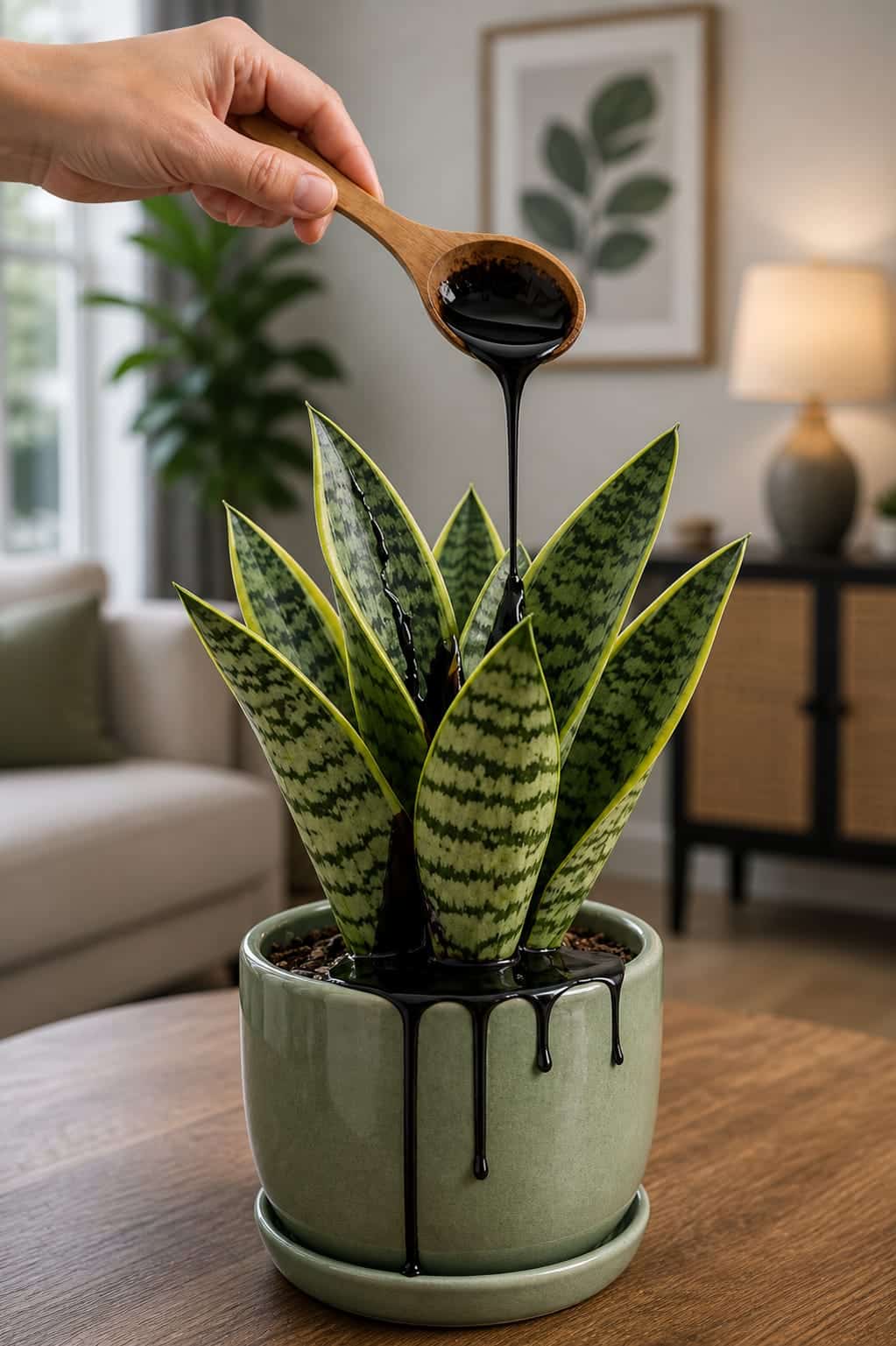
The black molasses trick can be useful in organic plant care, but it must be handled with care. The dramatic image of thick dark liquid pouring over a snake plant may look powerful, but that is not the safe way to do it. Snake plants need clean, airy, fast-draining soil. Thick sticky syrup can block oxygen, attract pests, and create mold.
The safe method is simple: use unsulfured blackstrap molasses, dilute it heavily, apply only a small amount to dry soil, and keep it away from the leaves and crown. Use it rarely, only during active growth, and only on a healthy plant with excellent drainage.
Molasses is not a miracle fertilizer. It will not save rotten roots, reverse yellow leaves, or force instant growth. But when used properly, it may support soil microbes and offer a mild mineral boost as part of a balanced snake plant care routine.
For the best results, focus first on the essentials: bright indirect light, a pot with drainage holes, fast-draining succulent soil, and careful watering. With those basics in place, your snake plant can stay firm, upright, and beautifully patterned for years. The molasses trick should remain exactly what it is: a rare, gentle soil support, not a heavy treatment.
8