Snake plants are some of the most reliable indoor plants you can grow. Their upright sword-shaped leaves, bold green pattern, yellow margins, and strong architectural form make them perfect for living rooms, offices, bedrooms, apartments, shelves, entryways, and modern home decor. They are famous for surviving neglect, low light, dry air, and missed watering days.
But even a tough snake plant can slow down. Sometimes the leaves stop producing new growth. Sometimes the soil becomes tired and compacted. Sometimes the plant looks alive but not vibrant. The leaves may remain firm, yet the plant seems frozen for months. That is when many indoor gardeners start looking for a natural houseplant fertilizer, a homemade plant food, or a simple kitchen-based trick that can support roots and refresh the soil.
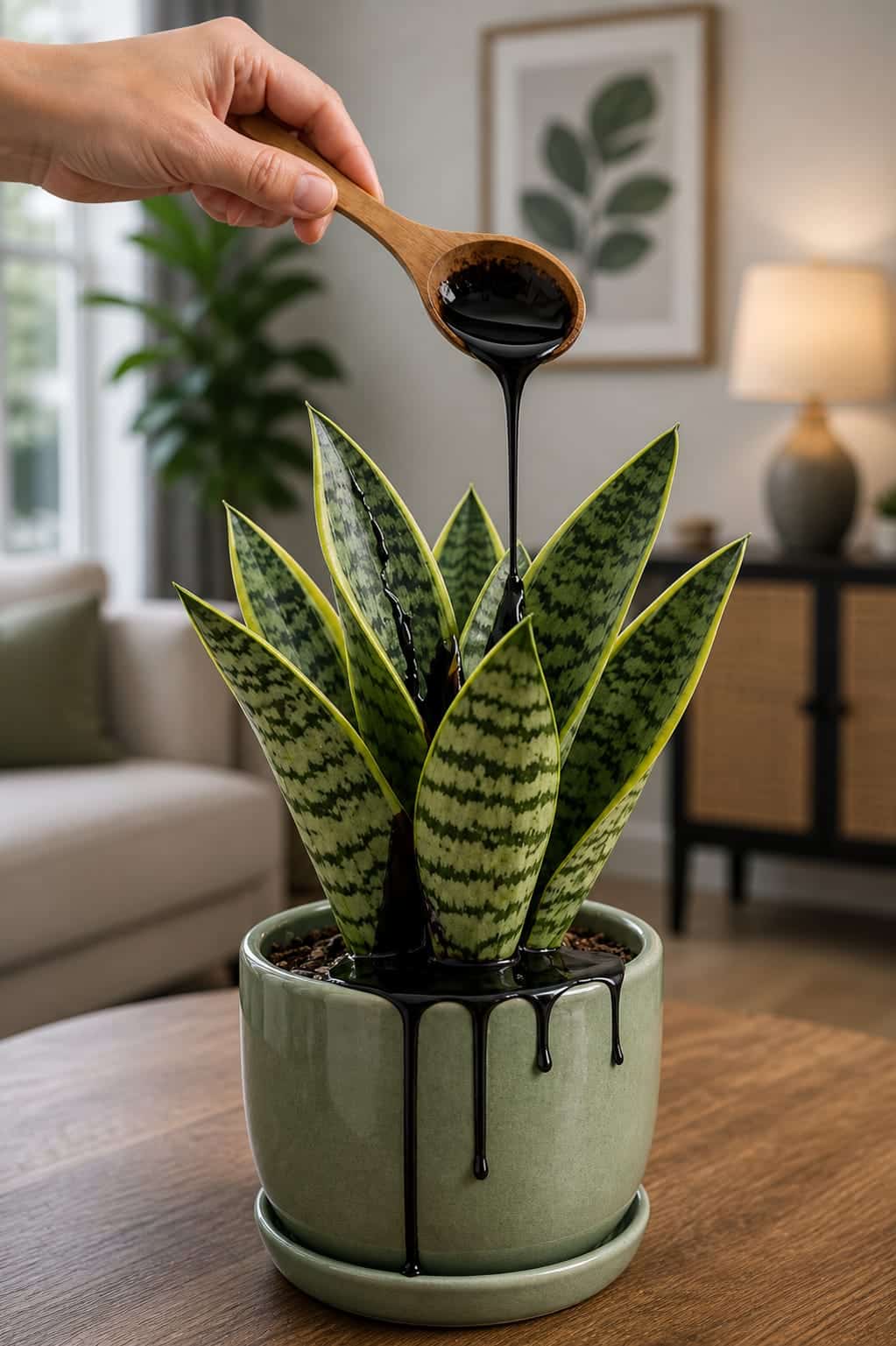
The image shows a snake plant while a thick black liquid is being poured over the leaves and soil. At first glance, it looks dramatic and powerful. This dark liquid is best explained as diluted blackstrap molasses, a traditional organic gardening ingredient often used to feed soil microbes and add tiny amounts of minerals. Molasses is rich, sticky, dark, and concentrated, so it must be handled carefully.
This is very important: you should never pour thick undiluted molasses directly onto a snake plant. The image is visually striking, but in real plant care, that much sticky liquid can clog the soil surface, attract ants, feed fungus gnats, encourage mold, and suffocate the roots. Snake plants need dry, airy soil. Anything heavy and sugary must be diluted heavily before it touches the pot.
The safe version of this trick is a very weak blackstrap molasses soil drench. You mix a tiny amount of unsulfured blackstrap molasses into plenty of warm water, dilute it well, and apply only a small amount to the soil when the plant actually needs watering. Used correctly and rarely, it may support microbial activity and provide a gentle mineral boost. Used incorrectly, it can damage the plant.
This guide explains exactly how to make the black molasses trick safely, how much to use, when to avoid it, what it can and cannot do, and how to keep your snake plant healthy, upright, and beautiful indoors.
What Plant Is in the Image?
The plant in the image is a snake plant, also known as Sansevieria or Dracaena trifasciata. It is one of the best low-maintenance houseplants because it stores water in its thick leaves and rhizomes. This allows it to survive dry periods better than many tropical indoor plants.
Snake plants are often recommended for beginner plant owners because they do not need frequent watering. They prefer fast-draining soil, moderate to bright indirect light, a pot with drainage holes, and long dry periods between waterings.
The snake plant in the image looks healthy. Its leaves are upright, patterned, and firm. This means it does not need a rescue treatment. It only needs careful maintenance. A strong homemade fertilizer should never be used on a healthy snake plant just because it looks impressive. With snake plants, gentle care is almost always better than aggressive feeding.
What Is the Black Liquid?
The black liquid in the image looks like blackstrap molasses or a very dark molasses-based plant tonic. Blackstrap molasses is a thick syrup left after sugarcane processing. In gardening, unsulfured blackstrap molasses is sometimes used in compost tea, organic soil care, and microbial soil feeding.
It contains small amounts of minerals such as potassium, calcium, magnesium, and iron. It also contains sugars that can feed beneficial soil microbes. That is why gardeners sometimes use it in outdoor organic gardening, raised beds, compost systems, and living soil mixes.
But indoor pots are different from outdoor garden beds. A snake plant pot is a small, contained environment. If too much molasses is added, it can create sticky, airless, pest-attracting soil.
For a snake plant, molasses must be:
- Unsulfured
- Highly diluted
- Used rarely
- Applied only to soil
- Never poured thickly over leaves
- Never used on wet or unhealthy roots
Why Gardeners Use Molasses for Plants
Molasses is popular in organic plant care because it may help support the living part of soil. Healthy soil is not just dirt. It contains microbes, fungi, organic matter, air spaces, minerals, and moisture. When soil biology is balanced, roots can absorb nutrients more efficiently.
Molasses may help support:
- Beneficial soil microbes
- Organic soil activity
- Slow nutrient cycling
- Root-zone health
- Mineral availability
- Compost tea strength
- Soil vitality in organic gardening
However, this does not mean molasses is automatically good for every houseplant. It is not a complete fertilizer. It is not a magic growth booster. It is not a cure for root rot, yellow leaves, or dying plants. It is a soil-support ingredient that must be used carefully.
Can Molasses Help Snake Plants?
Yes, but only in a very limited way. Snake plants do not need rich soil or heavy feeding. They naturally grow well in lean, well-draining conditions. A tiny amount of diluted molasses may support microbial activity in the potting mix, especially if the soil contains organic material.
Molasses may be useful if:
- The plant is healthy but growth is slow
- The soil is fast-draining and not soggy
- The plant is actively growing in spring or summer
- You use organic potting mix
- You dilute the molasses heavily
- You apply it rarely
Molasses is not useful if the plant is rotting, yellowing from overwatering, sitting in wet soil, or struggling in a pot without drainage. In those cases, molasses can make the problem worse.
Important Warning: Never Use Molasses Like the Image Shows
The image shows thick black liquid being poured directly over the plant. This is not the safe real-life method. Thick molasses can coat the leaves, run into the crown, block airflow, and create a sticky layer on the soil.
Snake plants are especially sensitive to crown moisture. Water or sticky liquid sitting between the leaves can cause rot. The crown should stay dry.
Never pour thick molasses:
- Over the leaves
- Into the center of the plant
- Across the crown
- In a heavy layer on the soil
- Down the outside of the pot
- On wet soil
- On a stressed or rotting plant
The safe method is a thin diluted soil drench, not a syrup pour.
What Kind of Molasses Should You Use?
Use only unsulfured blackstrap molasses. Avoid sulfured molasses because sulfur dioxide is used in processing and may not be ideal for sensitive indoor soil routines. Also avoid flavored syrups, pancake syrup, corn syrup, caramel sauce, sugar syrup, honey blends, or molasses products with additives.
The label should ideally say:
- Unsulfured
- Blackstrap molasses
- No added flavors
- No preservatives if possible
- No artificial sweeteners
Do not use molasses mixed with milk, oil, spices, or kitchen leftovers. Plants do not need dessert toppings.
How to Make the Safe Black Molasses Plant Tonic
The most important part of this trick is dilution. Molasses is extremely concentrated. For snake plants, the mixture must be weak.
Ingredients
- ¼ teaspoon unsulfured blackstrap molasses
- 1 liter warm water
- Clean jar or bottle
- Spoon for mixing
Step-by-Step Method
- Warm the water slightly. Do not use hot water.
- Add ¼ teaspoon unsulfured blackstrap molasses to 1 liter water.
- Stir until fully dissolved.
- Let the mixture cool to room temperature if needed.
- Use immediately.
- Do not store for many days.
The final liquid should look like weak brown tea, not thick black syrup. If the mixture is dark and sticky, it is too strong.
Extra-Safe Dilution for Indoor Snake Plants
If this is your first time using molasses on a snake plant, dilute even more.
Use:
⅛ teaspoon molasses in 1 liter water
This is safer for small pots, young plants, indoor plants in lower light, and snake plants that grow slowly.
With homemade plant food, gentle dilution protects the roots.
How to Apply Molasses Water to Snake Plants
Apply the diluted molasses water only when the snake plant soil is completely dry. Remember, this counts as watering. Do not add it on top of a regular watering schedule.
Application Steps
- Check the soil deeply.
- Make sure the soil is dry all the way down.
- Move the leaves gently apart without forcing them.
- Pour a small amount around the outer soil edge.
- Avoid the center crown completely.
- Do not splash the leaves.
- Let the pot drain fully.
- Empty the saucer after watering.
- Do not repeat until the soil dries again.
For a medium snake plant pot, you may only need ½ cup to 1 cup of diluted mixture, depending on pot size and soil dryness. Do not flood the pot.
How Often Should You Use Molasses on Snake Plants?
Use diluted molasses water rarely. Once every two to three months during active growth is enough. For many indoor snake plants, even that may be unnecessary.
A safe schedule:
- Spring: one weak application if the plant is actively growing
- Summer: one weak application if the plant is healthy
- Fall: avoid or use only if conditions are warm and bright
- Winter: do not use
Snake plants grow slowly in winter and use less water. Feeding in winter can increase the risk of root problems.
When Not to Use Molasses
Molasses is not suitable for every situation. Avoid it if your snake plant is already stressed or the soil is not drying properly.
Do not use molasses if:
- The soil is wet
- The plant has root rot
- The leaves are mushy
- The pot has no drainage holes
- There are fungus gnats
- The soil smells sour
- There is mold on the soil
- The plant is in low light
- The room is cold
- The plant was recently repotted
- You recently fertilized it
- The plant is already declining
Molasses can feed microbes, but it can also feed the wrong organisms if the soil is wet, stale, or compacted.
Can Molasses Attract Bugs?
Yes. This is one of the biggest risks. Molasses contains sugar. If used too strong or left sticky on the soil surface, it can attract ants, fungus gnats, fruit flies, and other pests.
To reduce pest risk:
- Use a very weak dilution
- Apply only to dry soil
- Do not spill on leaves or pot edges
- Do not let liquid sit in the saucer
- Do not use it often
- Keep the soil surface clean
- Use well-draining soil
If pests appear after using molasses, stop immediately and switch back to plain water.
Can Molasses Cause Mold?
Yes. If molasses is too strong, too frequent, or used on damp soil, it can encourage mold growth. Indoor potting soil already contains organic matter. Adding sugar to wet soil can make fungal growth worse.
Signs of trouble include:
- White fuzzy mold
- Sour smell
- Sticky soil surface
- Fungus gnats
- Soil staying wet too long
- Soft leaf bases
If mold appears, remove the top layer of soil, improve airflow, let the pot dry, and stop all homemade plant tonics for a while.
Can Molasses Burn Snake Plant Roots?
Molasses is not usually a chemical burn like strong synthetic fertilizer, but it can still harm roots indirectly. If the mixture is too thick, it can reduce oxygen in the soil, encourage microbial imbalance, and keep the soil wet or sticky.
Snake plant roots need oxygen. They prefer dry, airy soil. A syrupy soil environment is not suitable.
This is why dilution and rare use are essential.
What Molasses Can and Cannot Do
| Molasses May Help With | Molasses Will Not Fix |
|---|---|
| Mild soil microbial support | Root rot |
| Organic soil activity | Mushy leaves |
| Small mineral boost | Severe overwatering |
| Slow growth support | No drainage holes |
| Soil vitality in tiny doses | Dead leaves |
| Active-season maintenance | Low light problems |
Think of molasses as a small soil support, not a rescue miracle.
Why Snake Plants Grow Slowly
Many people use homemade fertilizers because their snake plant is not growing fast. But slow growth is normal for snake plants, especially indoors. They often grow in bursts rather than continuously.
Common reasons for slow snake plant growth include:
- Low light
- Cold room temperatures
- Winter dormancy
- Root-bound pot
- Old compacted soil
- Too much water
- Too little water over many months
- Lack of active growing season
Molasses will not overcome poor light or cold conditions. If you want faster snake plant growth, improve the basics first.
Best Light for Snake Plant Growth
Snake plants tolerate low light, but they grow better in bright indirect light. A spot near a bright window can help the plant produce stronger leaves and new shoots. Morning sun is usually safe. Harsh afternoon sun may scorch leaves if the plant is not acclimated.
If your snake plant is far from a window, it may survive but grow very slowly. Move it gradually into brighter light if possible.
Continue to Page 2
Continue to page 2 for more details about this article and the key points many readers miss on the first page.