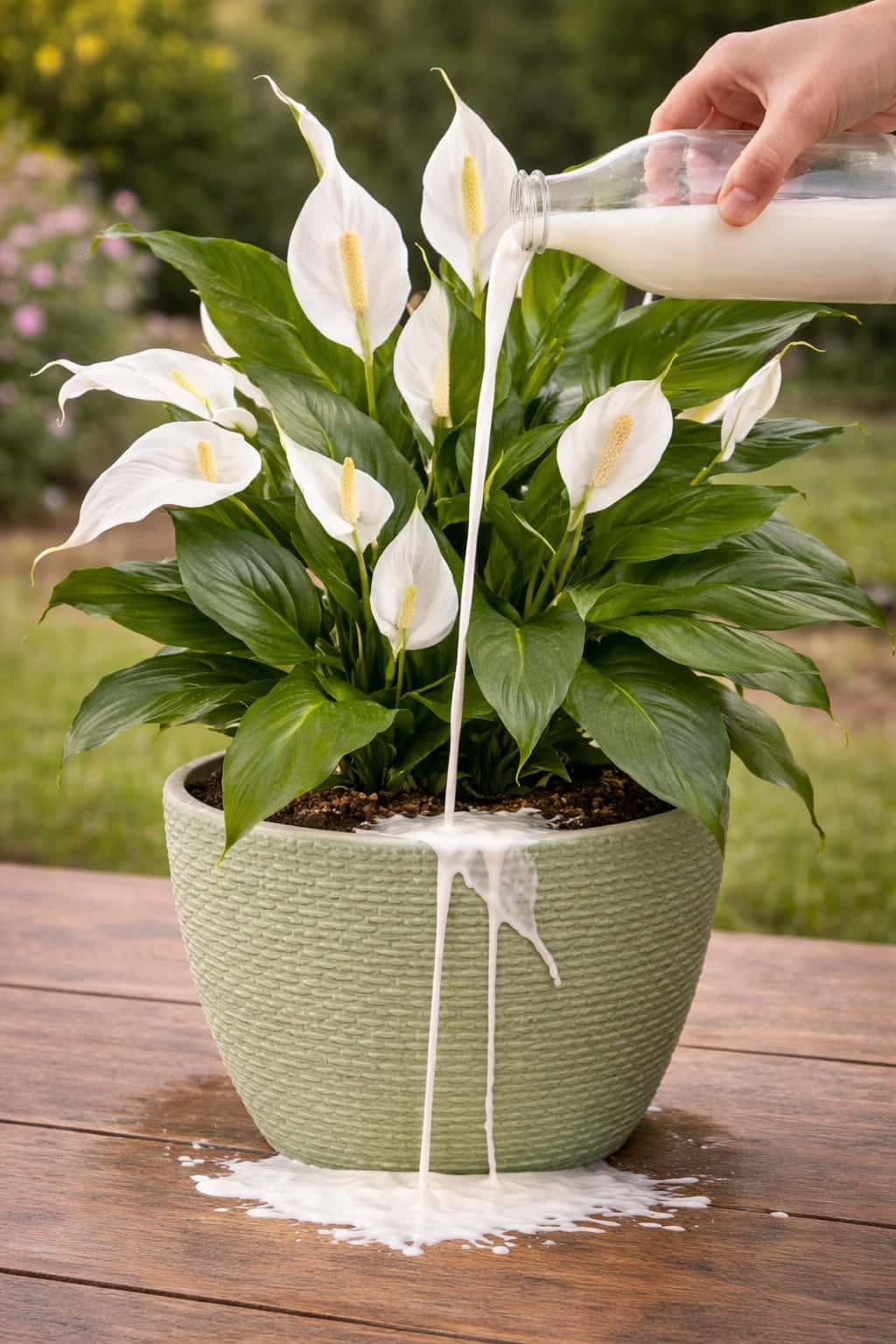
Want your peace lily to bloom more? Learn about the “white liquid” method (diluted milk or mild fertilizer) – and the real secrets: bright indirect light, consistent watering, and proper feeding. Complete care guide inside.
Let’s be honest: peace lilies (Spathiphyllum) are some of the most beloved houseplants for a reason. Their glossy, deep green leaves and elegant white blooms bring a sense of calm and sophistication to any room. But many plant owners struggle to get them to flower consistently indoors. You water it, you give it light, and yet – no blooms. Just leaves.
Recently, a simple “white liquid method” (usually diluted milk or a mild nutrient solution) has been trending among indoor gardeners. Videos show a white liquid being poured into the soil, and suddenly – more blooms, greener leaves. It looks powerful. It looks like magic.
👉 But like most plant tricks, it only works when used correctly and carefully.
In this guide, you’ll learn why peace lilies stop blooming, what the white liquid really is, how to use it safely, and – most importantly – the real secrets to getting more blooms: bright indirect light, consistent watering, good drainage, and proper feeding. No magic, just practical care.
🌿 Why Peace Lilies Stop Blooming Indoors
Before adding anything to your plant, it’s important to understand why blooms disappear. Peace lilies are tropical plants that naturally grow on the forest floor, where they receive dappled, indirect light and consistent moisture. Indoors, small environmental problems build up over time.
Common Reasons for No Blooms
Cause Effect
Low light conditions The plant grows leaves but lacks energy to produce flowers.
Overwatering or poor drainage Roots suffocate, plant focuses on survival, not blooming.
Lack of nutrients Soil becomes depleted; no energy for flowers.
Stress from temperature changes Drafts, cold windows, or heat vents disrupt the plant’s cycle.
Old or compacted soil Roots struggle to absorb water and nutrients.
Most bloom issues are environmental, not nutritional. Fix the environment first, and the blooms will follow.
🥛 What Is the “White Liquid”?
In many viral plant videos, the “white liquid” refers to one of two things:
· Diluted milk – a very small amount of milk mixed with water (typically 1 part milk to 4–5 parts water).
· A light liquid fertilizer solution – a balanced houseplant fertilizer diluted to quarter strength.
It is used to:
· Support leaf shine (milk can leave a slight gloss)
· Provide trace nutrients (calcium, proteins)
· Encourage bloom cycles (indirectly, by improving overall health)
· Improve soil microbial activity (milk can feed beneficial bacteria)
⚠️ Important: It must always be heavily diluted and used sparingly. Undiluted milk or fertilizer will harm the plant.
⚠️ When to Use It Safely – A Step‑by‑Step Guide
Using the white liquid incorrectly can harm your peace lily. Follow these strict guidelines.
✅ Safe Usage Guidelines
Factor Correct Approach
Frequency Once every 3–4 weeks, at most.
Dilution Very light – for milk: 1 part milk to 4–5 parts water. For fertilizer: quarter strength.
Application Apply to soil, not leaves. Avoid the crown.
Soil condition Only apply when soil is slightly dry (not wet, not bone dry).
Season Spring and summer (active growing season). Avoid in fall/winter.
After application Water lightly to help the solution soak in.
❌ What to Avoid
· Never pour directly in large amounts – a little goes a long way.
· Don’t use on already wet soil – can lead to root rot.
· Avoid frequent use – overuse causes odor, mold, and root problems.
· Don’t use milk that has soured – fresh only.
If you notice a sour smell, white mold on the soil, or yellowing leaves, stop immediately. Flush the soil with plain water.
🌱 The Real Secret to More Peace Lily Blooms
Forget shortcuts – focus on the fundamentals. The white liquid is at best a small supplement. These factors are essential.
- Bright Indirect Light – The #1 Bloom Trigger
Peace lilies need bright, indirect light to produce flowers. In low light, they grow leaves but rarely bloom.
Light Level Bloom Potential
Low light (north window, dark corner) Very low – leaves only.
Medium light (few feet from east/west window) Occasional blooms.
Bright, indirect (right by east/west window) Regular, abundant blooms.
Direct sun Leaf burn – no blooms.
Pro tip: If your peace lily hasn’t bloomed in over a year, move it closer to a window. East‑facing windows are ideal.
- Consistent Watering – Keep Soil Slightly Moist
Peace lilies are dramatic when thirsty – they droop dramatically. But they also hate soggy roots
· When to water: When the top inch of soil feels dry. Stick your finger in.
· How to water: Water thoroughly until it runs out the drainage holes. Empty the saucer.
· Signs of overwatering: Yellow leaves, mushy stems, foul smell.
· Signs of underwatering: Drooping, brown leaf tips.
- Good Drainage – Prevents Root Stress
· Use a pot with drainage holes – non‑negotiable.
· Soil mix: Light, well‑draining potting mix. Add perlite (30%) for extra drainage.
· Avoid: Heavy, compacted soil that stays wet for more than a week.
Want the full truth and the practical next steps?
Page 2 continues with the real explanation, the key details many readers skip, and the simple takeaways that make this guide more useful.