Orchids have a reputation for being elegant, delicate, and slightly mysterious. Their thick green leaves, exposed silver roots, and long-lasting blooms make them one of the most popular flowering houseplants. But when an orchid stops blooming, grows slowly, or looks tired, many plant owners start searching for a simple trick that will bring it back to life.
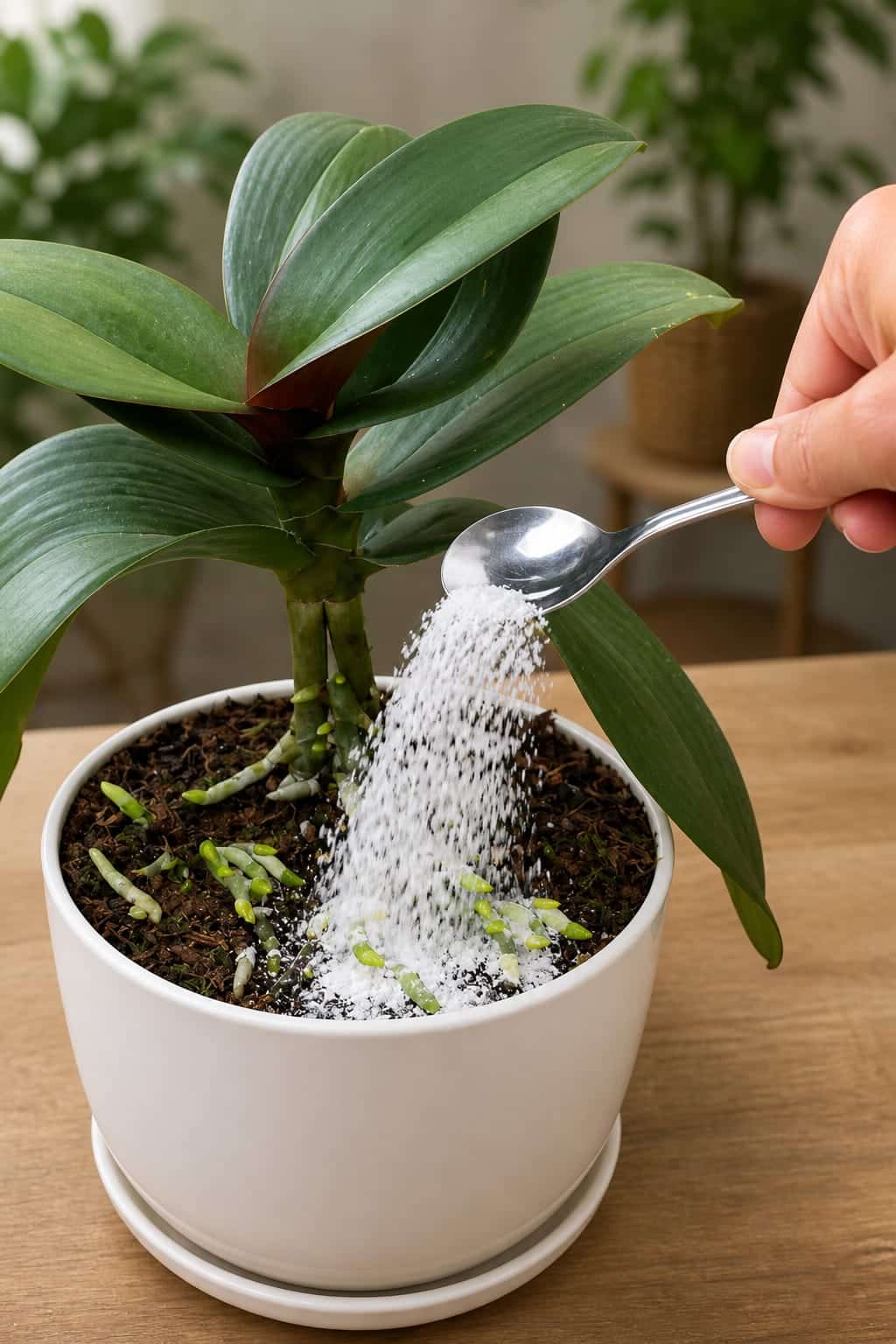
The image shows a healthy-looking orchid in a white pot. A hand is sprinkling a white powder from a spoon onto the surface of the potting medium. Around the base of the orchid, small green root tips and new growth points are visible. The white powder appears to be applied as a plant booster, root stimulant, fertilizer, or homemade revival treatment.
This type of image is designed to make the method look easy: just add a spoonful of white powder, and the orchid may grow stronger roots, greener leaves, and more flower spikes. But orchids are not ordinary houseplants. Most common indoor orchids, especially Phalaenopsis orchids, grow as epiphytes in nature. Their roots need air, moisture, and drainage rather than dense, wet soil. Because of this, powder treatments can be risky if used incorrectly.
The safest way to understand this trick is simple: never put a mystery white powder on an orchid. Some white powders can help when used correctly, but many can harm the roots, clog the bark, encourage mold, burn tender root tips, or create salt buildup. Orchids need gentle nutrition, clean water, bright indirect light, and excellent airflow far more than they need heavy powder treatments.
In this guide, you will learn what the white powder orchid trick might be, which powders are safe, which ones should be avoided, how to feed orchids properly, and what actually helps orchids grow strong roots and rebloom year after year.
What Is the White Powder Orchid Trick?
The white powder orchid trick is a plant-care method where a powdered substance is sprinkled onto the top of an orchid’s potting medium. It is often shown as a quick way to revive an orchid, encourage root growth, or stimulate blooming.
In the image, the powder is being applied with a spoon, which makes the method look controlled and simple. The orchid is growing in a chunky medium that appears to include bark. This is typical for many Phalaenopsis orchids because their roots need air pockets and fast drainage.
The problem is that white powder can mean many different things. It could be a proper orchid fertilizer, rooting hormone, mycorrhizal powder, calcium supplement, gypsum, dolomitic lime, perlite dust, baking soda, Epsom salt, powdered milk, or even sugar or flour. Some of these have limited plant uses. Others should never be placed in an orchid pot.
The trick is only safe if you know exactly what the powder is and why you are using it.
What Could the White Powder Be?
The powder in the image could represent several products. Some are plant-safe when used carefully, while others are risky.
Possible plant-safe powders include:
- Water-soluble orchid fertilizer
- Mycorrhizal root powder
- Rooting hormone powder
- Dolomitic lime
- Gypsum
- Calcium supplement labeled for plants
- Perlite or pumice dust
- Diatomaceous earth used carefully for pests
Risky or unsuitable powders include:
- Baking soda
- Table salt
- Sugar
- Flour
- Cornstarch
- Powdered milk
- Cleaning powder
- Laundry detergent
- Bleach powder
- Unidentified pest poison
- Any unknown white powder
If the powder is not clearly labeled for plants, do not use it. Orchids have sensitive roots, and once a powder becomes wet and moves through the potting medium, it can be difficult to remove completely.
The Most Important Rule: Do Not Use Mystery Powder
Orchid roots are very different from the roots of many houseplants. They are thick, spongy, and covered with a layer called velamen that absorbs water quickly and helps the roots breathe. Healthy orchid roots may look silver when dry and green after watering.
Because orchid roots are exposed to air in a chunky medium, they can be damaged by concentrated powders. A powder that might seem harmless in regular soil can sit directly on orchid roots and cause burning, drying, or residue buildup.
If you cannot identify the powder, skip it. A healthy orchid routine does not require mystery additives.
Can White Powder Help Orchids Grow Roots?
Some powders can support root growth, but only in the right situation. Mycorrhizal powder may help during repotting when placed near roots. Rooting hormone may help with certain propagation methods, although it is not usually needed for mature Phalaenopsis orchids. A diluted orchid fertilizer can support healthy growth during the active season.
However, powder sprinkled heavily on top of the potting mix is not the best way to grow orchid roots. Strong roots come from proper watering, airflow, humidity, light, and a fresh airy medium.
If an orchid’s roots are rotting, powder will not solve the problem. Rotten roots must be removed, and the orchid should be repotted into fresh bark or an orchid mix.
Can White Powder Make Orchids Bloom?
No powder can guarantee orchid blooms. Orchids rebloom when their overall care is right. For Phalaenopsis orchids, blooming depends on plant maturity, light, temperature changes, healthy roots, and gentle nutrition.
A proper fertilizer can support flowering, but it does not force blooms instantly. If an orchid has poor roots, low light, or old broken-down medium, powder will not produce flower spikes.
For most orchids, bright indirect light and healthy roots are more important than any spoonful of powder.
Why Orchids Are Sensitive to Powder Treatments
Orchid potting medium is usually chunky. It may include bark, coconut husk, charcoal, perlite, or sphagnum moss. This type of medium is designed to drain quickly and allow air to reach the roots.
Fine powder can settle between bark pieces and reduce airflow. When it gets wet, it may form a paste or crust. This can hold moisture around roots and create conditions for rot.
Orchid roots need moisture, but they also need oxygen. Anything that clogs the potting medium can become a problem.
Is Baking Soda Good for Orchids?
Baking soda is not an orchid fertilizer. It does not provide balanced nutrients, and it can alter the chemistry of the potting medium. It also contains sodium, which can build up and harm plants over time.
Some people use baking soda in very diluted sprays for certain fungal issues, but it should not be sprinkled into orchid pots as a growth booster. It is not a root stimulant, bloom booster, or general orchid tonic.
Do not pour or sprinkle baking soda onto orchid roots.
Is Epsom Salt Good for Orchids?
Epsom salt contains magnesium sulfate. Orchids may need magnesium in small amounts, but this does not mean they need regular spoonfuls of Epsom salt. Too much can create salt buildup and nutrient imbalance.
If you use Epsom salt, it should be dissolved in water at a weak concentration and used occasionally, not poured dry onto the pot. It is not a cure for every orchid problem.
For most people, a balanced orchid fertilizer that includes micronutrients is safer and more complete.
Is Powdered Milk Good for Orchids?
No. Powdered milk should not be used on orchids. It can mold, smell bad, attract pests, and leave residue in the bark. Orchid pots are airy and organic, which means food-based powders can break down in unpleasant ways.
Powdered milk may contain calcium, but it is not a clean or reliable orchid nutrient source. Use a proper plant calcium supplement only if your orchid actually needs one.
Is Flour or Cornstarch Good for Orchids?
No. Flour and cornstarch can become sticky when wet. They can clog orchid bark, encourage mold, attract insects, and reduce airflow around the roots.
These kitchen powders do not belong in orchid pots. Orchids need clean, airy conditions, not starch buildup.
Is Sugar Good for Orchids?
No. Sugar water or dry sugar should not be used as an orchid fertilizer. Plants make their own sugars through photosynthesis. Adding sugar to the potting medium can feed microbes, attract pests, and create sticky, sour conditions.
If an orchid is weak, it needs better roots, light, water management, and perhaps mild fertilizer. It does not need sugar.
Can Diatomaceous Earth Be Used on Orchids?
Diatomaceous earth is a fine white powder sometimes used for pest control. It may help with some crawling insects when it stays dry. However, orchids are watered regularly, and the powder loses much of its effectiveness when wet.
Diatomaceous earth can also create dust and may settle into the bark. If used, it should be applied very lightly and kept away from your face while pouring because the dust can irritate lungs.
It should not be used as a fertilizer or root booster.
Can Mycorrhizal Powder Help Orchids?
Mycorrhizal products are sometimes sold as root-support powders. They are generally most useful during repotting, when they can be placed near the root zone. Sprinkling them on top of the bark may not do much if the powder does not reach the roots.
For orchids, root health depends first on proper medium and watering. Mycorrhizal powder is optional. It should never be used to cover up root rot or poor potting conditions.
Can Rooting Hormone Powder Help Orchids?
Rooting hormone powder is mainly used for cuttings and propagation. Mature Phalaenopsis orchids usually do not need rooting hormone poured into the pot. If the orchid has no roots or is being rescued, some growers use specialized rooting products carefully, but the plant still needs correct humidity and airflow.
Do not sprinkle rooting hormone heavily over healthy orchid roots. Follow the product label and use only when appropriate.
Can Powdered Orchid Fertilizer Help?
Yes, but it must be used correctly. Many orchid fertilizers are water-soluble powders. They are meant to be dissolved in water before use. Sprinkling dry fertilizer powder onto the potting medium can create concentrated pockets that burn orchid roots.
If the white powder is orchid fertilizer, mix it with water according to the label. For routine orchid feeding, use a weak solution. Many orchid growers follow the idea of feeding weakly and regularly rather than strongly and rarely.
For home care, half strength or quarter strength is often safer than full strength.
How to Fertilize Orchids Safely
The safest way to fertilize most indoor orchids is with a diluted liquid or water-soluble orchid fertilizer.
- Water the orchid first if the roots are very dry.
- Mix orchid fertilizer with water at half or quarter strength.
- Pour the solution through the potting medium.
- Let it drain completely.
- Do not let the orchid sit in fertilizer water.
- Flush with plain water occasionally to remove salts.
Never leave fertilizer sitting in the saucer. Orchid roots should not soak in concentrated nutrient water.
How Often Should You Fertilize Orchids?
During active growth, many orchids can be fertilized every two to four weeks with a weak solution. If the orchid is growing new leaves or roots, it can use gentle nutrients. If it is resting, recently repotted, or struggling with root rot, skip fertilizer until it stabilizes.
In winter or lower light, reduce feeding. Orchids use fewer nutrients when growth slows.
Overfertilizing is more harmful than underfertilizing.
What Kind of Fertilizer Is Best for Orchids?
A balanced orchid fertilizer is usually best. Look for a product labeled for orchids or houseplants, ideally with micronutrients. The exact formula matters less than proper dilution and consistent, gentle use.
Some growers use bloom booster fertilizers, but these should not be used constantly. A plant with weak roots should not be pushed to bloom. First, build root and leaf health.
Healthy roots create better blooms later.
Why Powder Should Not Sit on Orchid Leaves
In the image, the powder is mostly falling onto the potting medium, but some may land on the lower leaves or base. Orchid leaves should be kept clean. Powder residue can block light, attract moisture, or leave marks.
If powder lands on leaves, wipe it off gently with a damp cloth. Do not let powder collect in the crown or between leaves.
This is especially important for Phalaenopsis orchids because water or residue trapped in the crown can lead to crown rot.
Keep Powder Away From the Orchid Crown
The crown is the central point where new leaves emerge. It must stay clean and dry. Powder, water, or debris trapped in the crown can create rot.
When applying any product, keep it on the potting medium and away from the leaf joints. If powder falls into the crown, remove it carefully with a soft brush or damp cotton swab, then dry the area.
A clean crown is essential for orchid survival.
Why Orchid Roots Should Not Be Buried in Powder
The image shows visible green root tips near the surface. These tips are delicate and actively growing. A pile of powder on top of them can dry, burn, or smother them depending on the substance.
Healthy root tips should remain exposed to air and gentle moisture. Do not bury them under thick powder, dense soil, or heavy top dressings.
New green root tips are a good sign. Protect them.
What the Small Green Growths Mean
The small green growths around the base of the orchid appear to be new root tips or possibly small shoots. On orchids, new roots often emerge as pale green or bright green tips. These are signs that the plant is actively growing.
When an orchid is producing new roots, it is a good time to support it gently with proper watering, light, and weak fertilizer. It is not a time to smother the root zone with heavy powder.
Best Light for Orchids
Most common Phalaenopsis orchids prefer bright indirect light. An east-facing window is often ideal. A south or west window can work if filtered by a sheer curtain. Direct hot sun can burn the leaves.
Signs of too little light include dark green leaves, slow growth, and lack of blooms. Signs of too much light include yellowish leaves, scorch marks, and rough bleached patches.
If your orchid is not blooming, improving light is often more effective than adding powder.
How to Water Orchids Correctly
Watering orchids depends on the potting medium, pot type, room temperature, and light. In bark, Phalaenopsis orchids usually need watering when the bark is nearly dry and the roots look silvery. After watering, roots turn green.
Water thoroughly by running water through the potting medium. Let it drain fully. Do not let the orchid sit in water.
Orchids like moisture followed by airflow. They do not like stagnant wet conditions.
Why Ice Cube Watering Is Not Ideal
Some orchids are sold with instructions to water with ice cubes. While this may prevent overwatering for some beginners, orchids are tropical plants and generally prefer room-temperature water. Ice can chill roots and does not water the medium evenly.
A better method is to use room-temperature water and let it drain completely. This gives roots a proper soak without cold shock.
Why Drainage Is Essential
The orchid in the image is in a white pot with a saucer. Drainage is critical. Orchid pots should allow water to escape quickly. If the pot has no drainage holes, water can collect at the bottom and rot the roots.
If you use a decorative outer pot, keep the orchid in a plastic nursery pot inside it. Remove the inner pot to water, let it drain, then return it to the decorative pot.
No powder treatment is safe in a pot that traps water.
Best Potting Medium for Orchids
Most Phalaenopsis orchids grow well in bark-based orchid mix. The mix may include bark, charcoal, perlite, and sometimes coconut husk. The goal is to hold some moisture while allowing plenty of air around the roots.
Sphagnum moss can also be used, but it holds more water and requires careful watering. Beginners often do better with bark because it dries more predictably.
If the potting medium is broken down, powder will not fix it. Repotting is the better solution.
Continue to Page 2
Continue to page 2 for more details about this article and the key points many readers miss on the first page.