When to Repot an Orchid
Repot an orchid when the bark has broken down, the medium smells sour, roots are rotting, the plant is unstable, or the pot is overcrowded with roots. Repotting is also useful after blooming if the orchid has been in the same medium for a long time.
Fresh orchid mix restores airflow. This often improves root health more than any fertilizer or powder.
After repotting, wait before fertilizing heavily. Let the plant adjust first.
How to Check Orchid Roots
Healthy roots are firm. They may be silver, white, or green depending on moisture. Rotten roots are brown, black, mushy, hollow, or slimy.
If your orchid is struggling, remove it from the pot and inspect the roots. Cut away dead or rotten roots with sterilized scissors. Repot into fresh orchid mix.
Do not add powder to a root system that is already rotting. Fix the roots first.
What to Do If Orchid Roots Are Rotting
If roots are rotting, stop fertilizing and stop using any powder treatment. Remove the orchid from the pot. Trim mushy roots with clean tools. Keep firm roots. Repot in fresh bark mix and use a pot with good drainage.
After repotting, water carefully. Give bright indirect light and good airflow. Do not overwater while the plant recovers.
Root rot is corrected by air, drainage, and clean roots, not by powder.
Can White Powder Stop Orchid Mold?
Some powders may dry the surface temporarily, but many powders can make mold worse. Organic powders such as flour, powdered milk, sugar, or food-based treatments can mold quickly in orchid bark.
If you see mold, improve airflow, reduce moisture, and remove decaying material. If the medium smells bad, repot. Do not cover mold with powder.
Can White Powder Stop Fungus Gnats?
Diatomaceous earth may help with some crawling insects when dry, but fungus gnats usually appear because the medium stays too wet or contains decaying organic matter. Orchid bark that is breaking down can attract gnats.
To reduce gnats, let the medium dry more between watering, remove decayed bark, use sticky traps, and repot if necessary.
Pest control works best when the watering problem is corrected.
Should You Feed an Orchid While It Is Blooming?
You can feed a blooming orchid lightly, but do not overdo it. A weak fertilizer solution is enough. Strong feeding during bloom can stress the plant or create salt buildup.
If the orchid is blooming well, keep care stable. Avoid heavy powder treatments, repotting, or drastic changes unless the plant is in trouble.
Should You Feed an Orchid After Blooming?
After blooming, the orchid often shifts energy into leaf and root growth. This is a good time to provide gentle fertilizer if the plant is healthy. New root growth is especially important because strong roots support future blooms.
Use diluted orchid fertilizer, not dry powder sprinkled heavily over the bark.
Should You Feed a Sick Orchid?
Usually not. A sick orchid needs diagnosis. If it has root rot, crown rot, pest damage, dehydration, or poor light, fertilizer will not solve the underlying issue.
Feed only after the orchid is stable and showing signs of active growth. Fertilizer supports growth; it does not repair rotten roots.
Signs the Powder Is Hurting Your Orchid
Stop using the powder if you notice:
- White crust on bark or roots
- Root tips turning brown
- Mold on the medium
- Sour smell from the pot
- Leaves becoming limp
- Yellowing after application
- Powder clumping into paste
- Gnats appearing
- Burn marks on roots
- Residue in the crown
These signs mean the treatment is causing stress or buildup. Remove the powder if possible and flush the pot with plain water if the orchid is in a draining pot.
What to Do If You Used Too Much Powder
If you added too much powder, remove the top layer of affected bark if possible. If the powder is fertilizer or an unknown product, flush the pot thoroughly with room-temperature water and let it drain completely.
If the powder has clumped deeply in the medium, repotting may be safer. Remove old bark, rinse the roots gently, and repot in fresh orchid mix.
Do not add another treatment to correct the first one. Keep recovery simple.
What to Do If Powder Gets in the Crown
Remove it immediately. Use a soft dry brush, cotton swab, or the corner of a paper towel. If the powder is stuck, use a slightly damp cotton swab and then dry the crown carefully.
Never leave wet powder sitting in the center of an orchid. Crown rot can kill a Phalaenopsis orchid quickly.
What to Do If Powder Lands on Aerial Roots
Aerial roots are normal and should not be buried or coated. If powder lands on them, gently wipe or rinse it away. Aerial roots absorb moisture from the air and should remain clean.
Do not cut healthy aerial roots just because they look untidy. They help the orchid.
How to Encourage Orchid Root Growth Safely
To grow stronger roots, focus on the right environment:
- Use fresh airy orchid bark.
- Water thoroughly, then let the medium partly dry.
- Provide bright indirect light.
- Keep temperatures warm and stable.
- Maintain moderate humidity.
- Use weak orchid fertilizer during active growth.
- Avoid leaving water in the crown.
- Do not let roots sit in water.
New roots grow best when the plant has air, light, and consistent moisture cycles.
How to Encourage Orchid Blooms Safely
For Phalaenopsis orchids, reblooming often requires healthy roots, bright indirect light, and a slight drop in nighttime temperature for a period of time. Many orchids set flower spikes when nights become a little cooler while days remain warm.
To encourage blooms:
- Give bright indirect light.
- Keep the roots healthy.
- Feed weakly during active growth.
- Avoid overwatering.
- Allow a mild nighttime temperature drop.
- Do not repot constantly.
- Be patient after the previous bloom cycle.
A powder cannot replace these conditions.
How to Know If Your Orchid Needs Fertilizer
An orchid may benefit from fertilizer if it is actively growing new roots or leaves, has not been fed for a long time, and is otherwise healthy. Slow growth alone does not always mean nutrient deficiency. It can also mean low light, old bark, or root damage.
Fertilizer should be used as gentle support. If the orchid is not growing because the roots are dead, fertilizer will not help.
How to Flush Fertilizer Salts From Orchid Bark
If you fertilize regularly, flush the pot occasionally with plain water. Run room-temperature water through the potting medium for several moments and let it drain completely. This helps remove salt buildup from fertilizer and hard water.
Flush only in a pot with drainage. Never let the orchid sit in the flushed water.
Why White Crust Appears on Orchid Pots
White crust can come from fertilizer salts, hard water minerals, or powder residue. It may appear on bark, roots, or the pot surface. Too much buildup can damage roots over time.
If you see white crust, reduce fertilizer strength, flush with plain water, and consider using filtered or rainwater. If the bark is old and crusty, repot.
Can You Use Eggshell Powder on Orchids?
Eggshell powder is sometimes used as a homemade calcium source, but it breaks down slowly and can leave residue. Orchids do not usually need eggshell powder in their pots. If calcium is needed, a plant-safe calcium supplement is more predictable.
Do not pile eggshell powder around orchid roots. It can collect in the bark and may not provide quick benefits.
Can You Use Rice Powder or Rice Water Instead?
Rice powder should not be used on orchids. It can become starchy, sticky, and moldy. Rice water is also risky if used too often or if it is thick or fermented.
Orchids are better served by clean water and diluted orchid fertilizer. Food-based plant hacks are less predictable in orchid bark.
Can You Use Cinnamon Powder on Orchids?
Cinnamon is sometimes used by orchid growers as a drying agent on cut surfaces. However, it should not be sprinkled over roots. Cinnamon can dry roots and may damage tender growing tips.
If you trim a flower spike or remove a rotten section, a tiny amount of cinnamon may be used only on the cut, not on living roots or the potting medium.
Can You Use Charcoal Powder on Orchids?
Horticultural charcoal is sometimes included in orchid mixes to help with freshness and drainage. Fine charcoal powder, however, can be messy and may clog spaces in the bark if overused.
If you want charcoal in an orchid mix, use chunky horticultural charcoal pieces rather than dust.
Can You Use Lime on Orchids?
Some orchid growers use dolomitic lime for certain orchid mixes, especially when bark breaks down and becomes acidic. But it should be used carefully and sparingly. Not every orchid needs lime.
If you are a beginner, it is safer to repot into fresh orchid mix than to guess with lime powder. Use lime only if you understand your medium and water conditions.
What If the Orchid Is Growing in Regular Soil?
If your orchid is a Phalaenopsis and it is growing in regular potting soil, that is a problem. Regular soil holds too much water and suffocates orchid roots. A powder treatment will not fix this.
Repot the orchid into bark-based orchid mix. Trim rotten roots and use a pot with good drainage. Once the roots recover, the plant will have a much better chance of growing and blooming.
Should Orchids Be Grown in Clear Pots?
Clear pots are useful for Phalaenopsis orchids because they allow you to see the roots and moisture level. You can tell when roots are green, silver, healthy, or rotting. Clear pots also let light reach the roots, which can benefit some orchids.
Decorative pots are fine as outer covers, but the inner pot should drain well.
Why Airflow Matters
Orchids dislike stagnant wet conditions. Good airflow helps the potting medium dry properly and reduces disease risk. This does not mean placing the orchid in a cold draft. It means avoiding stuffy, constantly damp locations.
If you use any powder that holds moisture, airflow becomes even more important. But the better solution is to avoid heavy powders in the first place.
A Safe White Powder Routine for Orchids
If you want to use a white powder product safely, follow this routine:
- Identify the product clearly.
- Use only products labeled for plants or orchids.
- Read the instructions before applying.
- Do not sprinkle dry fertilizer unless the label allows it.
- Keep powder off leaves, crown, and root tips.
- Use a very small amount.
- Do not apply to sick or rotting orchids.
- Do not apply to wet, decaying medium.
- Flush or repot if residue builds up.
- Stop immediately if roots or leaves react badly.
For most orchids, diluted liquid feeding is safer than dry powder application.
Common Mistakes With the White Powder Orchid Trick
Using an Unknown Powder
This is the biggest mistake. If you do not know what it is, do not use it.
Using Baking Soda as Fertilizer
Baking soda is not orchid food and can create sodium problems.
Sprinkling Powder on Roots
Orchid root tips are sensitive. Heavy powder can burn or smother them.
Letting Powder Sit in the Crown
This can cause crown rot, especially if it becomes wet.
Using Too Much Fertilizer
Orchids prefer weak feeding. Strong fertilizer can damage roots.
Trying to Feed a Rotten Orchid
Rotten roots need pruning and fresh medium, not fertilizer.
Ignoring Old Potting Medium
Broken-down bark causes root problems. Repotting is often the real fix.
Frequently Asked Questions
What is the white powder being added to the orchid?
It could be orchid fertilizer, mycorrhizal powder, rooting hormone, lime, diatomaceous earth, or another product. It should only be used if it is clearly identified and plant-safe.
Can white powder make orchids bloom?
No powder can guarantee blooms. Orchids bloom when they have healthy roots, good light, proper watering, and suitable temperature conditions.
Is baking soda good for orchids?
No. Baking soda is not a fertilizer and should not be sprinkled into orchid pots.
Can I sprinkle orchid fertilizer powder directly onto bark?
Only if the label says to do so. Most powdered orchid fertilizers should be dissolved in water first.
Can white powder damage orchid roots?
Yes. Concentrated fertilizer, salts, baking soda, food powders, and unknown powders can damage roots or clog the medium.
Should powder touch orchid leaves?
No. Wipe powder off leaves and keep it out of the crown.
What should I do if powder gets in the orchid crown?
Remove it immediately with a soft brush or cotton swab and dry the crown carefully.
Can mycorrhizal powder help orchids?
It may help during repotting when placed near roots, but it is not an instant cure or bloom booster.
How often should I fertilize orchids?
During active growth, feed every two to four weeks with a weak orchid fertilizer solution. Reduce feeding when growth slows.
What is the best way to help an orchid grow roots?
Use fresh airy orchid mix, water correctly, provide bright indirect light, maintain moderate humidity, and avoid root rot.
Final Thoughts
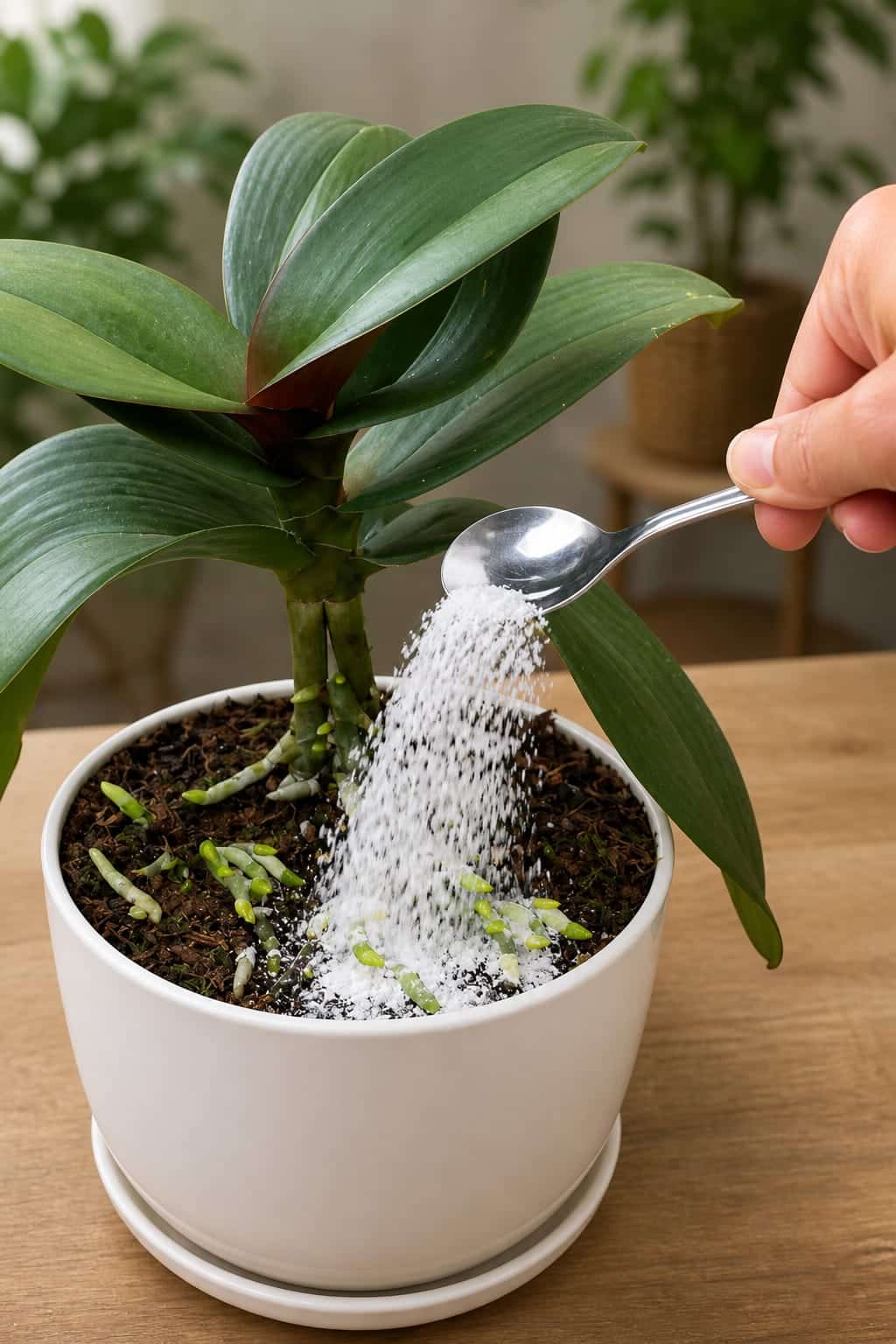
The white powder orchid trick looks simple and promising. A spoonful of powder appears to offer stronger roots, faster growth, and perhaps more blooms. But orchids are sensitive plants with special root needs, and powder treatments can easily cause more harm than good if they are used carelessly.
If the powder is a legitimate orchid fertilizer, it is usually safer to dissolve it in water and apply it weakly. If it is mycorrhizal powder or rooting powder, it should be used only according to the label and only when appropriate. If it is baking soda, flour, sugar, powdered milk, salt, cleaning powder, or anything unknown, keep it away from your orchid.
The real secret to orchid success is not a mystery powder. It is bright indirect light, fresh airy bark, correct watering, excellent drainage, clean roots, and gentle feeding during active growth. Keep the crown dry, protect new root tips, and repot when the medium breaks down.
If your orchid is healthy and growing new roots, support it lightly. If it is struggling, check the roots before adding anything. A sick orchid usually needs better airflow, fresh medium, and careful watering—not a heavy layer of powder.
Use plant-safe products with restraint, and your orchid will have the best chance to grow strong leaves, healthy roots, and beautiful blooms season after season.