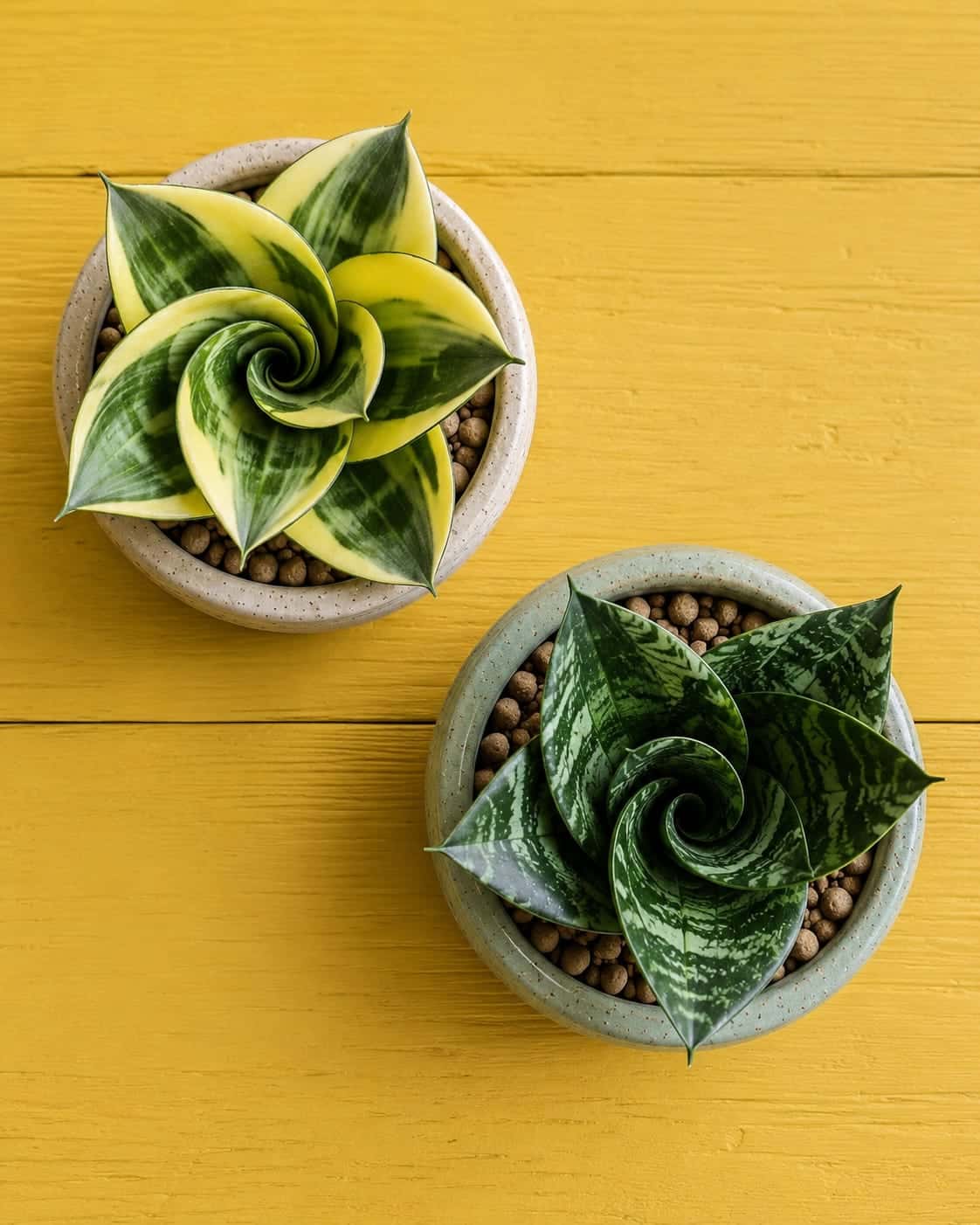
Some houseplants decorate a room quietly. Others become the room’s main attraction. Spiral snake plants belong to the second group. Their leaves do not simply grow upward like ordinary greenery. They twist, curl, overlap, and form a rosette that looks almost designed by an artist. From above, the plant resembles a living green sculpture, a botanical spiral, or a natural decorative centerpiece.
In the image, several small spiral snake plants are arranged on a bright yellow surface. Each plant sits in a compact ceramic pot, and every rosette has its own pattern. Some are dark green with silver-green markings. Others have creamy yellow edges that make the spiral look even more dramatic. The plants are small, symmetrical, and polished, which gives them a luxury decor feeling even though snake plants are known for being low-maintenance.
This is exactly why smart homeowners are choosing spiral snake plants for indoor decor. They offer the beauty of a sculptural plant without the difficult care routine of many designer houseplants. They look expensive, modern, and intentional, yet they are still related to one of the toughest houseplant groups you can own.
A spiral snake plant can make a coffee table feel styled. It can make a bathroom shelf look spa-like. It can make a work desk feel calmer and more elegant. It can turn a small plant corner into something curated. The secret is not only the plant itself, but how you display it, how you keep its shape clean, and how you care for it so the rosette stays firm, compact, and beautiful.
This guide explains what spiral snake plants are, why they look so luxurious, how to style them indoors, how to keep their spiral shape, how to water them, what soil they need, where to place them, and how to avoid the common mistakes that make them lose their decorative appeal.
What Are Spiral Snake Plants?
Spiral snake plants are compact snake plant varieties or specially grown rosette forms that naturally arrange their leaves in a circular, twisting pattern. Many people also associate this look with compact Sansevieria types such as Sansevieria hahnii, often called bird’s nest snake plant, and variegated forms that create a star-shaped rosette. Some varieties are sold under names like Twisted Sister, Golden Hahnii, Bird’s Nest Sansevieria, or Dwarf Snake Plant.
The classic snake plant has tall sword-like leaves. A spiral snake plant has shorter leaves arranged in a tight circular shape. Instead of rising like spears, the leaves curve inward and outward, creating a rosette. When seen from above, the plant can look like a green rose, a spiral shell, or a carefully folded ribbon.
The plants in the image appear to be compact rosette snake plants. Some have creamy yellow margins, while others are deep green with patterned markings. These differences make them excellent for decorative groupings because they look coordinated without being identical.
Why They Look So Luxurious Indoors
Luxury decor is often about shape, balance, texture, and restraint. Spiral snake plants naturally have all of these qualities.
They have strong geometry. Their leaves form a clean radial pattern, which makes them look organized and intentional. They have rich texture. The leaves are thick, smooth, and patterned, giving the plant visual depth. They have compact proportions. They do not look wild or messy when cared for properly. They have a sculptural silhouette. Even a small plant looks like a designed object.
Many houseplants create a soft jungle feeling. Spiral snake plants create a more architectural feeling. They are perfect for homeowners who want indoor greenery but still prefer a clean, modern, minimal, or elegant home style.
The Decorative Power of the Spiral Shape
The spiral shape is naturally attractive to the eye. It appears in shells, flowers, galaxies, pinecones, and many other natural forms. When a plant grows in a spiral pattern, it feels both organic and designed. That is why spiral snake plants look more luxurious than many ordinary potted plants.
The rosette draws attention from above, which makes these plants especially beautiful on low tables, counters, shelves, and plant stands. A tall plant is often admired from the side, but a spiral snake plant is admired from above. This makes it perfect for coffee tables, bedside tables, entryway consoles, and dining table centerpieces.
When displayed in a simple pot, the plant becomes the decoration. You do not need flowers, colorful accessories, or complicated styling. The spiral itself does the work.
Why Homeowners Love Them
Spiral snake plants are popular because they combine beauty with practicality. Many stylish plants are demanding. They need high humidity, exact watering, special lighting, or constant attention. Spiral snake plants look refined but remain relatively easy to care for.
Homeowners love them because they are:
- Compact and easy to place
- Beautiful from above
- Slow-growing and tidy
- Suitable for small spaces
- Easy to style in groups
- Available in green and variegated forms
- More drought-tolerant than many houseplants
- Modern, sculptural, and decorative
They are also excellent for people who like a neat indoor plant collection. Because these plants grow slowly and stay compact, they do not quickly become huge, leggy, or difficult to manage.
Best Places to Display Spiral Snake Plants
Spiral snake plants are versatile. Their compact size makes them suitable for almost any room. The key is to place them somewhere they can be seen from above or at a slight angle.
1. Coffee Table
A spiral snake plant on a coffee table looks like a living sculpture. Choose a low, wide ceramic pot and keep the surface around it simple. A single plant can look elegant, but a group of three can feel like a designer arrangement.
2. Desk or Home Office
Because spiral snake plants are compact, they are perfect for desks. They add greenery without taking over the workspace. Their structured shape can make a home office feel calmer and more polished.
3. Bathroom Shelf
A small spiral snake plant can look beautiful in a bright bathroom. The clean rosette shape pairs well with towels, candles, stone trays, and spa-style decor. Just make sure the bathroom has enough light and the pot does not stay wet.
4. Bedroom Nightstand
On a nightstand, a spiral snake plant gives a peaceful, minimal look. It does not drop petals, it does not need frequent watering, and it stays compact.
5. Entryway Console
An entry table is one of the best places for a decorative plant. A spiral snake plant gives guests an immediate impression of style and care. Pair it with a ceramic bowl, a framed print, or a small lamp.
6. Kitchen Counter
In a bright kitchen, a compact spiral snake plant can soften the look of counters without becoming messy. Keep it away from direct heat, steam, and cooking oil.
7. Bookshelves
These plants look excellent on shelves because they do not trail aggressively or grow too wide. Place one near books, pottery, or neutral decor for a curated look.
How to Style Spiral Snake Plants Like a Designer
The plant itself already has strong visual interest, so the best styling approach is to keep everything around it clean and intentional.
Use Simple Pots
Choose pots that do not compete with the plant. Ceramic, matte stone, terracotta, concrete, and soft neutral pots work beautifully. The image shows several compact pots in earthy tones, which makes the plants look collectible and refined.
Good pot colors include:
- Matte white
- Warm beige
- Soft gray
- Terracotta
- Sage green
- Charcoal
- Natural stone tones
Glossy pots can also work, but they should be simple. The spiral shape is already decorative, so a very busy pot may make the arrangement look cluttered.
Group in Odd Numbers
For a luxury decor effect, group spiral snake plants in odd numbers. Three plants on a tray can look balanced. Five small plants on a shelf can look curated. A collection of different variegations can feel like a botanical display.
Odd-number groupings often feel more natural and stylish than perfectly even arrangements.
Mix Variegated and Dark Green Types
The image shows both yellow-edged and dark green spiral snake plants. This contrast is beautiful. The yellow-edged plants brighten the arrangement, while the dark green plants add depth and richness.
For a designer look, mix:
- One yellow-variegated spiral plant
- One dark green spiral plant
- One pale ceramic or terracotta pot
This creates contrast without looking chaotic.
Use Pebble Top Dressing
The pots in the image appear to have a pebble or clay ball top layer. This gives the arrangement a clean, finished look. A top dressing can hide messy soil and make a small plant look more expensive.
Good top dressing options include:
- Small lava rock
- LECA clay balls
- Fine gravel
- Decorative pebbles
- Pumice
Use a thin layer only. Do not bury the crown of the plant. The base of the leaves should remain dry and airy.
Place Them on a Tray
A tray instantly makes several small plants look intentional. Use a wooden tray for warmth, a stone tray for luxury, or a metal tray for a modern look. Arrange the plants with space between them so each spiral can be seen clearly.
Give Them Breathing Room
Because the rosette shape is the main attraction, do not crowd these plants behind large leafy plants. Let the viewer see the spiral. A little empty space around the plant makes it look more expensive.
Best Light for Spiral Snake Plants
Spiral snake plants tolerate lower light, but they look their best in bright indirect light. Light affects color, compactness, and growth. In low light, the plant may survive, but it may grow slowly and lose some of its crisp, decorative appearance.
Bright indirect light helps:
- Maintain strong variegation
- Keep leaves firm and compact
- Support new growth
- Prevent stretching
- Improve overall plant shape
Place the plant near a bright window, but avoid harsh direct afternoon sun. Morning sun is usually fine, especially if the plant is gradually introduced to it. Too much direct sun can scorch the leaves, especially the yellow variegated sections.
Can Spiral Snake Plants Grow in Low Light?
Yes, they can tolerate low light better than many plants. This is one reason they are popular indoors. However, low light does not mean no light. A dark corner far from a window may keep the plant alive for a while, but it will not encourage strong growth or vibrant color.
In low light, water much less often. The plant uses water slowly when it is not receiving much light. Overwatering in low light is one of the easiest ways to rot a snake plant.
How to Water Spiral Snake Plants
Watering is the most important part of care. Spiral snake plants are drought-tolerant and can store moisture in their thick leaves and rhizomes. They do not like soggy soil.
The best rule is simple: water only when the soil is dry.
Do not water just because a week has passed. Do not water because the top dressing looks dry. Check the soil under the pebbles. If the potting mix still feels damp, wait.
Basic Watering Steps
- Check the soil with your finger or a moisture meter.
- Water only when the soil is dry or nearly dry.
- Pour water slowly around the soil, not directly into the center rosette.
- Let excess water drain out fully.
- Empty the saucer after watering.
- Do not water again until the pot dries.
Water collecting in the center of the rosette can increase the risk of rot, especially in cooler rooms. Always water the soil, not the crown.
How Often Should You Water?
The exact schedule depends on light, pot size, temperature, and soil mix. In many homes, a small spiral snake plant may need water every 2 to 4 weeks during warm months and every 4 to 6 weeks during colder months.
General guide:
- Bright warm room: every 2 to 3 weeks
- Medium light room: every 3 to 4 weeks
- Low light room: every 4 to 6 weeks
- Winter: water very sparingly
These are only guidelines. Always check the soil first.
Best Soil for Spiral Snake Plants
These plants need a fast-draining soil mix. Regular potting soil alone can stay too wet, especially in small decorative pots. A gritty, airy mix helps protect the roots and rhizomes.
Simple Soil Mix
- 2 parts cactus or succulent mix
- 1 part perlite or pumice
- 1 part orchid bark or coarse grit
This mixture drains well while still holding enough moisture for the roots. It also helps keep the plant upright and prevents the base from staying wet.
Choosing the Right Pot
The pot should match both the plant’s care needs and your decor style. A beautiful pot is important, but drainage is even more important.
Choose a pot with:
- Drainage holes
- A stable base
- Enough weight to support the rosette
- A size only slightly larger than the root ball
- A breathable material if possible
Terracotta is excellent because it helps soil dry faster. Ceramic and concrete pots are also beautiful, but make sure they drain properly. If you use a decorative cachepot without drainage, keep the plant in a plastic nursery pot inside it and remove the inner pot when watering.
Why Small Pots Often Look Better
Spiral snake plants look especially luxurious in small, snug pots. A tight pot emphasizes the rosette shape and keeps the plant looking compact. A pot that is too large can make the plant look lost and can also hold too much wet soil around the roots.
When repotting, move up only one pot size. Do not place a small spiral snake plant in a huge container.
How to Keep the Spiral Shape Beautiful
The spiral shape is the main reason people choose these plants. To keep that shape, you need to manage light, watering, rotation, and grooming.
Rotate the Pot
Plants grow toward light. If one side receives more light, the rosette may lean or become uneven. Rotate the pot every one or two weeks so the plant grows symmetrically.
Avoid Stretching
If the plant is in low light, new leaves may become longer, weaker, or less compact. Move it to brighter indirect light to maintain a tight rosette.
Do Not Overwater
Overwatering can make leaves soften, lose shape, or collapse. Firm leaves are essential for a sculptural look.
Remove Damaged Leaves
If a leaf becomes badly damaged, mushy, or brown, remove it carefully at the base. Do not tear leaves from the rosette. Use clean scissors or a sharp blade.
Keep the Center Dry
Water trapped in the center can cause rot. Always water the soil around the plant instead of pouring water directly into the spiral.
Continue to Page 2
Continue to page 2 for more details about this article and the key points many readers miss on the first page.