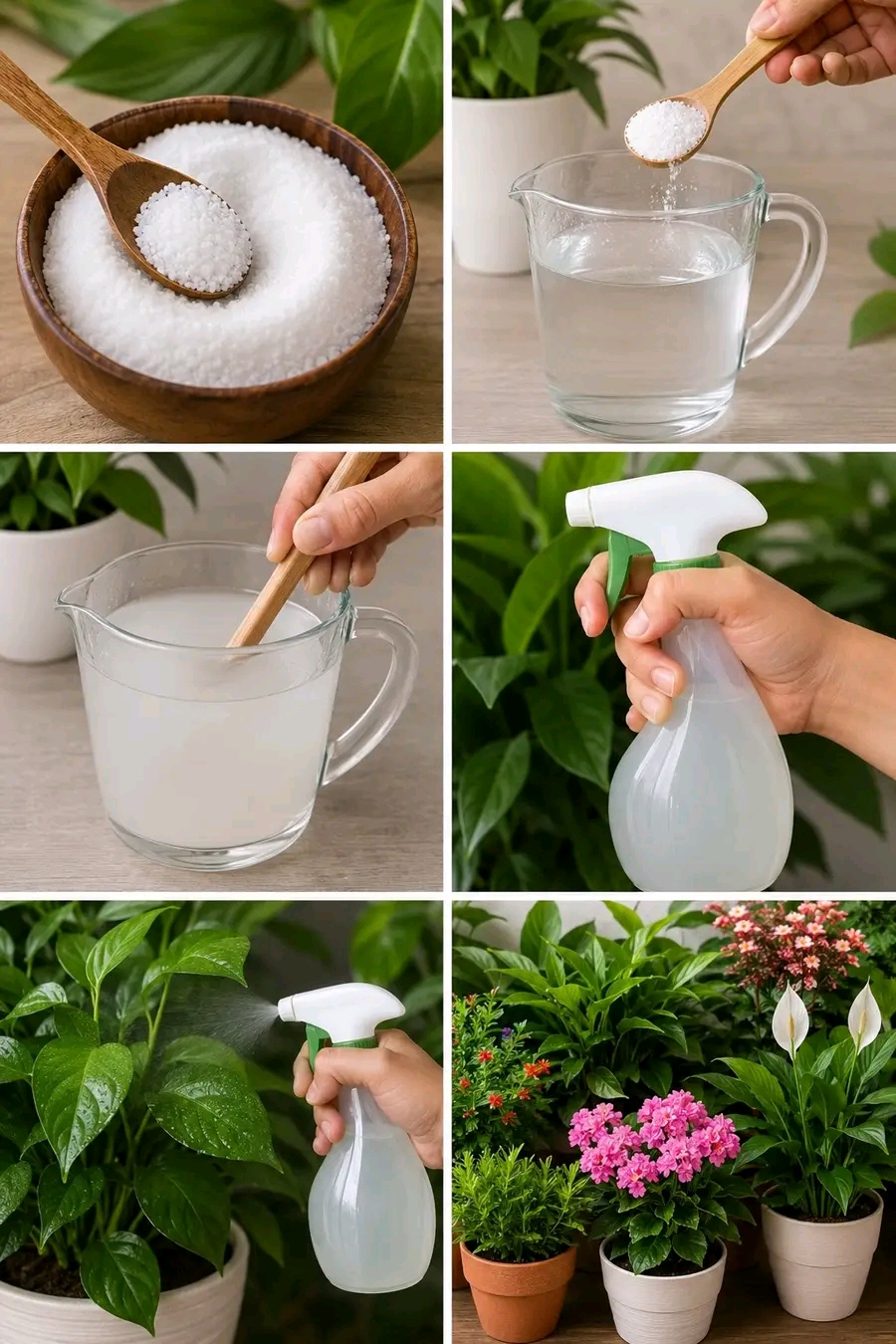
Many indoor plant lovers are always looking for simple ways to keep their plants looking fresh, glossy, full, and healthy without spending money on complicated products. A light spray made from white crystals dissolved in water is one of those popular plant-care ideas that often gets attention because it looks easy, inexpensive, and suitable for many common houseplants. The white crystals are often Epsom salt, a magnesium sulfate product used by many gardeners as a mild magnesium support when plants show signs of deficiency or when they need a careful boost during active growth.
Houseplants such as pothos, peace lily, flowering containers, leafy tropical plants, balcony plants, and patio displays can look more elegant when their leaves are clean, green, and actively growing. A mild mineral spray may help in some situations, but it should never be treated as a magic solution. Plants do not become lush because of one spray alone. They become lush because the roots are healthy, the light is correct, the soil drains well, the watering routine is balanced, the leaves are clean, and any extra feeding is done carefully. A white-crystal spray can only support that routine when it is mixed weakly and used with restraint.
The safest way to understand this method is to see it as an optional leaf-care or soil-support step, not a replacement for real plant care. If the white crystals are Epsom salt, they may provide magnesium and sulfur, two nutrients plants use in small amounts. Magnesium is involved in chlorophyll production, which is connected to green leaf color. However, not every pale plant needs magnesium. Yellow leaves can also come from overwatering, root rot, low light, old leaves, fertilizer imbalance, cold stress, or pests. Adding Epsom salt without understanding the real cause can create mineral buildup and stress the plant.
What the White Crystals May Be
The white crystals used in this kind of spray are often Epsom salt, but they should always be identified before use. Epsom salt is magnesium sulfate. It is different from table salt, sugar, baking soda, cleaning powder, fertilizer granules, or unknown white crystals. This distinction is extremely important because table salt can damage plants severely, baking soda can burn leaves or disturb soil balance, and unknown powders should never be sprayed on foliage or poured into pots.
If the product is labeled Epsom salt and contains only magnesium sulfate, it may be used cautiously on plants in very weak amounts. If the product includes fragrance, bath additives, oils, perfume, coloring, or cosmetic ingredients, it should not be used on plants. Many bath salts are made for skin, not horticulture. Only plain unscented Epsom salt should be considered for plant care.
Some white crystals may also be soluble fertilizer. If that is the case, the product should be mixed according to the label and used only on plants that need feeding. Fertilizer and Epsom salt are not the same thing. Epsom salt does not provide nitrogen, phosphorus, or potassium, which plants need for overall growth. It only supplies magnesium and sulfur. A plant that needs balanced feeding will not be fully supported by Epsom salt alone.
What an Epsom Salt Spray Can Actually Do
A mild Epsom salt spray may support plants when magnesium is genuinely low or when a plant is growing actively and needs a small mineral supplement. It may help leaves maintain a greener appearance if magnesium deficiency is part of the problem. It may also be used as a very occasional foliar spray on certain outdoor or indoor plants that tolerate it well. However, it is not a universal growth booster, and it does not force flowers, repair root rot, or make weak plants healthy overnight.
The spray may also encourage gardeners to inspect their plants more closely. When someone prepares a spray and applies it carefully, they often notice pests, dust, dry soil, yellow leaves, or weak stems. Sometimes the improvement that follows comes from better attention, not from the spray itself. Clean leaves, better watering, and improved light may create more visible results than the mineral solution.
An Epsom salt spray cannot solve low light. It cannot fix a plant sitting in soggy soil. It cannot repair roots damaged by overwatering. It cannot replace proper fertilizer. It cannot make a peace lily bloom in a dark corner or make a pothos grow fast if the room is cold and dim. It is a small support tool, not a complete plant-care system.
Why Magnesium Matters for Plants
Magnesium is part of chlorophyll, the green pigment plants use to capture light energy. Because of this, magnesium is connected to leaf color and photosynthesis. When a plant truly lacks magnesium, older leaves may show yellowing between the veins while the veins remain greener. This pattern is sometimes called interveinal chlorosis. However, visual symptoms can overlap with other problems, so it is not always easy to diagnose by appearance alone.
Indoor plants can sometimes experience nutrient imbalance when they have been in the same potting mix for a long time, when water quality is poor, when fertilizer has been uneven, or when the roots are stressed. In these situations, adding one mineral may not be enough. The plant may need fresh soil, a balanced fertilizer, better drainage, or improved light.
Magnesium is needed in small amounts. More magnesium does not automatically mean more growth. Too much can interfere with the balance of other nutrients and may build up in container soil. This is why Epsom salt should be used lightly and occasionally, not as a weekly habit for every plant.
How to Mix a Gentle Plant Spray
A gentle spray should be weak. A small amount of plain unscented Epsom salt should be dissolved completely in clean water before being added to a spray bottle. The liquid should look clear or only slightly cloudy after mixing. If crystals remain undissolved, they can clog the sprayer or leave residue on leaves. Stirring well and using warm water first can help dissolve the crystals, but the spray should be allowed to cool before applying to plants.
The mixture should not be thick or gritty. It should not leave visible crystals on the foliage. A plant spray should be light enough to mist evenly. Heavy mineral residue on leaves can make the plant look dusty and may cause spotting, especially if the leaves are exposed to sun afterward.
It is better to make a small amount and use it fresh. Old mixtures can collect dust, become contaminated, or be confused with other liquids. The spray bottle should be labeled clearly so it is not mistaken for plain water or cleaning product.
How to Apply the Spray Safely
The safest way to apply a mineral spray is to test it first. Choose one or two leaves and spray lightly. Wait at least twenty-four hours. If the leaves stay healthy with no spotting, curling, yellowing, or burned edges, the plant may tolerate a light application. If there is damage, rinse the leaves gently with clean water and do not use the spray again on that plant.
Spray during the cooler part of the day, away from direct sun. Morning or evening is usually safer. Spraying leaves in strong sunlight can increase the risk of leaf burn because droplets and mineral residue may concentrate light or dry too quickly. Indoor plants near bright windows should also be protected from harsh sun after spraying.
The spray should be applied lightly. Leaves should not be dripping heavily. Avoid spraying open flowers, delicate buds, fuzzy leaves, and sensitive new growth. For plants with large glossy leaves, it may be better to wipe the leaves with a damp cloth afterward if residue appears. Clean foliage is part of the premium indoor plant display, and visible white marks reduce the beauty of the plant.
When to Avoid This Spray
A white-crystal spray should be avoided on plants that are already stressed. If a plant is wilting from root rot, sitting in wet soil, recovering from repotting, sunburned, pest-infested, or severely underwatered, do not add mineral spray immediately. Stressed leaves are more likely to burn or react badly. Fix the main care problem first.
It should also be avoided on fuzzy-leaved plants such as African violets, many begonias, and some soft-leaved ornamentals. Fuzzy leaves can hold moisture and residue, which may cause spotting or rot. It should be used very carefully on orchids, calatheas, ferns, and other sensitive tropical plants because these plants can react poorly to mineral buildup or leaf residue.
Do not use scented Epsom salt, bath crystals, table salt, sea salt, rock salt, cleaning powder, or unknown white products. These can damage plants. Plain unscented magnesium sulfate is the only form that should be considered, and even then only in weak amounts.
Using Epsom Salt Around Pothos
Pothos is a forgiving houseplant with trailing green or variegated leaves, but it still needs good care to look lush. If a pothos has pale leaves, slow growth, or weak vines, the first things to check are light, watering, pot size, and soil condition. A pothos in low light may lose vigor. A pothos in soggy soil may develop root problems. A pothos in old depleted soil may need balanced fertilizer or fresh potting mix.
A mild Epsom salt spray may be tested on pothos if the plant is otherwise healthy and growing actively. Apply lightly and avoid direct sun. If the leaves show residue, wipe them clean. Pothos leaves look best when they are glossy and free from mineral spots. For a clean indoor display, the spray should never make the plant look dusty or coated.
If pothos leaves are yellowing, check the roots before assuming magnesium deficiency. Yellow leaves are commonly caused by overwatering, old leaves, inconsistent moisture, or low light. Epsom salt cannot fix root rot. Healthy roots and correct watering will always matter more.
Using Epsom Salt Around Peace Lilies
Peace lilies are known for glossy leaves and elegant white spathes, but they are sensitive to mineral buildup and fertilizer stress. Brown tips are common on peace lilies and can be caused by hard water, dry air, overfertilizing, underwatering, or inconsistent moisture. Because of this, using Epsom salt too often can make tip burn worse rather than better.
If a peace lily is healthy, a very mild spray may be tested on a small area, but it should not be used heavily. Peace lilies usually respond better to bright indirect light, correct watering, clean leaves, and gentle balanced fertilizer than to repeated mineral sprays. If the plant is not blooming, light is usually more important than Epsom salt.
Peace lily leaves should be wiped clean after any visible residue appears. The plant’s beauty depends on deep green glossy foliage. A white film from mineral spray can make the plant look neglected. In luxury home staging or premium indoor plant displays, clean leaves are essential.
Using Epsom Salt Around Flowering Plants
Some gardeners use Epsom salt around flowering plants because magnesium can support green growth and nutrient function. However, flowers require more than magnesium. They need adequate light, balanced nutrition, healthy roots, and proper watering. A flowering plant that lacks potassium or phosphorus will not be fixed by magnesium alone. A plant that is too shaded will not bloom heavily because of a spray.
When spraying flowering plants, avoid open blooms. Petals are delicate and may spot easily. Spray the foliage lightly instead. If the plant is outdoors, apply in the cooler part of the day and avoid spraying when pollinators are active on flowers. Protecting beneficial insects is part of responsible garden care.
For flowering container displays, a balanced flowering plant fertilizer is usually more useful than Epsom salt alone. Epsom salt may be an occasional support if magnesium is needed, but it should not replace a complete feeding routine.
Soil Application Versus Foliar Spray
Epsom salt can be used either as a weak foliar spray or as a weak soil drench, but both methods require caution. A foliar spray applies the solution to leaves, where it may be absorbed in small amounts. A soil drench sends the mineral into the root zone. For potted plants, soil application can contribute to mineral buildup if repeated too often.
Foliar spraying can leave residue on leaves if the solution is too strong or if water quality is poor. Soil drenching can affect the nutrient balance in the pot. Neither method should be used frequently without a reason. Container plants live in limited soil, so extra minerals cannot disappear the way they might in open garden soil.
If the plant is in fresh potting mix and receives balanced fertilizer, it may not need Epsom salt at all. More amendments do not automatically create better growth. Sometimes the cleanest routine is the safest routine.
Why Balanced Fertilizer Still Matters
Epsom salt is not a complete fertilizer. It does not provide nitrogen for leafy growth, phosphorus for root and flower support, or potassium for overall plant strength. It only provides magnesium and sulfur. If a plant is hungry, a balanced houseplant fertilizer or flowering plant fertilizer may be more appropriate.
Using Epsom salt instead of fertilizer can leave the plant lacking other nutrients. This may lead to weak growth over time. On the other hand, using Epsom salt on top of heavy fertilizer can create too many salts in the pot. The best approach is to keep feeding simple and measured.
During active growth, many houseplants benefit from a diluted balanced fertilizer every few weeks or months, depending on the plant type and light level. During winter or low-light periods, feeding should usually be reduced. Epsom salt should be occasional and purposeful, not automatic.
Water Quality and Leaf Residue
Water quality affects how plants respond to sprays. Hard tap water can leave mineral spots on leaves. When mixed with Epsom salt, visible residue may be more likely. Filtered water, rainwater, or distilled water can reduce spotting if the plant is sensitive.
If leaves develop white marks after spraying, wipe them gently with a damp cloth. Do not leave mineral residue on glossy leaves. It can make plants look dull and may interfere with light absorption. For plants used in interior decor, clean leaves are part of the design.
Residue is also a sign that the spray may be too strong. A gentle solution should not leave heavy deposits. If residue appears often, reduce the concentration or stop using the spray.
Continue to Page 2
Continue to page 2 for more details about this article and the key points many readers miss on the first page.