Anthuriums are some of the most elegant flowering houseplants you can grow indoors. Their glossy heart-shaped leaves, tall flower stems, and colorful spathes make them look tropical, polished, and luxurious. A healthy Anthurium can brighten a room for months, producing long-lasting blooms that rise above the foliage like little waxy hearts.
But many Anthurium owners eventually face the same problem: the plant stays green but stops blooming, the leaves lose their shine, or the flowers fade faster than expected. When this happens, people often search for a simple natural trick to encourage stronger growth and more beautiful flowers. One kitchen ingredient that appears often in plant-care routines is lemon.
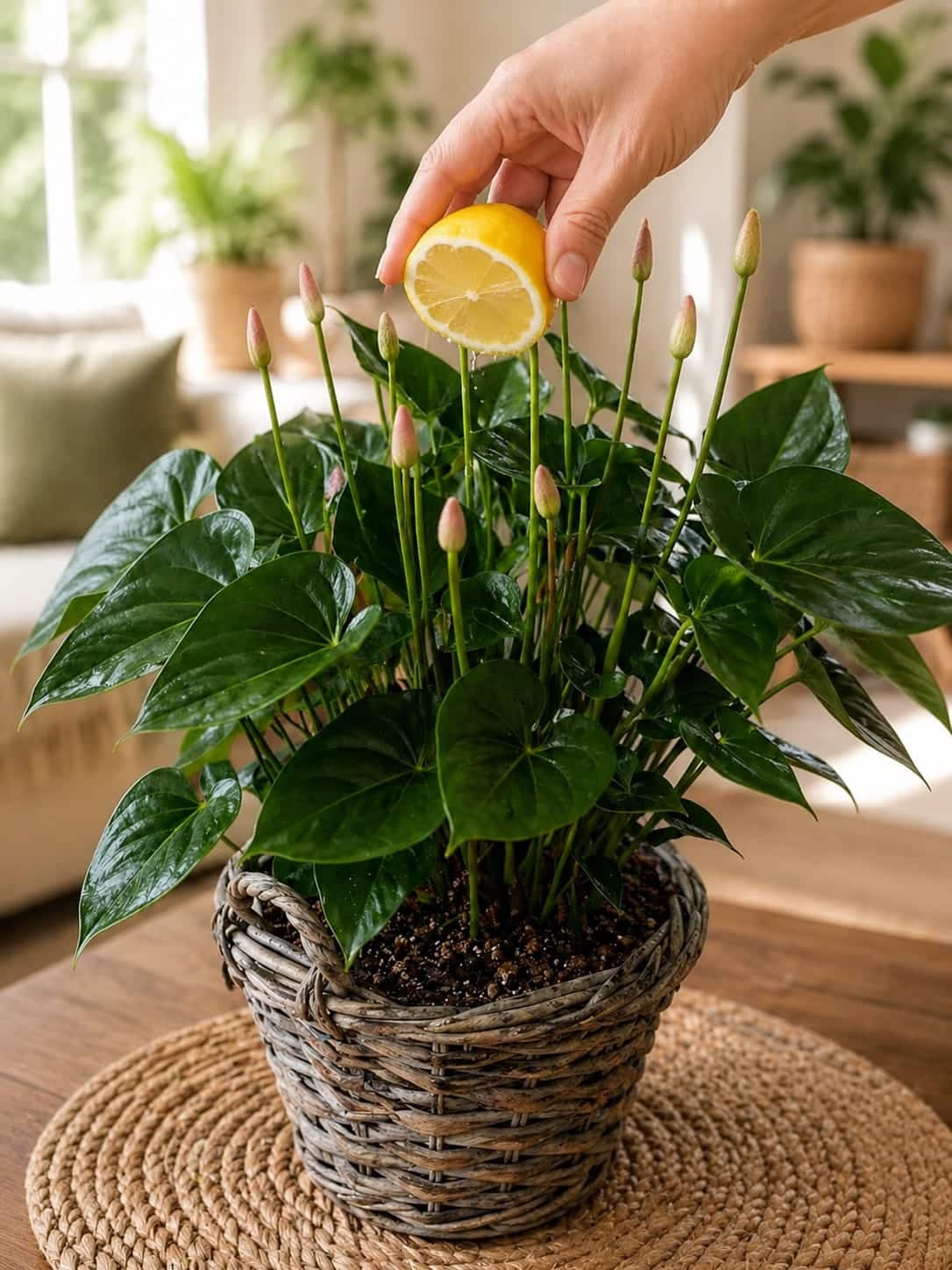
The image shows a lush Anthurium with glossy dark green leaves and many flower buds while lemon juice is being squeezed over the plant. This creates an attractive natural-care idea, but it needs to be explained carefully. Lemon water is not a miracle bloom booster. It will not instantly force an Anthurium to flower, and it will not fix root rot, poor light, compacted soil, or overwatering. Used too strongly, lemon juice can harm the roots because it is acidic.
However, when used in a very diluted form and only occasionally, lemon water may be useful as a mild water-adjusting routine for Anthuriums, especially when tap water is hard or leaves and soil show mineral buildup. Anthuriums generally prefer slightly acidic to neutral growing conditions, and very diluted lemon water may help refresh the root zone when used with caution.
The key is dilution. Lemon juice should never be squeezed directly onto the plant, leaves, flowers, or soil. A few drops in plenty of water is enough. The goal is not to feed the plant with lemon. The goal is to create a gentle, occasional rinse that supports a healthier growing environment.
This guide explains how to use lemon water safely for Anthurium, when it may help, when to avoid it, and what care steps truly encourage glossy leaves, strong roots, and more reliable blooms.
Understanding Anthurium Growth
Anthuriums are tropical plants that naturally grow in warm, humid environments. Many popular indoor varieties are epiphytic or semi-epiphytic, meaning they are adapted to grow with plenty of air around their roots. This is why Anthuriums do not like dense, heavy, soggy soil.
A healthy Anthurium needs bright indirect light, warm temperatures, moderate humidity, an airy potting mix, and careful watering. When these needs are met, the plant can produce glossy foliage and colorful spathes repeatedly throughout the year.
The “flower” of an Anthurium is actually a colorful spathe, which is a modified leaf. The true flowers are tiny and grow on the central spike, called the spadix. These spathes can last for weeks, sometimes longer, when the plant is healthy.
If an Anthurium stops blooming, the reason is usually not a lack of one kitchen ingredient. It is more often caused by low light, weak roots, poor soil, inconsistent watering, or lack of balanced nutrition.
Can Lemon Water Help Anthurium Bloom?
Lemon water cannot directly make an Anthurium bloom. It does not contain balanced plant nutrients, and it does not act like a flowering fertilizer. Anthurium blooms depend on energy, and energy comes from healthy leaves receiving enough light and roots absorbing water and nutrients properly.
That said, lemon water may support the plant indirectly in certain situations. If your tap water is hard and leaves mineral deposits on the soil or pot, a very mild lemon-water rinse may help reduce some buildup over time. If the growing medium has become slightly alkaline from repeated watering with mineral-heavy water, a carefully diluted acidic rinse may help refresh conditions.
But this should be done rarely. Lemon water is not something to use every week. Anthurium roots are sensitive, and strong acidity can damage them.
The safest way to think about lemon water is this: it is an occasional water-quality adjustment, not a bloom button. The real bloom support comes from good light, healthy roots, airy soil, and gentle feeding.
Why Direct Lemon Juice Is Dangerous
The image shows lemon being squeezed directly over the plant, but in real care, this should be avoided. Fresh lemon juice is highly acidic. If it touches leaves, flower buds, roots, or the crown in concentrated form, it may cause irritation, spots, or tissue damage.
Direct lemon juice on the soil can create an uneven acidic area around the roots. Some roots may receive a strong dose while others receive none. This can stress the plant instead of helping it.
Lemon pulp, seeds, and peel should also not be placed in the pot. They can rot, attract fungus gnats, encourage mold, and disturb the soil environment. A houseplant pot is not a compost bin.
If lemon is used at all, it should be diluted in water first. The final mixture should be extremely weak, with only a faint hint of lemon. If the water smells strongly like lemon, it is probably too strong for an Anthurium.
The Safest Lemon Water Ratio for Anthurium
The safest beginner ratio is one or two drops of fresh lemon juice in one cup of water. For a larger watering can, use only a few drops in one liter of water. Stir well before applying.
The water should look clear. It should not be cloudy with lemon pulp. It should not smell like lemonade. It should not taste strongly acidic. This is a very mild rinse, not a drink recipe.
Use fresh lemon juice only. Do not use lemonade, bottled sweetened lemon drinks, lemon syrup, or anything with sugar. Sugar can attract insects and cause microbial problems in the soil.
After mixing, use the solution immediately. Do not store lemon water for days. Homemade mixtures can change over time, especially in warm rooms.
When Lemon Water May Be Useful
Lemon water may be useful if your Anthurium is healthy but you notice signs of mineral buildup. These signs may include white crust on the soil surface, white residue around the pot edge, or dull leaves caused by mineral-heavy water splashing and drying.
It may also be useful if your local tap water is very hard and you want to occasionally soften the watering routine. In that case, using filtered water, rainwater, or distilled water may be even safer than relying on lemon. But a very diluted lemon-water rinse can be used occasionally if done carefully.
Lemon water is best used during active growth, when the plant is stable and able to respond well. The plant should have firm leaves, no root rot, and soil that drains properly.
If the Anthurium is already blooming and healthy, you may not need lemon water at all. Consistency is often better than extra treatments.
🌱 Gentle reminder: Lemon water is not a substitute for good care. It should only be used rarely and when the plant is already healthy.
When You Should Avoid Lemon Water
- Do not use if the Anthurium is sick, wilted, or sitting in wet soil. A plant with root rot does not need acidity – it needs root inspection, fresh airy soil, and corrected watering.
- Do not use if the leaves are yellowing quickly and the potting mix smells sour. This usually points to root or soil problems.
- Do not use on a newly repotted Anthurium. Freshly disturbed roots need time to settle. Plain water is safer during the first recovery period.
- Do not use if you already fertilize frequently or if the soil has mineral buildup from too much fertilizer. Flushing with plain water or repotting may be better.
- Do not use it on leaves, flowers, or buds. Apply only to the soil, and only in a very diluted form.
Step-by-Step Lemon Water Routine for Anthurium
Step 1: Check the Soil First
Before using lemon water, check the soil moisture. Anthuriums like evenly moist soil, but they do not like soggy roots. The top layer of soil should begin to dry before watering again.
If the soil is still wet, do not add lemon water. Wait until the plant is actually due for watering.
Step 2: Prepare a Very Weak Mixture
Add one or two drops of fresh lemon juice to one cup of room-temperature water. Stir well. For a larger amount, add only a few drops per liter.
Strain the lemon juice if pulp or seeds are present. Only clear diluted water should go into the pot.
Step 3: Apply to the Soil Only
Pour the diluted lemon water around the soil surface. Avoid splashing the leaves, buds, flowers, or stems. Do not pour it into the center of the plant.
Step 4: Let the Pot Drain
If the pot has drainage holes, allow excess liquid to drain completely. Empty the saucer afterward. Anthurium roots should not sit in standing water.
Step 5: Wait Before Repeating
Do not repeat quickly. Wait at least six to eight weeks before considering another application, and only use it again if the plant is healthy and there is a reason to use it.
How Often Should You Use Lemon Water?
Lemon water should be rare. Once every six to eight weeks is more than enough for most Anthuriums, and many plants do not need it at all.
Do not use lemon water weekly. Do not use it every time you water. Do not use it as a regular fertilizer. Too much acidity can damage roots and disturb the potting mix.
If you are using lemon water because of hard water, consider improving your water source instead. Filtered water, rainwater, or distilled water may be gentler for long-term care.
For most Anthuriums, plain water and a balanced fertilizer routine are more important than lemon water.
The Real Secret to More Anthurium Blooms
The real secret to more Anthurium blooms is bright indirect light. Anthuriums can survive in lower light, but they bloom better when they receive strong filtered brightness. If your plant has glossy leaves but few flowers, light is the first thing to improve.
Place the plant near a bright window where it receives plenty of indirect light. Avoid harsh direct afternoon sun, which can scorch the leaves. Morning light or filtered light through a sheer curtain is often ideal.
Healthy roots are the second secret. If the roots are struggling in dense, wet soil, the plant will not bloom well. Anthuriums need an airy mix that drains well but still holds some moisture.
Balanced nutrition is the third secret. A diluted flowering houseplant fertilizer used during active growth can support blooms more reliably than lemon water.
Continue to Page 2
Continue to page 2 for more details about this article and the key points many readers miss on the first page.