Geraniums are among the most cheerful flowering plants you can grow in pots, window boxes, balconies, patios, and sunny garden corners. Their rounded leaves, strong stems, and bright flower clusters bring instant color wherever they are placed. A healthy geranium can bloom for months, producing red, pink, white, coral, purple, or salmon-colored flowers again and again through the growing season.
But sometimes geraniums begin to slow down. The leaves may lose their rich green color. The plant may bloom less. Stems may look tired, and the soil may seem depleted after weeks of watering and flowering. This is when many gardeners start looking for a simple homemade boost that can help the plant look fresh again.
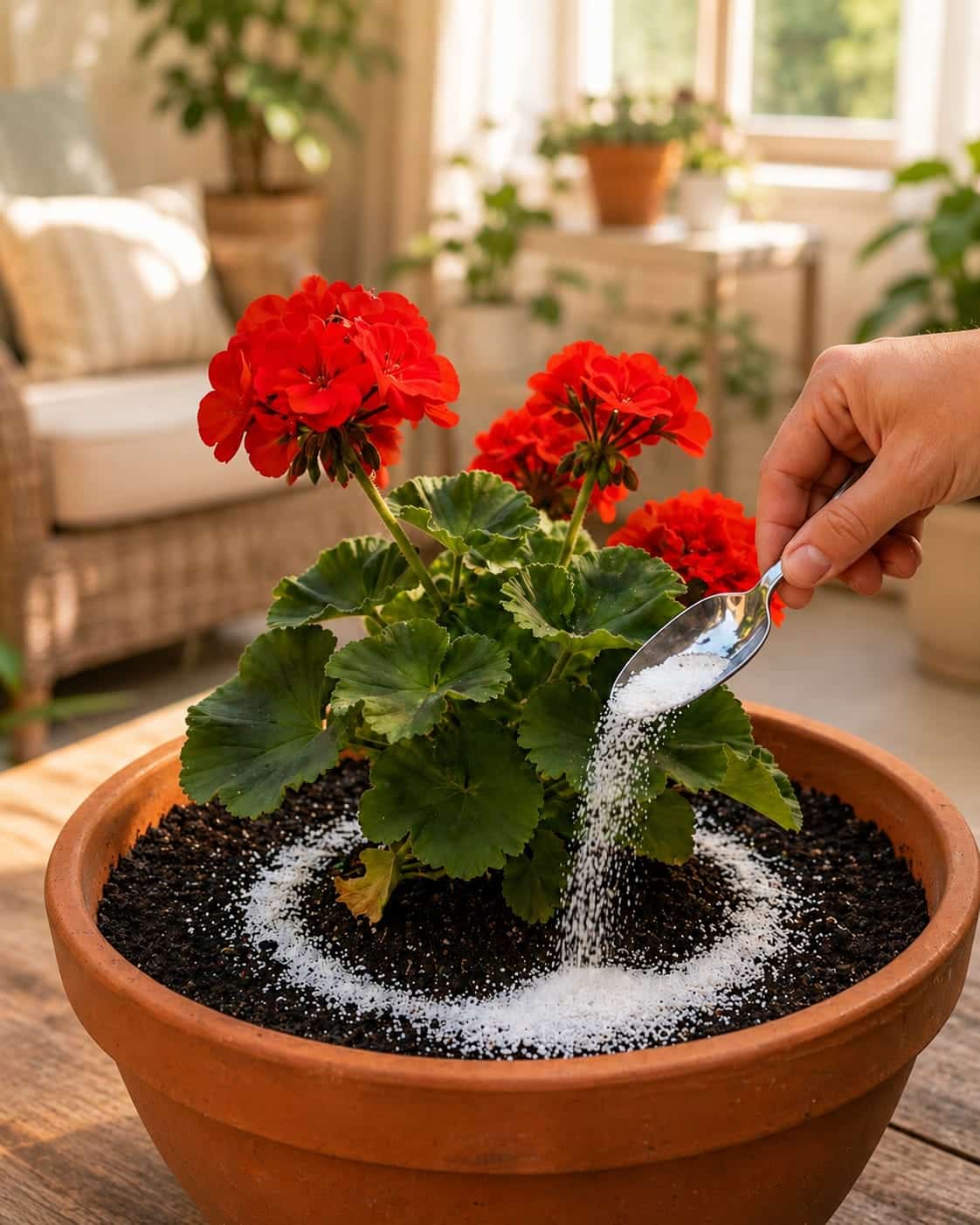
One common natural plant-care idea is using Epsom salt. In the image, a spoonful of white crystals is being sprinkled around a blooming red geranium in a terracotta pot. This suggests a simple mineral supplement that many gardeners associate with greener leaves and stronger flowering. Epsom salt can be useful in some cases, but it must be used correctly. It is not a miracle fertilizer, and it should not be poured heavily over the soil.
Epsom salt is magnesium sulfate. It provides magnesium and sulfur, two nutrients plants use in small amounts. Magnesium is especially important because it helps plants produce chlorophyll, the green pigment that allows leaves to use light. When a plant truly lacks magnesium, a small dose of Epsom salt may help support healthier green growth.
However, geraniums also need nitrogen, phosphorus, potassium, calcium, and trace elements. Epsom salt does not provide all of these. It cannot replace a balanced fertilizer. It cannot fix poor light, root rot, soggy soil, pest problems, or old compacted potting mix. Used too often, it can contribute to mineral buildup and create more stress for the roots.
The safest way to use Epsom salt for geraniums is to dissolve a small amount in water and apply it occasionally during active growth. Sprinkling dry crystals directly on the soil, as shown in many dramatic plant-care images, is less ideal because it can create concentrated spots around the roots when watered. A diluted solution is gentler and more even.
This guide explains how to use Epsom salt safely for geraniums, when it may help, when to avoid it, and what care steps truly keep geraniums full, green, and covered in flowers.
What Epsom Salt Does for Geraniums
Epsom salt contains magnesium and sulfur. Magnesium helps support chlorophyll production, which is connected to healthy green leaves. Sulfur is also involved in plant growth and plant proteins. These nutrients are needed in small amounts, not large amounts.
For geraniums, Epsom salt may be helpful if the plant is showing signs that could suggest magnesium deficiency. A possible sign is pale leaves with greener veins, especially if the plant is otherwise receiving good light, correct watering, and balanced feeding. In this situation, a light magnesium supplement may support better color in future growth.
But Epsom salt does not work like a complete flower fertilizer. It does not contain phosphorus or potassium, which are important for flowering plants. It also does not contain nitrogen, which supports leafy growth. If a geranium is weak because it is not being fed properly, Epsom salt alone will not solve the problem.
The best way to understand Epsom salt is as a specific supplement, not a full meal. It can support one part of plant nutrition, but it cannot replace the entire care routine.
Can Epsom Salt Make Geraniums Bloom More?
Epsom salt may support flowering indirectly if the plant is low in magnesium and struggling to produce healthy leaves. Strong leaves help the plant make energy, and energy supports flowers. But Epsom salt does not directly force geraniums to bloom.
Geranium blooms depend mostly on bright light, regular deadheading, healthy roots, proper watering, and balanced nutrition. If your geranium is not blooming, the first thing to check is light. Geraniums need strong light to flower well. A plant in shade may grow leaves but produce few blooms.
The second thing to check is old flowers. If faded flower clusters remain on the plant, the geranium may put energy into seed production instead of new blooms. Removing spent blooms encourages repeat flowering.
The third factor is feeding. A geranium that blooms heavily uses nutrients. A balanced fertilizer during the growing season is often more useful than relying only on Epsom salt.
So, Epsom salt may help as a small part of a bloom-support routine, but it is not the main bloom trigger. Light and good care matter far more.
🌸 Blooming secret: Regular deadheading (removing faded flowers) and bright light matter more than any magnesium supplement.
Why Sprinkling Dry Epsom Salt Can Be Risky
The image shows Epsom salt being sprinkled directly onto the soil. This looks simple, but it is not always the safest method for potted plants. When dry crystals sit in one place, they can dissolve unevenly during watering. This creates concentrated spots in the soil.
Roots near those spots may receive too much magnesium sulfate at once. In a garden bed, minerals spread through a larger soil volume. In a pot, the soil volume is limited, so concentration matters more.
Too much Epsom salt can contribute to mineral buildup. This may lead to brown leaf edges, root stress, poor water absorption, or an imbalance with other nutrients. Plants need nutrients in balance. More of one mineral does not automatically mean healthier growth.
A diluted liquid application is usually safer because the Epsom salt is spread more evenly through the watering water. This reduces the risk of hot spots around the roots.
The Safest Epsom Salt Ratio for Geraniums
A gentle beginner-safe mixture is one teaspoon of Epsom salt dissolved in one gallon of water. Stir until the crystals dissolve completely. Use this solution only when the geranium is already due for watering.
For smaller pots or plants that are slightly stressed, use an even weaker mixture, such as half a teaspoon per gallon of water. With mineral supplements, gentle is better than strong.
Do not pour the entire gallon into one pot. Use only enough to water the plant normally, then let the pot drain. The rest of the solution can be discarded or used sparingly on other suitable flowering plants.
Do not use Epsom salt water every week. For geraniums, once every four to six weeks during active growth is enough if you choose to use it. Many geraniums do not need it at all if they are already growing well and receiving balanced fertilizer.
When Epsom Salt May Be Useful
Epsom salt may be useful when a geranium is actively growing and blooming but the leaves look slightly pale despite good care. It may also be helpful if the plant is in a container where nutrients are washed out regularly by watering.
Container plants lose nutrients faster than plants in the ground because water drains through the pot and carries minerals with it. If a geranium has been in the same pot for a long time, the soil may become depleted. In that case, a light supplement can support growth, but fresh soil and balanced feeding may be even more important.
Epsom salt is best used during spring and summer when geraniums are actively growing. This is when the plant can use nutrients more efficiently.
Use it only on a plant that has healthy roots, good drainage, and no signs of rot. A plant must be able to absorb water properly before any supplement can help.
When You Should Avoid Epsom Salt
- Do not use if the soil is wet and the plant is drooping – this may indicate overwatering or root rot.
- Do not use if leaf tips are already browning from fertilizer burn or mineral buildup.
- Do not use in a pot without drainage holes – salts can accumulate.
- Do not use as a replacement for balanced fertilizer – geraniums need complete nutrition.
- Do not use on newly transplanted or severely stressed geraniums – let them settle first.
Step-by-Step: How to Use Epsom Salt on Geraniums
Step 1: Check the Soil
Before using Epsom salt water, check the soil moisture. Geraniums like soil that dries slightly between waterings. The top inch of soil should feel dry before watering again. If the soil is still wet, wait.
Step 2: Prepare a Weak Solution
Dissolve one teaspoon of Epsom salt in one gallon of room-temperature water. Stir well until fully dissolved. For small pots, use half strength.
Step 3: Apply to the Soil Only
Pour the solution around the soil surface, not over the flowers or leaves. Avoid splashing the blooms. Wet flowers may fade faster, and residue on leaves is unnecessary.
Step 4: Let the Pot Drain
If the pot has drainage holes, allow excess liquid to drain completely. Empty the saucer afterward. Geranium roots should not sit in standing water.
Step 5: Wait Before Repeating
Do not repeat the treatment too soon. Wait at least four to six weeks before considering another light application, and only repeat during active growth if the plant appears to need it.
Continue to Page 2
Continue to page 2 for more details about this article and the key points many readers miss on the first page.