Snake plants are already known for their bold upright leaves, strong patterns, and easy care. Their green sword-shaped foliage with yellow edges makes them one of the most popular indoor plants for modern homes, apartments, offices, kitchens, and bright living rooms. But some plant lovers like to take this classic plant even further by shaping the leaves into creative forms. One of the most eye-catching ideas is the spiral bottle shape, where flexible snake plant leaves are gently wrapped around a plastic bottle to create a twisted decorative tower.
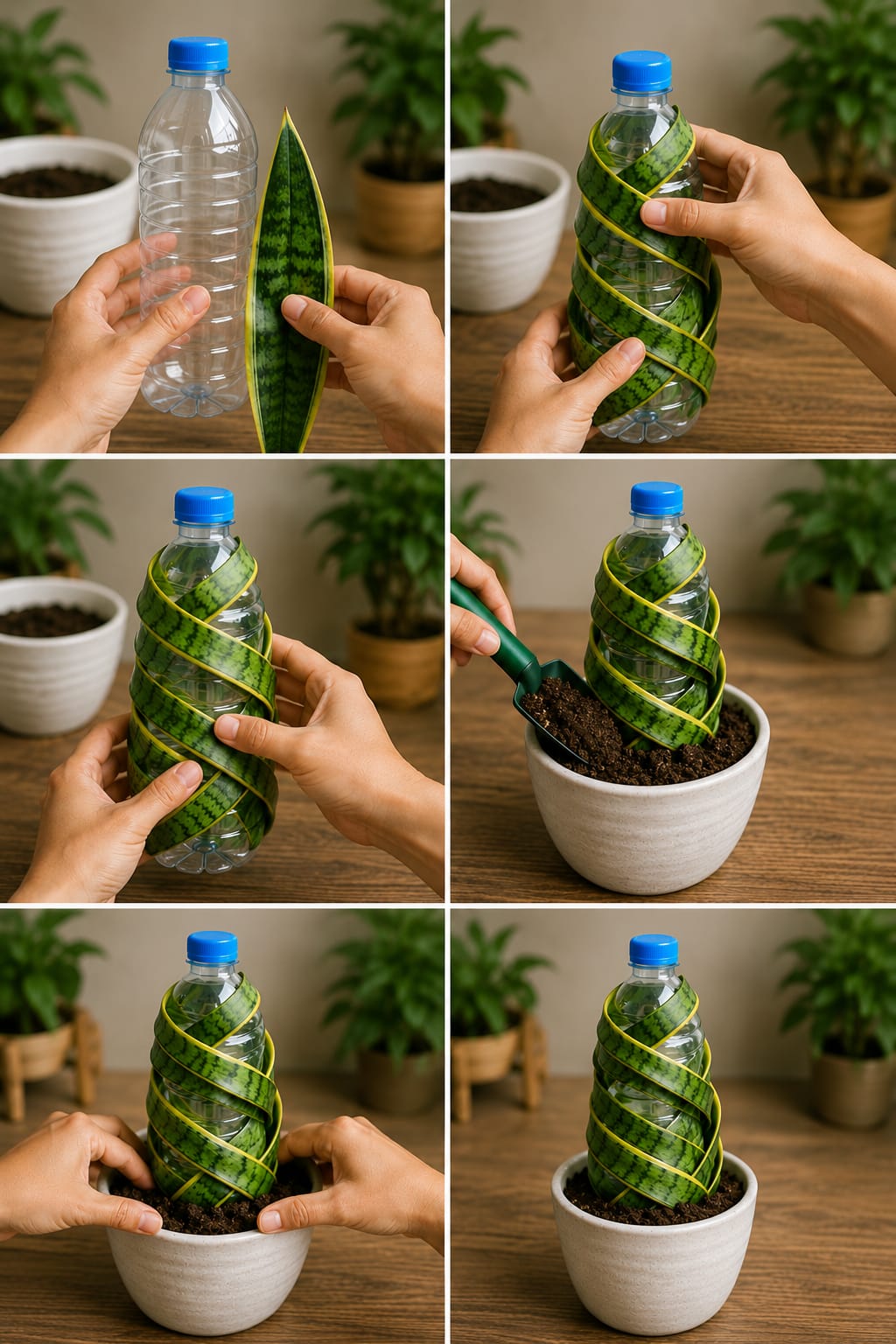
The image shows a step-by-step visual idea. A plastic bottle is used as a temporary support. A long snake plant leaf is placed beside it, then wrapped around the bottle in a spiral pattern. After more leaves are arranged around the bottle, the whole structure is placed into a pot with soil. The result looks like a living green sculpture, almost like a braided snake plant tower. It is unique, artistic, and perfect for people who enjoy unusual houseplant displays.
Before trying this idea, it is important to understand one thing clearly. Snake plant leaves are not naturally vines. They do not climb, twist, or wrap around supports by themselves. They are thick, stiff leaves designed to grow upright from rhizomes under the soil. Because of this, shaping them around a bottle must be done gently. If the leaves are bent too hard, folded sharply, tied too tightly, or forced when they are dry and stiff, they can crack, bruise, rot, or stop growing properly.
This project is best treated as a decorative plant styling idea, not a natural growth method. It works best with younger, flexible leaves or with leaves that are already slightly curved. The bottle acts as a guide and support. The goal is not to torture the plant into a shape, but to guide it carefully while keeping the roots, crown, and leaf tissue healthy.
Understanding the Snake Plant Before Shaping It
Snake plant, now commonly classified under Dracaena but still widely known as Sansevieria, is a tough succulent-like houseplant. It stores moisture in its thick leaves and underground rhizomes. This is why it can survive missed watering, dry rooms, and lower light better than many tropical plants. It is also why overwatering is one of the fastest ways to damage it.
Most snake plants grow vertically. Their leaves rise straight from the soil, forming a sharp architectural look. Some varieties have dark green bands, some have yellow edges, and others have silver or compact rosette growth. The leaf tissue is thick and fibrous. It can bend slightly when young, but mature leaves become firmer over time.
When you create a bottle spiral shape, you are working with the physical flexibility of the leaf. You are not changing the plant’s genetics. The plant will not naturally continue growing around the bottle like a vine. New growth will still try to grow upright from the base. This means the spiral shape needs support and occasional adjustment if you want it to keep its sculptural appearance.
Is This Method Safe for Snake Plants?
It can be safe if done gently, but it can also damage the plant if done aggressively. The most common problem is leaf cracking. Snake plant leaves may look flexible, but they can split if twisted too sharply. Once a leaf cracks, that damaged area does not heal perfectly. It may scar, dry, or become a weak point where rot can start if moisture enters the wound.
Another risk is trapping moisture. If leaves are wrapped tightly around a plastic bottle, air cannot move well between the leaf and the bottle. If water sits in those tight spaces, fungal problems may appear. This is especially risky in humid rooms, dark corners, or homes where plants are watered too often.
The third risk is crown rot. The crown is the base area where the leaves meet the soil. If the bottle is pushed too deep, soil is packed too tightly, or water collects around the base, the plant can rot. Snake plants need their crown to stay dry and airy. A decorative project should never sacrifice root health for appearance.
For the safest result, use healthy leaves, do not force tight curves, keep the bottle clean, avoid wet leaves, use very well-draining soil, and water carefully. The plant should still be treated like a snake plant, not like a water-loving tropical vine.
Choosing the Right Snake Plant for This Project
Not every snake plant is suitable for a spiral bottle design. A very old, stiff, tall leaf may crack when you try to wrap it. A very small leaf may not reach around the bottle. The best leaf is long, healthy, slightly flexible, and free from disease. It should feel firm but not brittle. The color should be strong, with no mushy patches, black marks, or dry split edges.
Variegated snake plants with yellow margins create the most dramatic spiral look because the yellow edges form visible lines around the bottle. The green center and yellow border create a natural ribbon effect. This is why the display in the image looks so striking. The leaf pattern becomes part of the design.
If you want to build a fuller tower, you may need more than one long leaf. However, cutting many leaves from a healthy mother plant can reduce its appearance. A better method is to use leaves that were already removed during pruning, damaged at the base, or taken from a plant that needs thinning. Another option is to use artificial support with rooted divisions placed around the bottle, but this takes more planning.
Choosing the Bottle Support
The bottle in the image is a clear plastic water bottle with a blue cap. A bottle like this is easy to use because it is lightweight, smooth, and simple to hold. The rounded shape helps guide the leaf into a spiral without sharp corners. A clear bottle also lets you see how the leaf sits against the surface.
The size of the bottle matters. A narrow bottle creates tighter curves, which may stress the leaves. A wider bottle creates softer curves and is safer for the plant. If your snake plant leaf is stiff, choose a larger bottle so the spiral is gentle. If the leaf is young and flexible, a medium bottle may work. Avoid tiny bottles because they force the leaf into a sharp bend.
The bottle should be clean and dry before use. Do not leave sticky labels, glue, or sugary drink residue on the surface. Any residue can attract insects or mold. Wash the bottle, remove labels, and dry it completely. If you plan to keep the bottle inside the pot long-term, make sure it does not trap water at the base.
Preparing the Leaf
The leaf should be clean before wrapping. Dust can be wiped away with a soft damp cloth, then the leaf should be allowed to dry. Never wrap a wet leaf tightly around plastic because moisture can remain trapped. The leaf should also be checked carefully for cracks. If it already has a deep split, do not use it for the spiral. That split may widen when bent.
If the leaf is attached to a rooted plant, the process is different from using a detached leaf. A rooted leaf still gets water and nutrients from the plant. A detached leaf can be used as a temporary decorative cutting or propagation material, but it will not stay beautiful forever unless it roots successfully. The image looks like a styling method using long leaves around a bottle, then placing the structure into a pot. If the leaves do not have roots or rhizomes attached, the display may not last as a living plant unless the cuttings root later.
For a real long-term plant, it is better to use rooted divisions or leaves attached to a base. If you use cut leaves only, understand that they are in a transition stage. They may root slowly, but snake plant cuttings take time and can rot if buried too deeply or kept too wet.
Wrapping the Snake Plant Leaf Around the Bottle
Start gently. Hold the bottle in one hand and the leaf in the other. Place the base of the leaf near the lower part of the bottle and begin guiding it upward in a soft diagonal direction. The leaf should curve naturally around the bottle. If you feel resistance, stop. Do not force the leaf to twist more than it wants to.
The spiral should be loose enough that you can see small spaces between the leaf and the bottle. If the leaf is pressed completely flat against the plastic, airflow will be poor. A slightly open spiral looks more natural and is safer.
If you need to hold the leaf in place, use soft plant tape, cotton string, or flexible garden ties. Do not use wire directly against the leaf. Do not use rubber bands that squeeze tightly. Do not use strong glue on living tissue. Any support should be gentle and removable.
As you add more leaves, place each one in a similar spiral direction. Try to keep the yellow edges visible so the design looks balanced. The leaves should overlap slightly but not crush each other. The goal is a decorative woven look, not a tightly packed bundle.
Planting the Spiral Structure
The image shows the bottle and wrapped leaves being placed into a pot with soil. This part must be done carefully because snake plants are sensitive to wet soil and deep planting. The pot should have drainage holes. A decorative pot without drainage may look pretty, but it can cause root rot quickly.
Use a loose cactus or succulent mix. Regular indoor potting soil often holds too much moisture for snake plants, especially when a bottle is sitting in the middle of the pot. A good mix should feel gritty and airy. Perlite, pumice, coarse sand, and orchid bark can help improve drainage.
Do not bury the leaves deeply. If the leaves are cuttings, only the lower end should be inserted into the soil. If the leaves have roots or rhizomes, cover the roots but keep the crown above the soil line. Soil should be firm enough to hold the structure upright but not packed hard. Roots need air.
The bottle can act like a central support, but it should not block drainage. If the bottle bottom sits flat on the soil and traps moisture, adjust it slightly or add drainage material around it. The soil should dry properly between waterings.
Watering After Planting
After creating the display, many people want to water heavily. This is a mistake. Snake plants should not be soaked after stressful handling, especially if leaves were cut, bent, or recently planted. If the soil is already slightly moist, wait several days before watering. If the soil is completely dry and the plant has roots, water lightly around the outer soil, not directly into the wrapped center.
If you used cut leaves without roots, be even more careful. Wet soil can rot cut ends before they form roots. It is often better to let cut ends callus for a day or two before planting. Once planted, the soil should be barely moist, not wet.
For regular care, water only when the soil is fully dry. Snake plants store water in their leaves, so they do not need constant moisture. In a decorative bottle arrangement, drying may be slower because airflow around the center is reduced. Always check soil before watering.
Light for a Spiral Snake Plant Display
Bright indirect light is best. Snake plants tolerate lower light, but the display will stay healthier and more colorful with good brightness. A spot near an east-facing window, a bright north-facing window, or a filtered south-facing window can work well. Avoid intense afternoon sun on the plastic bottle because plastic can heat up and stress the leaves.
Good light also helps prevent the plant from weakening. If the display is kept in a dark corner, new growth may become thin, pale, or stretched. The existing leaves may survive, but the plant will not look fresh over time. If your home is dark, a grow light can help maintain strong color.
Will the Leaves Keep Growing in the Spiral Shape?
The wrapped leaves may stay in place as long as the support remains, but new snake plant growth will not naturally follow the spiral. New shoots will usually come from the soil and grow upright. This means the bottle spiral is more like a trained display than a permanent natural growth habit.
If new pups appear at the base, they can make the pot look fuller. You can let them grow naturally around the bottle, or you can use them later to create a new display. Do not force tiny pups around the bottle too early. Wait until they are strong enough to handle.
Over time, the wrapped leaves may become firmer in their curved position, but they still depend on the support. If you remove the bottle too soon, the leaves may loosen or shift. If you keep the bottle permanently, make sure it stays clean and does not trap moisture.
Keeping the Display Healthy
A spiral snake plant display needs more monitoring than a normal snake plant because the leaves are closer together and wrapped around a surface. Check the hidden areas between the bottle and the leaves. Look for trapped water, dust, pests, soft spots, or signs of rot. If you see condensation inside the wrapped areas, improve airflow and reduce watering.
Wipe the leaves gently when they become dusty. Use a soft dry or barely damp cloth. Do not spray water into the spiral. Moisture trapped between leaves can create problems. If you need to clean the bottle, do it carefully without pulling hard on the leaves.
Rotate the pot every week or two so all sides receive light. This keeps the display balanced and prevents the plant from leaning. If the bottle becomes unstable, press the soil gently around the base or add a few stones on top of the soil for support. Do not compact the entire pot too hard.
Common Problems With This Method
One common issue is cracking. If a leaf cracks while wrapping, stop immediately. Do not continue bending that leaf. You can leave it in a gentler position or remove it if the damage is severe. A small crack may dry and scar, but a deep crack can become ugly or invite rot.
Another problem is yellowing. Yellow leaves may mean the plant is stressed, overwatered, or damaged at the base. Check the soil first. If the soil is wet, wait longer before watering. If the leaf base is soft, rot may have started.
Soft mushy leaves are a warning sign. Snake plant leaves should feel firm. If they become soft near the soil, the plant may be rotting. Remove affected leaves and check the roots or cut ends. Repot into dry, airy soil if needed.
Brown dry tips can happen from old damage, underwatering, dry air, or physical stress from bending. Brown tips do not turn green again, but the plant can continue growing if the damage is minor.
Can This Be Done With Real Rooted Snake Plants?
Yes, but the best long-term version uses rooted snake plant divisions rather than loose leaves. A rooted division has rhizomes and roots attached, which gives it a better chance of survival. You can place several rooted divisions around a central support and guide the leaves gently into a spiral. This creates a living display that continues growing from the base.
If you only use cut leaves, they may root, but the process is slow and less predictable. Cut leaves can also lose variegation when propagated, depending on the variety. Variegated snake plant leaf cuttings sometimes produce green pups without the yellow edge. If you want to preserve the same yellow border, division is usually better than leaf cuttings.
Should You Keep the Plastic Bottle Visible?
The clear bottle is part of the design in the image. It creates a modern transparent support and allows the spiral leaves to stand tall. Some people may like the visible bottle look, while others may prefer to hide it. If you want a more natural appearance, you can wrap the bottle with moss, jute, bamboo matting, or a neutral sleeve before training the leaves. However, any covering should stay dry and should not hold moisture against the leaves.
Another option is to use a moss pole or smooth garden stake instead of a plastic bottle. A moss pole gives a more natural look, but snake plants do not cling to moss like climbing plants. It would still be a support, not a climbing surface. A smooth cylinder is usually easier for creating the spiral shape.
Decor Ideas for This Snake Plant Style
This type of plant display works beautifully in modern and artistic interiors. A white ceramic pot gives a clean minimalist look. A terracotta pot gives a warm natural style. A black pot makes the green and yellow leaf pattern look dramatic. A woven basket can soften the look and make it fit boho or rustic decor.
Place the finished display on a wooden table, plant stand, bright shelf, or near a window. Because the shape is tall and sculptural, it can work as a centerpiece. It also pairs well with round-leaf plants like pothos, pilea, or peperomia because the contrast in leaf shape makes the display more interesting.
Continue to Page 2
Continue to page 2 for more details about this article and the key points many readers miss on the first page.