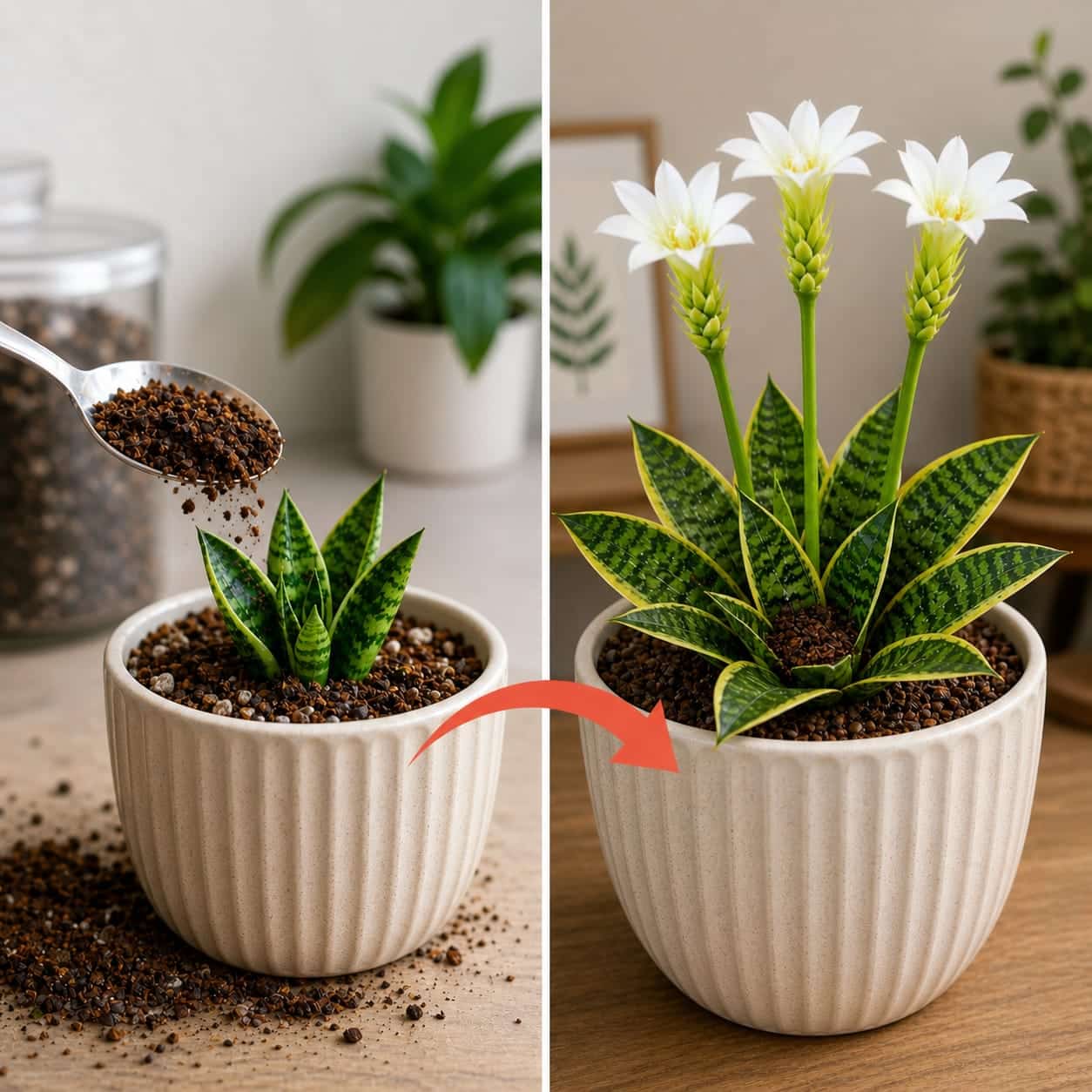
Best Brown Granules for a Snake Plant
The safest brown granules are usually dry and mineral-based or bark-based. Good options include:
- Small lava rock
- Akadama
- Coarse bonsai soil
- Clay granules
- Fine orchid bark
- Coco husk chips
- Gritty succulent top dressing
These materials help create a neat surface without adding too much moisture. If you use organic material like worm castings, use only a tiny amount and avoid repeated applications.
Brown Granules to Avoid
Avoid materials that are wet, sticky, rich, salty, or likely to mold. Do not use:
- Fresh coffee grounds
- Wet tea leaves
- Kitchen scraps
- Uncomposted manure
- Outdoor mulch from unknown sources
- Garden soil
- Unknown fertilizer pellets
- Pet bedding or animal waste
- Food crumbs
- Anything with sugar or salt
Snake plants prefer a clean, dry root environment. Food-based hacks rarely belong in their pots.
Can Snake Plants Really Grow Flowers Like the Image?
Yes, snake plants can flower, but the flowers in the image are stylized and unusually dramatic for a small plant. Real snake plant flowers usually appear on tall stalks with clusters of small tubular white, cream, or pale green blooms. They are often fragrant, especially at night.
Flowers may emerge from mature plants that have been growing for years. A small young snake plant is unlikely to bloom suddenly from one spoonful of granules.
If your snake plant never flowers, that does not mean it is unhealthy. Most indoor snake plants are grown for foliage, and many perfectly healthy plants never bloom indoors.
What Triggers Snake Plant Flowers?
Snake plant flowering is not fully predictable, but several conditions may increase the chances:
- The plant is mature.
- The pot is slightly root-bound.
- The plant receives bright indirect light.
- The soil drains quickly.
- The plant dries between waterings.
- The plant is not overfed.
- The plant experiences stable warmth.
- The roots remain healthy for a long period.
Some growers notice blooms after mild stress, such as a period of dryness. However, stress should not mean neglecting the plant until it shrivels. Healthy controlled dryness is different from damage.
Should You Try to Stress a Snake Plant Into Blooming?
Not aggressively. Mild root-bound conditions and drying between waterings are normal for snake plants. But severe drought, harsh sun, or cramped roots for too long can weaken the plant.
The best approach is to grow the plant well and patiently. Give it bright indirect light, avoid overwatering, keep it in a snug but not suffocating pot, and feed lightly during active growth.
If it blooms, enjoy it. If it does not, the leaves are still the main beauty of the plant.
Best Light for Snake Plants
Snake plants tolerate low light, but they grow best in bright indirect light. In brighter conditions, they usually grow faster, produce stronger variegation, and may form pups more readily.
Direct harsh afternoon sun can scorch leaves, especially on variegated types. Morning sun or filtered sunlight is usually safer.
If your snake plant is small and not growing, move it gradually closer to a bright window before trying fertilizer tricks.
Why Pot Size Affects Growth
Snake plants often grow better in pots that are slightly snug. A pot that is too large holds extra soil, which holds extra water. That can increase the risk of root rot.
A slightly snug pot may also encourage the plant to produce pups and, in some mature cases, flowers. However, an extremely crowded pot can eventually crack, dry too fast, or restrict growth.
Repot only when needed, and move up just one pot size.
When to Repot a Snake Plant
Repot a snake plant when roots are pushing hard against the pot, the pot is cracking, water runs straight through, or the soil has become old and compacted. Spring or early summer is the best time.
When repotting, use a fast-draining mix and a pot with drainage holes. Do not bury the leaves deeper than they were before.
After repotting, wait a week or more before watering if roots were disturbed, especially if any cuts were made.
Can the Brown Granules Replace Repotting?
No. If the soil is dense, sour, or waterlogged, adding granules on top will not fix the root zone. Repotting into a better mix is the correct solution.
Top dressing improves only the surface. The roots live deeper in the pot. If the deeper mix is wrong, the plant will continue to struggle.
What If the Snake Plant Is Small?
The left side of the image shows a relatively small plant. Young snake plants should not be pushed with heavy feeding. They need good light, a small well-draining pot, and careful watering.
A small plant can rot quickly if the soil stays wet. Use a light mix and avoid rich top dressings. Let it establish before fertilizing.
Patience is better than forcing growth.
What If the Snake Plant Has Pups?
Pups are a sign that the plant is growing. If you see pups, keep care steady. Do not dig around them too much or pile granules over them. Baby leaves need space to emerge.
Once pups are large enough, you can leave them attached for a fuller pot or divide them during repotting.
Light feeding can support pup growth, but overwatering is still the biggest danger.
How to Divide Snake Plant Pups
To divide a snake plant pup, remove the plant from the pot and locate the rhizome connecting the pup to the mother plant. Use a clean sharp knife to separate the pup with roots attached. Let the cut dry for a day if needed, then plant it in dry, well-draining soil.
Wait several days before watering. Fresh cuts need time to callus to reduce rot risk.
Do not fertilize newly divided pups right away.
Can Brown Granules Prevent Fungus Gnats?
Some dry mineral top dressings can help discourage fungus gnats because they make the soil surface less inviting. Pumice, grit, lava rock, or coarse sand can help the top dry faster.
Organic brown granules, however, may attract gnats if they stay damp. Coffee grounds, compost, and tea leaves can make the problem worse.
If fungus gnats are already present, reduce watering, remove decaying material, and consider using sticky traps or mosquito-bit water treatments according to safe instructions.
Can Brown Granules Improve Drainage?
Only if they are mixed into the soil. A surface layer alone does not change how the deeper root zone drains. If your soil is too wet, repot into a gritty mix.
For drainage improvement, mix perlite, pumice, bark, or coarse mineral particles throughout the potting medium. Do not rely on a decorative top layer.
Should You Add Granules Before or After Watering?
For decorative mineral top dressing, add it when the soil surface is dry. Then continue watering only when the potting mix is dry.
For fertilizer granules, follow the product label. Some slow-release fertilizers are applied before watering. Others have specific instructions.
Do not water just because you added granules if the soil is still wet. Snake plants should not be watered unnecessarily.
How Much Is Too Much?
A thin layer is enough. For a small pot, a teaspoon or two of dry top dressing may be plenty. For fertilizer, use only the amount recommended on the label, and consider using less for snake plants.
If the soil surface disappears under a thick mound of granules, that is probably too much. The leaf bases should remain exposed and airy.
Top dressing should not bury the plant.
What to Do If You Added Too Many Granules
If you added too many granules, scoop off the excess. If the material is plant-safe and dry, leaving a thin layer is fine. If it is organic, damp, moldy, or unknown, remove as much as possible.
If the granules mixed deeply into the soil and caused mold or slow drying, repot the plant into fresh succulent mix.
After correcting the problem, avoid watering until the soil is dry.
How to Tell If Your Snake Plant Is Healthy
A healthy snake plant has firm upright leaves, clear variegation, and no mushy base. Growth may be slow, especially indoors, but the plant should not smell sour or feel soft near the soil.
Healthy signs include:
- Firm leaves
- Stable upright growth
- New pups over time
- No mushy spots
- Drying soil between waterings
- No foul odor
- No spreading yellow patches
If the plant is firm and stable, do not overcomplicate care.
Signs of Overwatering
Overwatering is the most common snake plant problem. Watch for:
- Mushy leaf bases
- Yellowing leaves
- Soft brown patches
- Collapsed leaves
- Sour soil smell
- Fungus gnats
- Soil staying wet too long
If these appear, stop watering and inspect the roots. Remove rotten parts and repot in dry, well-draining mix if needed.
Signs of Underwatering
Snake plants tolerate dryness, but extreme underwatering can still stress them. Signs include wrinkled leaves, curling, very dry soil pulling from the pot edge, and slow growth.
If the plant is underwatered, water thoroughly and let it drain. Do not compensate by watering repeatedly over several days. One deep watering is better than constant small sips.
Can the Brown Granule Trick Revive a Weak Snake Plant?
Only if the plant is weak from depleted soil and otherwise healthy. If weakness comes from rot, poor light, pests, or compacted wet soil, granules will not solve the problem.
For a weak snake plant, first check:
- Is the soil wet or dry?
- Does the pot have drainage?
- Are the leaf bases firm?
- Are the roots healthy?
- Is the plant getting enough light?
- Is the pot too large?
Fix those basics before adding any amendment.
A Safe Brown Granule Routine for Snake Plants
If you want to try the safe version of this trick, follow this routine:
- Choose dry plant-safe granules such as pumice, lava rock, bark, clay granules, or cactus top dressing.
- Make sure the pot has drainage holes.
- Check that the soil is well-draining.
- Apply only a thin layer on the surface.
- Leave space around the leaf bases.
- Do not use fresh coffee grounds or kitchen scraps.
- Water only when the soil is dry.
- Feed lightly only during spring and summer if needed.
- Watch for mold, gnats, or soft leaves.
- Remove the granules if they cause problems.
This gives you the tidy look without risking the plant’s roots.
Best Care Routine for Strong Snake Plants
For long-term growth, keep the routine simple:
- Give bright indirect light.
- Use a pot with drainage.
- Use cactus or succulent soil with extra grit.
- Water only when the soil is dry.
- Avoid water sitting in the saucer.
- Feed lightly during active growth.
- Keep the leaf bases uncovered.
- Repot only when needed.
- Remove damaged leaves at the base.
- Be patient with slow growth.
This routine is more reliable than any one-spoon trick.
Frequently Asked Questions
What are the brown granules being added to the snake plant?
They could be bark, clay granules, gritty top dressing, slow-release fertilizer, worm castings, or another soil amendment. Use only plant-safe materials you can identify.
Can brown granules make snake plants flower?
No granules can guarantee flowers. Snake plants bloom only when mature and grown in suitable conditions, usually with bright light, healthy roots, and a slightly snug pot.
Can I use coffee grounds on a snake plant?
Fresh coffee grounds are not recommended. They can hold moisture, compact the soil, grow mold, and attract fungus gnats.
What is the best top dressing for snake plants?
Dry mineral top dressings such as pumice, lava rock, coarse grit, clay granules, or bonsai soil are safer than food-based materials.
How often should I fertilize a snake plant?
Once every two to three months during spring and summer is enough for most snake plants. Use a diluted cactus or houseplant fertilizer.
Why is my snake plant not blooming?
It may be too young, in low light, not mature enough, not root-bound, or simply not ready. Many healthy indoor snake plants never bloom.
Are snake plant flowers rare?
They are uncommon indoors, but they can happen on mature plants under the right conditions.
Can top dressing cause rot?
Yes, if it traps moisture or is piled around the leaf bases. Keep top dressing thin and dry.
Should I water after adding granules?
Only water if the soil is dry. Do not water just because you added a top dressing.
What should I do if the granules grow mold?
Remove them immediately, let the soil dry, improve airflow, and reduce watering. Repot if the soil smells sour or stays wet too long.
Final Thoughts
The brown granule snake plant trick looks impressive because the image suggests a dramatic transformation from a small plant to a blooming one. It is easy to understand why homeowners would want to try it. Snake plant flowers are unusual, and the idea of triggering them with one spoonful of granules is tempting.
But real snake plant success does not come from mystery granules. It comes from bright indirect light, fast-draining soil, careful watering, a pot with drainage, and patience. Snake plants can flower indoors, but only mature plants usually do, and even then, flowering is unpredictable.
If the brown granules are plant-safe materials such as bark, clay granules, lava rock, pumice, or gritty top dressing, they can be used lightly to keep the soil surface neat and airy. If they are slow-release fertilizer, they must be used sparingly. If they are fresh coffee grounds, kitchen scraps, wet compost, or unknown material, they are better avoided.
The safest version of the trick is simple: use a thin layer of dry, plant-safe granules, keep them away from the leaf bases, and continue watering only when the soil is dry. Do not bury the crown, do not overfeed, and do not expect instant flowers.
A healthy snake plant may reward you with pups, stronger leaves, and perhaps one day a fragrant flower spike. But even without blooms, a firm, upright, variegated snake plant is already doing exactly what it does best: bringing bold, low-maintenance greenery into your home.